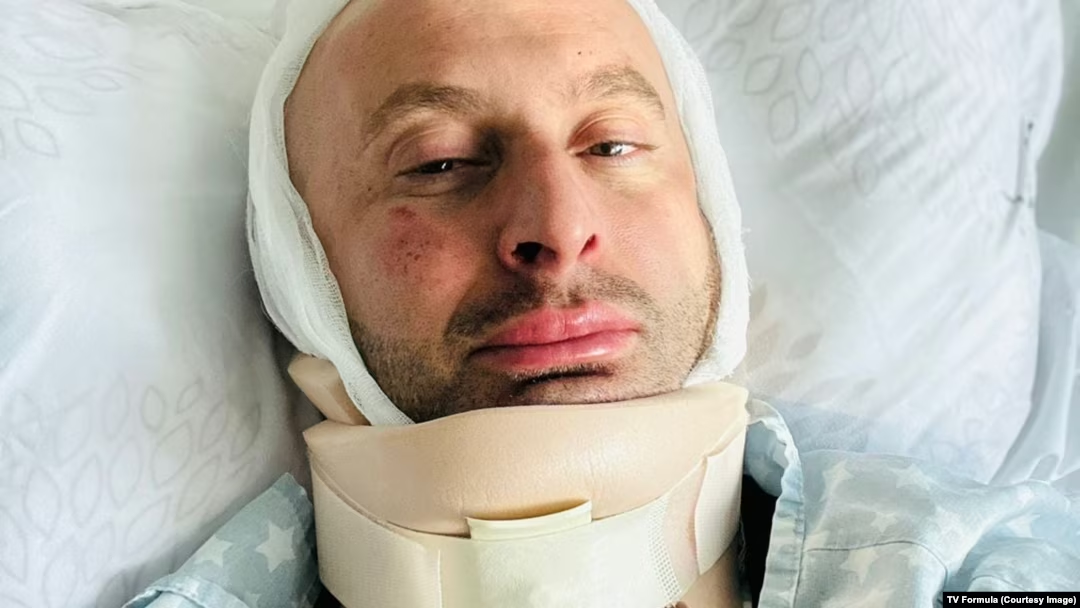
On January 17, after an investigative report aired on Saturday Formula about the possible involvement of “Georgian Dream” supporter Goga Khaindrava in corruption schemes, the program’s host, Davit Kashiashvili, received a threatening message on social media from an unknown person. The author of the threat wrote to the journalist: “Tbilisi is a small city… take care of yourself, buddy.”
Davit Kashiashvili announced the incident himself during the program’s live broadcast, thereby informing the Ministry of Internal Affairs of Georgia. It is also noteworthy that a few weeks earlier Saturday Formula had prepared a report on Goga Khaindrava’s property, after the broadcast of which the director publicly stated his intention to file a lawsuit against the television company.
According to the assessment of the Charter of Journalistic Ethics, this case of threats against a journalist is particularly alarming against the backdrop of inadequate protection of journalists’ safety in Georgia. The organization calls on the Ministry of Internal Affairs to immediately investigate the incident and ensure the journalist’s safety.
On January 12, the POSTV program “Analytica” aired a report titled “The Criminal Chronology of Criminal Mzia Amaghlobeli,” which employs stigmatizing and discrediting language against journalist Mzia Amaghlobeli, the founder of the publications Batumelebi and Netgazeti.
The report is built on a narrative suggesting that the ongoing protest processes in the country are managed by the so-called “Global War Party.” In this context, emphasis is placed on alleged violence by protesters against the police. The segment reinforces this narrative by portraying Mzia Amaghlobeli as “one of the figures in a script drafted by the Global War Party.” Furthermore, it uses an incident involving a police officer to solidify her stigmatization, depicting her as an assailant and an aggressor against law enforcement. The report ignores the broader context and other significant circumstances.
Overall, the segment creates a sharply biased narrative in which the police are cast in the role of the victim, while the journalist is presented as a figure posing a threat to society. Such rhetoric is part of a systemic trend of discredit against Mzia Amaghlobeli and facilitates the deliberate manipulation of public opinion against her.
On January 12, 2025, Mzia Amaghlobeli was arrested on charges of assaulting a police officer for slapping the head of the Batumi Police, Irakli Dgebuadze. On August 6, 2025, the court sentenced her to two years in prison, while the charge was reclassified from “assault on a police officer” to “resistance, threat, or violence against a protector of public order.” Numerous international and local organizations have condemned Amaghlobeli’s imprisonment and called for her release. She is considered a political prisoner.
On January 12, during a public comment, Kakha Kaladze verbally insulted a journalist from the TV company TV Pirveli. The incident followed a question posed by the journalist regarding the presence at the port of Kulevi of a vessel marked as part of the so-called “shadow fleet” and the risk of secondary sanctions being imposed on the country.
The mayor’s response to the journalist’s question contained offensive statements, including accusations that the journalist was lying and attempting to mislead the public. Despite the journalist’s efforts to obtain serious answers and relevant evidence, Kaladze continued to make insulting remarks.
Such rhetoric toward critical media outlets is systemic in nature and is regularly used by representatives of “Georgian Dream,” which significantly harms the environment for journalistic activity, especially when covering issues of high public interest.
Gia Gachechiladze, a supporter of “Georgian Dream” and host of the show “Ai Ucnobi” referred to Mzia Amaghlobel, founder of Netgazeti/Batumelebi and journalist, using insulting epithets.
“I would also punch Mzia Amaghlobeli and throw her out; she pretends to be a media luminary, not a Sakharov Prize winner, but just an ordinary abuser,” said Gia Gachechiladze. Gachechiladze is known for making offensive statements against independent non-governmental organizations and journalists.
Mzia Amaghlobeli was first detained administratively on January 11, 2025, and a few hours later, on January 12, was taken into criminal custody. On August 6, 2025, the Batumi City Court sentenced the journalist to two years in prison, a decision later upheld by the Kutaisi Court of Appeal.
On December 14, 2025, a segment aired on the TV program Imedi Weekly on the television company Imedi, accusing independent Georgian media and non-governmental organizations of advancing foreign countries’ interests and engaging in so-called “hybrid warfare.”
The segment addressed a journalistic investigatigation published by the BBC, which reported that during the dispersal of protests in Georgia in November–December 2024, law enforcement allegedly used the toxic chemical compound bromobenzyl cyanide (“Camite”), which, according to the BBC investigation, was mixed into water cannons.
In the Imedi Weekly segment, the BBC investigation is presented as part of a pre-planned and coordinated campaign, which, according to the segment’s authors, involved “propaganda media networks” and “influence agents.” The program described the BBC’s journalistic investigation as a “continuation of hybrid warfare.” Particular attention in the segment was given to the so-called “media network,” which pro-government media accused of advancing foreign interests, as well as Radio Free Europe/Radio Liberty, whose journalistic materials published in January 2025 regarding alleged poisoning incidents were interpreted as if they were deliberately preparing the ground for subsequent BBC investigative reporting.
A coalition of 22 independent media organizations united in August 2024 under the initiative “Sinatle Media” to collect financial resources and continue their work. The cooperation among these media organizations is linked to restrictive legislative regulations imposed on independent media and the NGO sector. Against a backdrop of strong public support and solidarity, Sinatle Media and its member organizations have repeatedly been targets of public criticism and attempts at discreditation by the “Georgian Dream” party.
On 30 November 2025, the pro-government television station Imedi aired yet another report aimed at discrediting the “Light Media” platform.
The title of the segment broadcast on Imedi resembled that of a report called “Foreign Intelligence Services’ Media Network,” which aired on 23 November. In that earlier report, without presenting any evidence, it was repeatedly claimed that various media outlets were operating in the interests of “foreign intelligence services,” allegedly receiving 17,434,381 million GEL in funding for this purpose.
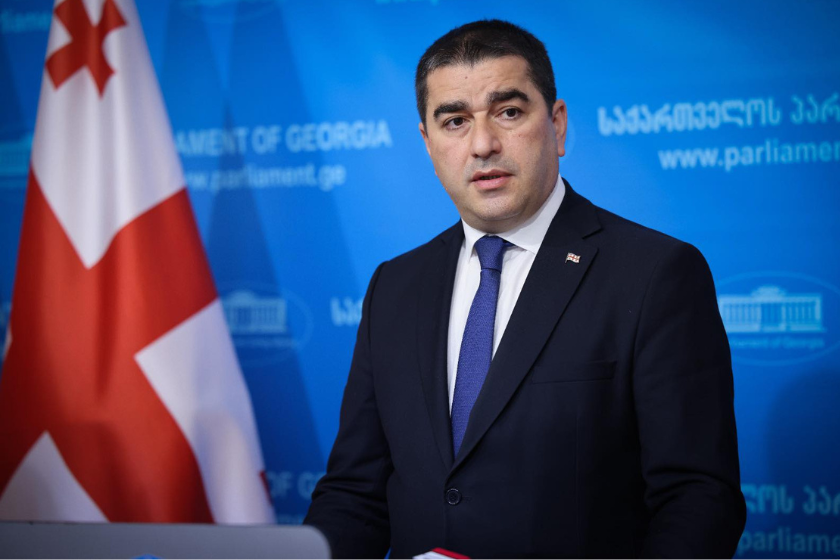
The Speaker of Parliament from the Georgian Dream party, Shalva Papuashvili, spoke about so-called “black money,” accusing independent media outlets of supposedly acting according to a “plan drafted by foreign intelligence services,” alongside other similar schemes, and of opposing “national interest” projects initiated by Georgian Dream.
“Light Media” is a coalition of 22 independent online media outlets, including:
“Light Media” was formed after legislative regulations adopted by Georgian Dream placed media organizations in a difficult situation. Specifically, laws passed in the spring restrict media outlets from receiving grants, label them as organizations “carrying out the interests of a foreign power,” and expose them to the risk of criminal prosecution. The media outlets decided to unite and appeal to the public for financial support.
On November 24, the Speaker of Parliament from “Georgian Dream,” Shalva Papuashvili, issued a statement against “Radio Liberty” and said that the media outlet was created by the “Central Intelligence Agency.” He also called the journalists “propagandists.”
“Radio Liberty is media?! It was created by the Central Intelligence Agency. It is an organization created by an intelligence service, funded by the U.S. budget. The current U.S. government stopped its funding because it said they are a tool of propaganda.”
At the same press conference, Papuashvili spoke in detail about a report aired on the pro-government channel “Imedi,” against “Light Media.” According to Papuashvili, independent online media “put criminal energy into their work and commit criminal offenses, including tax evasion and other types of crimes.”
On November 24, the Speaker of Parliament from “Georgian Dream,” Shalva Papuashvili, accused the online media outlet “Mtis Ambebi” of hiding finances. He said that donors, by funding “Mtis Ambebi,” are financing xenophobia. This is how Shalva Papuashvili responded to a question from a pro-government television station about “Mtis Ambebi.” The journalist was asking Papuashvili about “Mtis Ambebi’s” coverage of the Eagle Hills project. Eagle Hills has been presented by the “Georgian Dream” government as an unprecedented, multimillion-dollar project.
Shalva Papuashvili frequently makes disinformative statements against independent online media. Among them, he actively refers to “Mtis Ambebi,” “Netgazeti/Batumelebi,” and “Publika” in a negative context.
On November 24, the Prime Minister of Georgian Dream, Irakli Kobakhidze, stated that “associations funded from foreign countries are acting against the development of our country.”
He was responding to a report aired on Imedi’s Week on November 23, in which the pro-government media disseminated a disinformation piece against Light Media, a coalition of 22 independent online media outlets, referring to the media as “agents of foreign intelligence services” and accusing them of receiving funding through illegal means.
According to Irakli Kobakhidze, the goal of these media outlets is to “disrupt the processes of economic development.”
Before Irakli Kobakhidze commented on the report aired on the pro-government channel, the Speaker of Parliament, Shalva Papuashvili, had already responded.
The Speaker of Parliament from “Georgian Dream“, Shalva Papuashvili, responded to a report aired on the pro-government TV channel Imedi targeting the association of independent online media outlets, Light Media, attempting to discredit and intimidate them.
Shalva Papuashvili said that online media outlets are bypassing the law and accused them of committing “criminal” offenses.
“[Online media outlets] invent schemes to circumvent legislation, and part of this scheme involves violating restrictions when money moves undeclared across the territory of Georgia. Therefore, of course, attention must be paid to all of this. Those whose competence this falls under are monitoring these processes. Wherever they detect signs of a crime, there will be an appropriate response,” said Shalva Papuashvili.
On November 23, the pro-government TV channel Imedi aired a propagandistic report against Light Media. Light Media is a coalition of 22 independent online media outlets formed after laws and legislative changes adopted by the Georgian Dream parliament placed online media in a dire situation. The report broadcast on Imedi, aimed at discrediting these outlets, claimed that the media were supposedly working on the orders of “foreign intelligence services” and were engaged in “anti-state” activities.