
May 2025 – April 2026
The Center for Media, Information and Social Research has documented 306 incidents targeting journalists, media outlets, and civil society organizations working on media rights’ issues in Georgia. In a number of cases, multiple forms of violations occurred within a single incident (e.g., detention accompanied by physical violence).
Media Environment
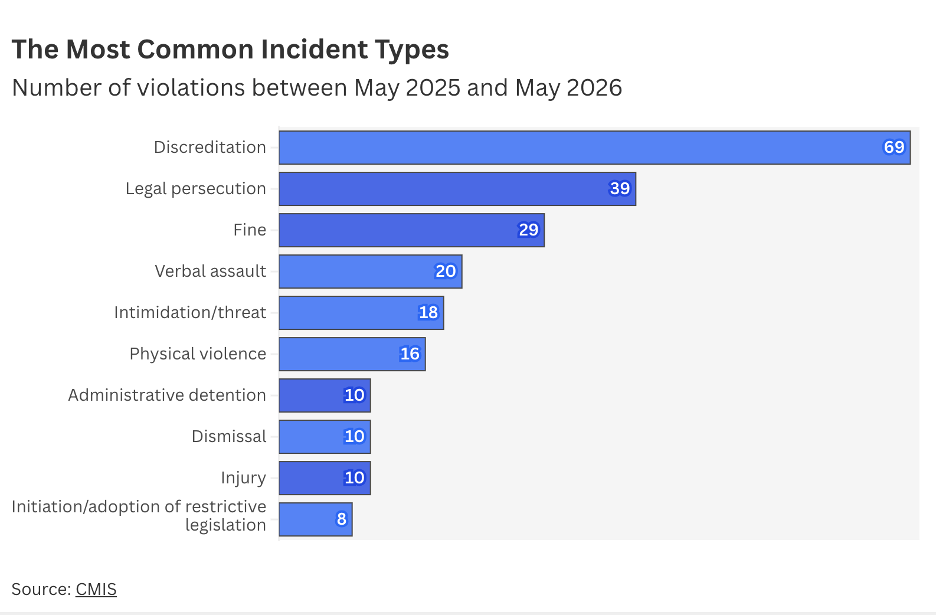
The media environment in Georgia remains in a critical condition. Over the past year, independent journalists and media organizations have been subjected to a wide spectrum of violations. Discreditation is the most frequent documented type of incident (see chart below). This suggests that reputational attacks and delegitimization are central instruments of pressure against independent media. Legal and administrative pressure is also prominent. Legal persecution, fines, administrative imprisonment, restrictive legislation, SLAPP lawsuits, interrogations, and detentions together indicate a pattern of institutional pressure. Physical violence and injury remain serious concerns. Although they have been recorded less frequently than discreditation or legal pressure, they represent direct coercive harm against journalists and media workers, including in protest contexts. Despite the scale and persistence of these violations, impunity remains pervasive: no perpetrators—including publicly identified individuals – have been held accountable.
A particularly notable case concerns Mzia Amaglobeli, a Sakharov Prize laureate. On April 2, 2026, the Parole Commission denied her early release. She was sentenced to two years’ imprisonment on August 6, 2025. Both domestic and international organizations assess the case as politically motivated and call for her immediate release.
The most recent index by Reporters Without Borders ranked Georgia 135th out of 180 countries and territories. Notably, Georgia has dropped 75 places in the past few years.
Recorded Violations between May 1, 2025- April 30, 2026:
- Politically Motivated Convictions and Imprisonment – 1 case
· On August 6, 2025: Mzia Amaglobeli sentenced to 2 years in prison
- Legal and Administrative Pressure – 103 cases
· Fining of journalists while covering rallies – 16 (Alleged “artificial roadblocking” during pro-European protests. The majority of fines have been appealed; a number of them have been waived).
· Other financial fines – 13 (Including fines for social media posts or fines imposed on media outlets)
· Legal persecution – 39 (Encompassing the initiation of investigations, application of restrictive legal frameworks, and formal or informal measures such as correspondence from the Anti-Corruption Bureau and verbal reprimands issued by the Communications Commission)
- Administrative imprisonment – 10 (largest majority of the cases occurred in connection to “standing on a sidewalk”)
· Adoption of restrictive legislation- 8
· SLAPP lawsuit- 7
· Interrogation – 5 (within the broader context of systemic pressure on journalists, such measures function as indirect coercion and contribute to a chilling effect on media activity)
· Detention – 5
- Verbal Abuse, Intimidation, and Discreditation: 108 cases
·. Discreditation – 69
· Verbal abuse – 20
· Intimidation – 18
- Interference in Journalistic Activities: 35 cases
· Prohibition of filming – 9
· Denial of entry to administrative buildings – 8
· Denial of admission to public events – 8
· Expulsion from courts – 7
· Suspension of accreditation – 3
- Physical Violence and Injury: 26 cases
· Physical violence against journalists – 16
· Physical violence resulting in journalists’ injury – 10
- Labor Rights Violations: 13 cases (All relate to the Georgian Public Broadcaster)
· Dismissal from work: 10
· Imposition of disciplinary sanctions – 3
- Attacks on Property: 12 cases
· Confiscation or seizure of equipment – 7
· Damage to equipment – 4
· Damage to property (such as home, office or vehicle) – 1
According to publicly available information, there were 7 cases of unjustified denial of entry to the country of foreign journalists during the year, 4 of which occurred in the run-up to the October 2025 local government elections.