JamNews Copywriter Irakli Datunashvili Fined Twice for “Artificially Blocking the Road” at February 28 and March 6, 2025 Protests.
JamNews copywriter Irakli Datunashvili was fined twice for “artificially blocking the road” during protests held on February 28 and March 6, 2025. He appealed the fines at the Ministry of Internal Affairs, which together total 10,000 GEL.
In the context of pro-European protests, the Georgian Dream party increased the fines, which have been applied since November 28. Under amendments to Georgia’s Administrative Offenses Code, fines for illegally blocking roads were raised tenfold—from 500 GEL to 5,000 GEL.
On January 8, 2026, the website of the news agency CNews went offline. When attempting to access the site, a message appeared stating, “Disconnected due to outstanding debt.” On the same day, employees of the agency and of the newspaper Kronika Plus (which share the same founder) were unable to enter the editorial office building, as they found that the door lock had been changed.
The founder of the outlets, Eliso Kiladze, blamed the incident on her former business partner, who is also the owner of the business center where the newsrooms are located. According to her, the website had no outstanding debts, and its shutdown could have been carried out by the former business partner, who had access to the site. Eliso Kiladze linked the problem to a dispute with her former business partner and described it as an act of retaliation.
The organization “Journalistic Ethics Charter” called on the relevant authorities to promptly look into the incident and to “immediately ensure that the journalistic staff of CNews and the newspaper Kronika Plus are granted access to their workplace, that their computers are not damaged, and that unauthorized individuals do not gain access to the information stored on their electronic devices.”
From January 1, 2026, a new rule for issuing one-time special accreditation came into effect, according to which the head of the apparatus makes a decision on granting special accreditation no later than 5 working days from the submission of the application. The one-time special accreditation is a mechanism that allows journalists who do not hold parliamentary accreditation to enter the Parliament of Georgia and carry out their professional activities for a specific purpose.
Considering the operational nature of media work, this deadline may create practical difficulties for journalists in terms of timely coverage of ongoing events in Parliament. The issue gains additional significance in the context where the current regulations already set quantitative limits on accredited parliamentary journalists based on the type of media outlet. For example, for online publications, the maximum number of parliamentary accreditations is set at 4 journalists. This change negatively affects the efficiency of media work and creates additional barriers to accessing information in Parliament.
From the perspective of “Georgian Dream,” the imposition of additional restrictions on journalists in the Parliament building is related to the approval of the accreditation rules for media in the Parliament of Georgia on February 6, 2023. Among other provisions, the accreditation rules stipulate that video and photo recording of sessions is allowed only with the permission of the session chairperson, a journalist must stop an interview if the respondent refuses, and the head of the apparatus has the authority to restrict the access, movement, or placement of equipment of accredited journalists based on the “specificity of the event” or “security regime.” These criteria are not specified in the document, which creates a risk of broad discretion. Violations of the rules may result in suspension of accreditation for one to six months.
These regulations have been criticized by the Georgian Charter of Journalistic Ethics, which assesses that such norms negatively affect the ability to obtain and provide information to the public. Practice has shown that the media accreditation rules have been repeatedly used in the context of restricting the activities of independent journalists.
During the hearing on December 17 of the so-called “October 4 case,” involving 13 detained individuals, Tbilisi City Court Judge Tamar Makharoblidze stated in court, in response to television journalists’ request to briefly leave the courtroom for a live broadcast, that if the journalists left, they would not be allowed to return. According to her explanation, media representatives could cover the trial only after its conclusion. All 13 individuals are charged with group violence and attempting to seize or block a strategic facility the President’s Palace.
Journalists have stated that, under conditions where photography and video recording are prohibited in court, leaving the courtroom effectively deprives them of the opportunity to follow the proceedings and provide the public with complete information. This is particularly problematic in multi-hour, all-day hearings, where leaving the courtroom during the trial means missing the remainder of the proceedings entirely.
According to media representatives, against the backdrop of already limited resources, this practice makes it virtually impossible for journalists to cover court proceedings of public interest effectively.
The current practice of media coverage of court proceedings is linked to amendments to the Organic Law “On Common Courts,” adopted on June 26 under an expedited procedure. These amendments significantly restricted media access to court hearings, including banning photography and video recording within court buildings and abolishing the previously existing special coverage regime for broadcasters.
According to the Young Lawyers’ Association of Georgia (GYLA), the eyesight condition of Mzia Amaghlobeli, founder of “Batumelebi” and “Netgazeti,” is at an alarming level. The organization notes that Mzia Amaghlobeli has not undergone the necessary examinations and, to date, has not received proper consultation from a doctor, which is essential for maintaining eyesight and planning treatment.
“In 2025, before being placed in the penitentiary institution, her eyesight in the right eye was approximately 30% (0.3), which could have increased up to 90% with corrective glasses. After being placed in prison, her eyesight deteriorated alarmingly. According to examinations conducted on February 4, 2025, her right eye’s eyesight could be corrected with glasses to approximately 60%, but a repeated examination two days later showed that Mzia Amaghlobeli’s eyesight in the right eye had dropped to 0.1 (a 20% decrease in two days), and correction with glasses was now possible only up to 40%, instead of the 90% before imprisonment,” the statement released by GYLA reads.
According to the Young Lawyers’ Association of Georgia, in July 2025, lawyers requested that the prison administration provide Mzia Amaghlobeli with the necessary examinations at the medical institutions she had visited prior to her arrest, where her patient history was kept. This request was denied by the penitentiary service, after which the journalist’s eyesight was examined at a clinic chosen by the prison administration.
“Despite medical assessments that clearly show the alarming deterioration of Mzia Amaghlobeli’s eyesight during her time in prison, the penitentiary institution has not taken any effective measures to arrange adequate examinations and appropriate treatment, nor has the cause of such dramatic deterioration in eyesight been determined,” the statement said.
On August 6, Mzia Amaghlobeli was sentenced by the Batumi City Court to two years in prison. The decision was upheld by the Kutaisi Court of Appeals.
On November 24, the Tbilisi City Court dismissed the case of Mzia Amaghlobeli, founder of “Batumelebi” and “Netgazeti,” against the Georgian Dream Prime Minister, Irakli Kobakhidze. In the lawsuit, Mzia Amaghlobeli sought a denial from Irakli Kobakhidze of the false accusations he made about her.
In July 2025, through pro-government television channels “Imedi” and “Adjara TV,” Georgian Dream Prime Minister Irakli Kobakhidze stated about the imprisoned journalist Mzia Amaghlobeli that she had slapped the then Batumi Police Chief, Irakli Dgebuadze, on the orders of “foreign powers.”
The judge ruled that Irakli Kobakhidze’s statement was made within the context of political debate.
After the hearing, Mzia Amaghlobeli’s lawyer, Ana Rekhviashvili, said: “Such a decision in a case like this is a dangerous precedent for Georgian justice, as the court has opened the way for political officeholders and told them that they can make any statement, spread any falsehood, and political officeholders will not be held accountable for spreading such falsehoods.”
On November 24, the Parliament suspended the accreditation of Dea Badzagua, a journalist for the investigative program “Shabatis Formula” of the TV “Formula,” for one month. The suspension of accreditation was requested by the “Georgian Dream” MP Maia Bitadze.
A report aired on “Shabatis Formula” [at 18:41 and 20:02], showing Dea Badzagua trying to ask questions to “Georgian Dream” MP Aluda Gghudushauri regarding the case initiated against the chairman of the party “For Georgia,” Giorgi Gakharia. The interview was recorded by phone by Parliament member Maia Bitadze from “Georgian Dream.” According to the journalist on “Formula,” she did not even have questions for Maia Bitadze, but the MP became irritated by listening to questions directed at her colleague.
“It is noteworthy that she [Maia Bitadze] immediately threatened us with sanctions and, apparently, carried them out… Representatives of ‘Georgian Dream’ in the parliamentary body do not answer any questions from critical media,” said journalist Dea Badzagua on “Formula.”
On November 13, another journalist from “Formula,” Tiko Eradze, had her accreditation suspended after she published a video shot in the parliamentary plenary hall, where she filmed “Georgian Dream” MP Eka Chichinadze from the journalists’ designated gallery, while the MP was watching the video recording on her phone.
On November 26, the “yellow level” of security came into effect in the building of the Parliament of Georgia, which fully restricts online media from working in the Parliament. The restriction is linked to the speech of the “Georgian Dream” Prime Minister, Irakli Kobakhidze.
During the operation of the “yellow level” in Parliament, only journalists from TV broadcasters (no more than three groups from each broadcaster) and invited guests are allowed in the building.
The Parliament of Georgia approved the controversial restrictive rules for the media by Order N1/259/23 of September 4, 2023.
In November, at the Zugdidi District Court, a “TV Pirveli” journalist had their mobile phone confiscated. According to the television company, the journalist was only allowed to attend the court hearing after the court’s security service sealed their phone. “As an alternative, they were only offered paper and a pen,” stated TV Pirveli.
On June 30, 2025, amendments to the Law on Common Courts came into effect, significantly restricting media rights. Specifically:
- Photography, video recording, and audio recording were prohibited inside court buildings, courtrooms, and courtyards;
- The previous provision that prohibited confiscating personal items, including phones, computers, or other devices capable of recording audio or video, was repealed.
Following these changes, the media’s ability to freely cover important proceedings has been severely limited, including cases such as the trial of Mzia Amaghlobeli, founder of Netgazeti, and other conscientious objectors.
It is noteworthy that recently, several individuals have reported instances of violence, as well as physical and verbal abuse by court ushers at the Tbilisi City Court. The legislative amendments adopted on June 30 now further restrict the media’s ability to report on such unlawful actions within the justice system.
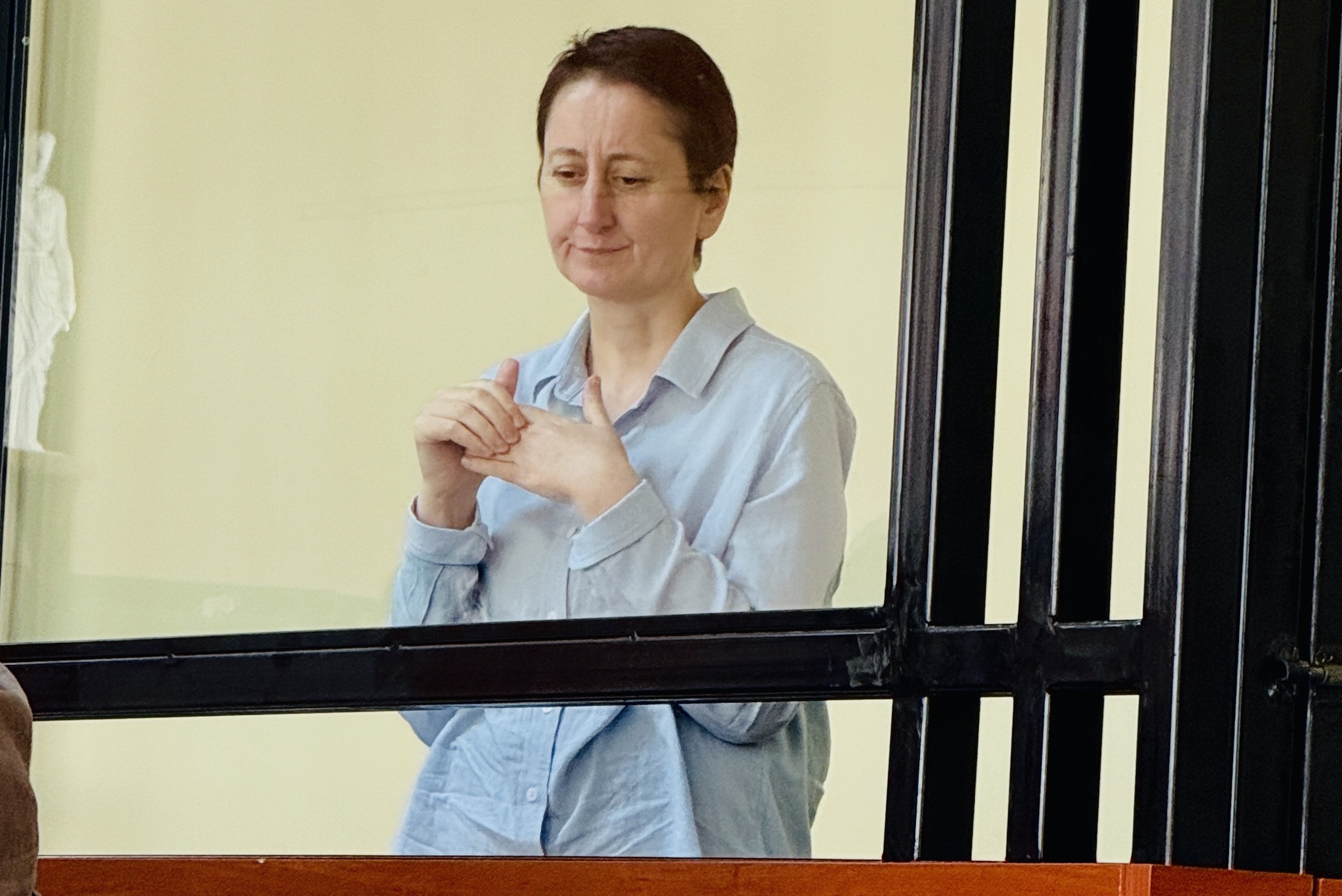
On November 11, 2025, the Kutaisi Court of Appeals began reviewing the appeal of Mzia Amaghlobeli, a prisoner and founder of the publications “Batumelebi” and “Netgazeti.” Due to high public interest, her colleagues and supporters traveled to Kutaisi from various cities in Georgia to attend Mzia Amaghlobeli’s court trial, but most of them could not enter the courtroom – the trial was held in a small, 24-person hall, and seats were quickly filled. Journalists who wished to cover the proceedings were also unable to attend. Furthermore, the court security locked the yard gate, restricting the entry of Mzia Amaghlobeli’s colleagues and supporters even into the court yard.
Mzia Amaghlobeli was arrested twice on the night of January 11-12, 2025. She was initially detained for putting up a protest sticker on a police building. She was released on recognizance a few hours after her detention, but was soon re-arrested under criminal law for the fact of slapping Batumi Police Chief, Irakli Dgebuadze. She was accused of assaulting a police officer, which carries a sentence of 4 to 7 years in prison. On August 6, 2025, Batumi City Court Judge Nino Sakhelashvili reclassified the charge, found Amaghlobeli guilty not of assaulting a police officer, but of resisting a police officer, and sentenced the journalist to 2 years in prison. The defense is appealing this verdict to the Court of Appeals and is demanding Mzia Amaghlobeli’s release; the prosecution is also appealing the verdict, with the prosecution again demanding a sentence of 4 to 7 years.
According to authoritative international and local human rights organizations, as well as Members of the European Parliament, Mzia Amaghlobeli is facing politically motivated retribution, and they are demanding the immediate release of the journalist.