Criminal Prosecution Initiated Against Civic Activists, Father and Son Kakha and Konstantine Mikaia, for Standing on a Sidewalk

The Ministry of Internal Affairs has initiated criminal prosecution against civic activist Kakha Mikaia, a former member of the Political Council of Georgian Dream, and his son, Konstantine Mikaia, in connection with standing on a sidewalk. In an interview with TV Pirveli, Kakha Mikaia stated: “I received a decision stating that, following amendments to certain provisions of the Administrative Offences Code, the case has been transferred to criminal proceedings. This was expected from the current authorities.”

Father and son Kakha and Konstantine Mikaia are active participants in the protests on Rustaveli Avenue. Both had previously been subjected to administrative detention on the grounds of allegedly blocking a roadway. On 21 October 2025, Judge Nino Enukidze sentenced Kakha Mikaia, who had been detained during a protest on allegations of unlawfully blocking a roadway, to 14 days of administrative detention. On the same day, Konstantine Mikaia was also sentenced to 14 days of administrative detention. Prior to that, on 17 September 2025, Konstantine Mikaia had been detained for 10 days for non-payment of a fine.

The Ministry of Internal Affairs has been accusing individuals of obstructing citizens’ movement for protests expressed on sidewalks since Georgian Dream adopted another repressive legislative amendment restricting freedom of assembly on 12 December 2025, which in fact banned protests on sidewalks. Under the amended legal framework, a first violation is punishable by administrative detention for up to 15 days (up to 20 days for organizers), while a repeated violation may give rise to criminal liability.

On the same grounds, the court has, to date, referred the cases of three civic activists to the Ministry of Internal Affairs for further action: Vazha Gaprindashvili, Giorgi Tsulaia, and Ana Bdeiani.
Bank Accounts of Civic Activist Elene Devidze Subject to Enforcement Seizure

The bank accounts of civic activist Elene Devidze, a participant in pro-European protests, have been subject to enforcement seizure. She disclosed this information via social media. In an interview with the outlet Publika, she stated that the enforcement measure was imposed in connection with an outstanding administrative fine.

According to available information, Elene Devidze was subjected to an administrative fine in the amount of GEL 5,000 on 10 August 2025 on the grounds of the alleged blocking of a roadway. The activist reports that she was not duly notified of the imposition of the fine, as her contact number was incorrectly recorded by the Ministry of Internal Affairs, and the administrative offense report was not personally served on her. Elene Devidze has stated her intention to challenge the fine through legal remedies.

Elene Devidze is the sister of Mate Devidze, a convicted prisoner of conscience. Mate Devidze was detained on 19 November 2024 during a protest against the results of the parliamentary elections on charges of assault on a police officer and was subsequently sentenced to four years and six months of imprisonment~

Journalists’ Accounts Frozen Without Prior Notice of Fines

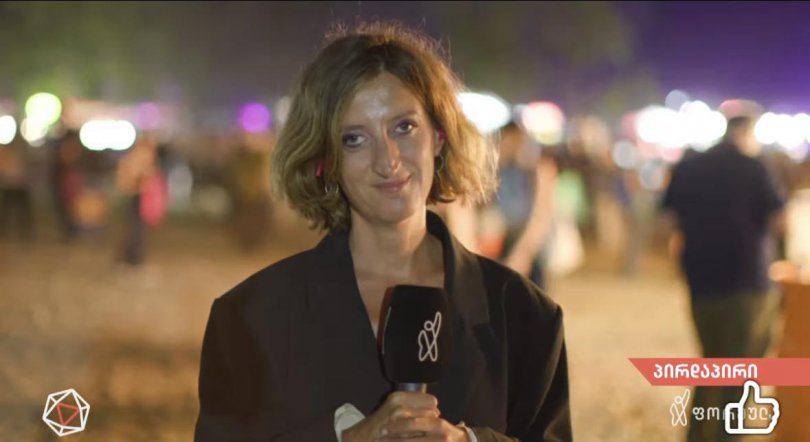
On April 15, according to TV Pirveli, the bank accounts of Maka Chikhladze, a journalist for the channel’s Saturday broadcast, were frozen. On social media, Irakli Datunashvili (known online as Leo Nafta), the Georgia editor for the online publication JamNews, also wrote that his bank accounts had been frozen. According to his information, the basis for the freeze is cited as a fine from October 15, the existence of which he had not been informed of until now.

According to Nodar Meladze, head of the news service, Maka Chikhladze was covering ongoing events on Rustaveli Avenue in the line of professional duty on October 15, 2025, which led to her being fined 5,000 GEL on charges of “artificially blocking the road.” He stated that the journalist was not notified of this fine and subsequently had her accounts frozen.

Maka Chikhladze herself states that she only learned about the existence of the fine after her accounts were frozen.

“In such a large agency as the Ministry of Internal Affairs, they couldn’t find the resources to send me a single SMS… if they had simply notified me that I had been fined, I would have looked into it and proven that I was performing my professional duties. I didn’t know about it until my accounts were frozen,” Chikhladze said.

In her assessment, the case may be related to her journalistic activities. “I believe this is an act of revenge and has nothing to do with the law on assembly and manifestation or any actual violation,” she noted. Chikhladze also points out that representatives of other media outlets were also working at the scene, yet she was the only one targeted with a fine.

On December 7, 2024, on Besiki Street in Tbilisi, TV Pirveli journalist Maka Chikhladze and cameraman Giorgi Shetsiruli were attacked and physically assaulted by unidentified masked individuals while working on a live broadcast. The investigation launched into that incident has not yet been concluded.

Communications Commission Issues Written Warnings to Four TV Stations

The Communications Commission has issued written warnings to four television stations, including two pro-government channels, for violating the Law of Georgia on Broadcasting. The channels involved are the government-critical outlets Formula and TV Pirveli, as well as pro-government broadcasters POSTV and Imedi. The Commission issued the warnings based on violations of articles concerning content regulation.

According to ComCom, the issue was placed on the agenda following its own media monitoring. The stations were accused of failing to meet standards regarding impartiality, balance, reporting based on personal attitudes/opinions, and factual accuracy. For instance, the Commission determined that by using phrases such as “Dream’s Prosecutor’s Office,” “Dream’s Parliament,” “Ivanishvili’s Prime Minister,” “Rajden Kuprashvili’s agency,” “with members of the Dream government,” and “judicial clan,” Formula covered issues based on the broadcaster’s personal attitude or opinion in its news programming, thereby violating the law.

During the monitoring process, ComCom’s Media Services Regulation Department “discovered” the highest number of potential violations at the independent channels—20 for Formula and 18 for TV Pirveli. The lowest number of violations were attributed to the pro-government outlets: Imedi (4 violations), which has been sanctioned for spreading Russian disinformation, and POSTV (7 violations).

On this occasion, the Communications Commission limited its response to written warnings on the grounds that none of these television stations had been sanctioned for similar violations within the past year.

It is worth noting that in early March, following the sanctioning of pro-government Imedi and POSTV, ComCom released a threatening statement announcing it would begin monitoring broadcaster content starting in March. Last year, Georgian Dream passed repressive amendments to the Law on Broadcasting, which are linked to the regulation of broadcaster content.

TV Formula Journalist Liza Tsitsishvili’s Accounts Frozen

The bank accounts of TV Formula journalist Liza Tsitsishvili have been frozen. According to the journalist, it was discovered that she had been fined 5,000 GEL on the grounds of “artificially blocking the road” while performing her professional duties on Rustaveli Avenue on September 10, 2025.

The journalist had not received any notice regarding the fine. Furthermore, she states that since September, she has been detained once and has even crossed the national border, yet in neither instance was she informed that she had been fined.

According to publicly available information, more than 40 fines have been issued against journalists for “artificially blocking the road” between October 26, 2024, and the present day.

“Parole Board” Denies Early Release for Mzia Amaghlobeli

The “Parole Board” (the Local Council of the Special Penitentiary Service for the Review of Convicts’ Cases) has denied the early release of prisoner Mzia Amaghlobeli, the founder of the publications Batumelebi and Netgazeti.

According to Batumelebi, the decision states that the prisoner cannot be released early because she “still does not repent for her actions.” The same outlet reports that the commission reached this decision despite a positive recommendation from Women’s Penitentiary Facility No. 5.

Mzia Amaghlobeli has been wrongfully imprisoned for one year and three months. She was sentenced to two years for slapping Irakli Dgebuadze, the head of the Batumi Police. Under current legislation, individuals convicted of less serious crimes are eligible for early release once they have served half of their sentence. A special commission reviews these cases, with the prison administration formally submitting the motion for a prisoner’s early release. According to Batumelebi, Penitentiary Facility No. 5 submitted the motion for Mzia Amaghlobeli’s parole to the board on January 12 of this year.

Georgian Parliament Denies Special One-Day Accreditation to Monitor Journalist

On March 25, 2026, Monitor published an investigative report stating that they were unable to interview Member of the Georgian Parliament Zaal Dugladze because the Parliament refused to issue a special entry pass for their journalist.

“We were unable to go to the Parliament of Georgia and pose questions to a Member of Parliament. According to the new rules, before entering the Parliament, it is necessary to specify a concrete reason to obtain a special pass. When they learned that we wanted to record an interview with Zaal Dugladze, the Parliament refused to issue the pass,” the Monitor investigation states.

Monitor first applied to the Parliament for a special pass on February 17, and again on February 19. In both instances, the pass was denied. No explanation for the refusal was provided to the outlet.

A new rule for issuing one-day special accreditations came into effect on January 1, 2026. Under this rule, the Head of the Staff makes a decision regarding the issuance of special accreditation no later than five working days after receiving the application. This one-day special accreditation is a mechanism that allows journalists who do not hold permanent parliamentary accreditation to enter the Parliament building and carry out professional activities for a specific purpose. According to these special rules, an application must be submitted to the Speaker of the Parliament, specifying the exact reason for the request. Previously, no such requirement existed in the law.

The imposition of restrictions on journalists within the Parliament building by “Georgian Dream” began on February 6, 2023, when the initial media accreditation rules for the Parliament of Georgia were first approved.

Law Enforcement Accuses Netgazeti Journalist of “Blocking the Road” While Performing Professional Duties

The Georgian Ministry of Internal Affairs (MIA) is accusing Mariam Dzidziaria, a journalist for the online publication Netgazeti, of “blocking the road” on Rustaveli Avenue. The charges stem from the “Saturday March” rally held on January 31, 2026, where Dzidziaria was performing her professional duties. According to Netgazeti, while covering the protest, Mariam was wearing a press badge and a “PRESS” armband, and was carrying a camera.

On March 6, it was revealed that administrative proceedings on identical charges have been initiated against two other media representatives. The MIA is also accusing Tabula journalist Mariam Kuprava and photographer Giorgi Tarkhnishvili of “blocking the road” while fulfilling their professional duties.

The Georgian Charter of Journalistic Ethics stated that the MIA’s stance toward journalists covering protest rallies raises serious suspicions that the true objective of law enforcement is to intimidate them and force them to stop informing the public about protest sentiments. “Systemic pressure on journalists and the media violates the public’s right to be informed and damages the country’s interests,” the Charter’s statement reads.

Under the repressive legislative amendments passed by “Georgian Dream,” blocking a roadway has become a punishable offense. This is prohibited under Article 174-prime, Part 10 of the Administrative Offenses Code. Later, standing on the sidewalk was also integrated into this same article, leading to the prosecution of protesters as well.

Violating this article carries a penalty of up to 15 days of administrative detention (up to 20 days for organizers). Administrative detention does not apply to pregnant women, mothers with children under 12, minors, or persons with severe or significant disabilities. Instead, they face a fine of 5,000 GEL, or 15,000 GEL if they are an organizer. A repeat of the same “offense” leads to criminal liability.

Since October 26, 2024, more than 40 citations have been issued to journalists on charges of “blocking the road.”

Ministry of Internal Affairs Accuses Photographer Giorgi Tarkhnishvili of “Blocking the Road” While Performing Professional Duties

The Ministry of Internal Affairs (MIA) is accusing photographer Giorgi Tarkhnishvili of obstructing pedestrians by standing on the sidewalk while performing his professional duties. The case pertains to a protest on December 18, 2025, where the photographer was working on assignment.

The court hearing for this case was held on March 6, 2026. Judge Davit Makaradze of the Administrative Cases Panel of the Tbilisi City Court examined the evidence but deferred the announcement of the verdict.

“We presented documents proving he is a journalist, as well as the badges he was wearing. Even his hat is marked ‘PRESS,’ and he is holding a large camera. All of this proves he was fulfilling his professional duties, and the video presented by the MIA clearly shows him taking photos or videos,” Tarkhnishvili’s lawyer, Giorgi Tabatadze, stated in an interview with MediaChecker.

On March 6, it also became known that administrative proceedings on the same charges had been initiated against another media representative. The MIA is similarly accusing Tabula journalist Mariam Kuprava of “blocking the road” while performing her professional duties.

According to a statement from the Georgian Charter of Journalistic Ethics, the MIA’s stance toward journalists covering protests raises a well-founded suspicion that the true goal of law enforcement is to intimidate them and force them to stop informing the public about protest activities. “Systemic pressure on journalists and the media violates the public’s right to be informed and harms the country’s interests,” the Charter’s statement reads.

Under the repressive legislative amendments passed by “Georgian Dream,” blocking a roadway has become a punishable offense. This is prohibited under Article 174-prime, Part 10 of the Administrative Offenses Code. Later, standing on the sidewalk was integrated into this same article, leading to the prosecution of protesters as well.

Violating this article carries a penalty of up to 15 days of administrative detention (up to 20 days for organizers). Administrative detention does not apply to pregnant women, mothers with children under 12, minors, or persons with severe or significant disabilities. Instead, they are subject to a fine of 5,000 GEL, or 15,000 GEL if they are identified as an organizer. A repeat of the same “offense” leads to criminal liability.

Since October 26, 2024, approximately 40 citations have been issued to journalists on charges of “blocking the road.”

Ministry of Internal Affairs Accuses Tabula Journalist of “Blocking the Road” While Performing Professional Duties

The Georgian Ministry of Internal Affairs (MIA) has accused Mariam Kuprava, a journalist for the online publication Tabula, of “blocking the road” on Rustaveli Avenue. The accusation stems from a protest on February 7, 2026, while Kuprava was performing her journalistic duties covering the “Saturday March.” In an official report filed on February 9, the MIA claims that “Mariam Kuprava artificially blocked the motorable part of the roadway.”

The Georgian Charter of Journalistic Ethics issued a statement arguing that the Ministry’s stance toward journalists covering protests raises serious suspicions. They suggest the true objective of law enforcement is to intimidate and force journalists to stop informing the public about protest sentiments: “Systemic pressure on journalists and the media violates the public’s right to be informed and damages the country’s interests,” the Charter stated.

Under repressive legislative amendments passed by “Georgian Dream,” blocking a roadway has become a punishable offense under Article 174-prime, Part 10 of the Administrative Offenses Code. Later, standing on the sidewalk was also integrated into this same article, leading to the prosecution of protesters as well. Violation of this article carries a penalty of up to 15 days of administrative detention (up to 20 days for organizers). Administrative detention is not applied to pregnant women, mothers with children under 12, minors, or persons with severe or significant disabilities; instead, they face a fine of 5,000 GEL, or 15,000 GEL if identified as an organizer. Repeatedly committing the same “offense” leads to criminal liability.

Since October 26, 2024, approximately 40 citations have been issued to journalists on charges of blocking the road.

Update:

On April 2, Judge Tornike Kapanadze of the Administrative Cases Panel of the Tbilisi City Court dismissed the “road blocking” case against Mariam Kuprava. According to her lawyer, Nika Simonishvili, even the footage submitted by the Ministry of Internal Affairs clearly showed the Tabula journalist wearing press identification and performing her professional duties on-site.