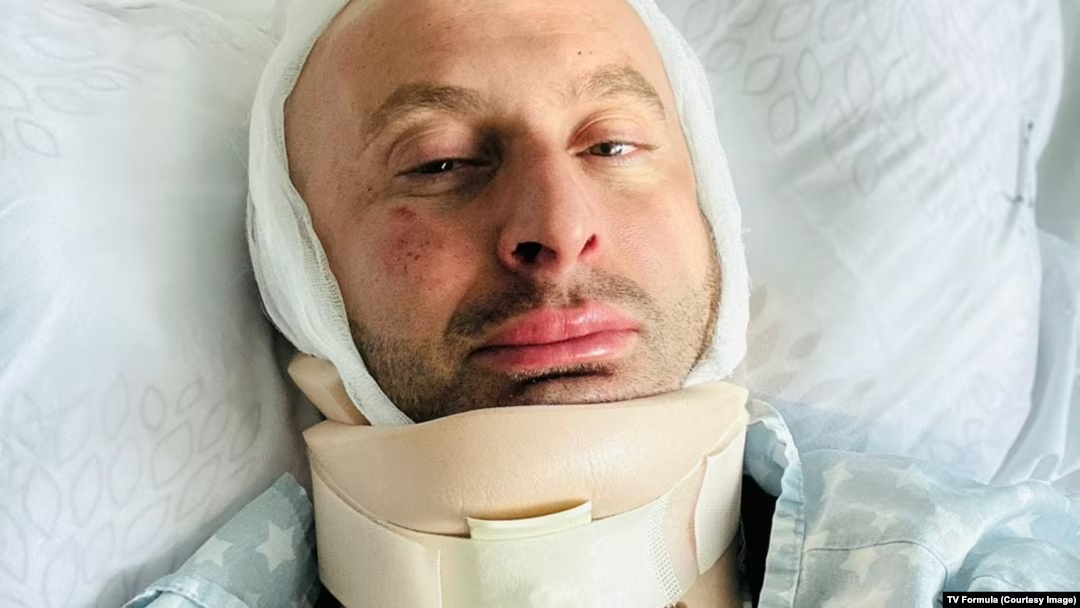
On May 10, 2026, the television network Imedi, which has been sanctioned by the United Kingdom for spreading disinformation, published a discrediting post against journalist Guram Rogava. TV Imedi refers to Guram Rogava as a “propagandist for the National Movement.”
On November 29, 2024, while performing his professional duties and covering pro-European protests, a riot police officer assaulted Guram Rogava, striking him forcefully on the back of the head.
On April 24, TV Imedi a broadcaster sanctioned by the United Kingdom for spreading Russian disinformation published a social media post accusing the critical news outlet TV Pirveli of manipulation. The post concerns a report by TV Pirveli claiming that 60% of those granted Georgian citizenship in 2025 were Russian citizens.
TV Imedi writes that “beyond the statistical figure intended to mislead the public, the opposition media says nothing about the fact that restoration, retention, or the granting of citizenship by way of exception can be requested by former Georgian citizens or citizens who have either already lost or have not yet lost their Georgian citizenship after acquiring the citizenship of another country.”
The post features a photo of Nodar Meladze, the head of TV Pirveli’s news service, with the word “Manipulation” stamped across it in red. TV Imedi frequently publishes posts targeting the critical broadcaster TV Pirveli and its news director, Nodar Meladze.
Pro-government television stations—Imedi, Rustavi 2, and POSTV—are labeling independent online publications Netgazeti, Publika, and On.ge as anti-Georgian media, discrediting and stigmatizing them because these outlets refer to high-ranking officials as the “Georgian Dream” Prime Minister and Minister.
All three channels published nearly identical text on social media, accompanied by a short screenshot of a text prepared by these online media outlets regarding the visit of Armenian Prime Minister Nikol Pashinyan to Georgia.
“So-called online media outlets funded by foreign countries refer to Nikol Pashinyan as Prime Minister, while referring to Irakli Kobakhidze and Maka Bochorishvili as the ‘Georgian Dream’ Prime Minister and Minister,” states Rustavi 2, referring to the online outlets as “so-called” media. POSTV also places the term online media in quotation marks: “The anti-Georgian policy of ‘online media’ funded from abroad: publications refer to Nikol Pashinyan as the Prime Minister of Armenia, while referring to the Prime Minister and the Foreign Minister of Georgia as the ‘Georgian Dream’ Prime Minister and Minister.” Imedi goes even further, calling these publications tools of hybrid warfare: “Another anti-Georgian act by the anti-Georgian online ‘media’ in Georgia—all three tools of hybrid warfare refer to Nikol Pashinyan as the Armenian Prime Minister, while referring to Irakli Kobakhidze and Maka Bochorishvili as the ‘Georgian Dream’ Prime Minister and Minister.”
Notably, all three channels published this visual material almost simultaneously on the same day that “Georgian Dream” passed the law in its third and final reading, which made the “systemic non-recognition of Georgian Dream” a criminal offense.
On January 28, a post was published on the Facebook page of the pro–“Georgian Dream” TV company Imedi, showing a photo that included TV Pirveli journalist and producer Nodar Meladze alongside the Executive Director of Transparency International Georgia. Imedi accused TV Pirveli of spreading false propaganda and called it a “propaganda tool.”
Like POSTV, Imedi is actively involved in promoting narratives created by Georgian Dream to discredit independent media, both on television broadcasts and on social media accounts.
On January 20, Pro-Government TV”Imedi” published a clip on its social media page taken from a monologue by TV Pirveli journalist Vika Bukia, with the caption: “The grammatical ‘education’ of a propagandist.”
Vika Bukia is a journalist known for her critical stance toward “Georgian Dream.” It is for this reason that the pro-government TV station “Imedi” singled out an excerpt from the journalist’s monologue and, for the purpose of discrediting her, labeled her a “propagandist.”
On December 14, 2025, a segment aired on the TV program Imedi Weekly on the television company Imedi, accusing independent Georgian media and non-governmental organizations of advancing foreign countries’ interests and engaging in so-called “hybrid warfare.”
The segment addressed a journalistic investigatigation published by the BBC, which reported that during the dispersal of protests in Georgia in November–December 2024, law enforcement allegedly used the toxic chemical compound bromobenzyl cyanide (“Camite”), which, according to the BBC investigation, was mixed into water cannons.
In the Imedi Weekly segment, the BBC investigation is presented as part of a pre-planned and coordinated campaign, which, according to the segment’s authors, involved “propaganda media networks” and “influence agents.” The program described the BBC’s journalistic investigation as a “continuation of hybrid warfare.” Particular attention in the segment was given to the so-called “media network,” which pro-government media accused of advancing foreign interests, as well as Radio Free Europe/Radio Liberty, whose journalistic materials published in January 2025 regarding alleged poisoning incidents were interpreted as if they were deliberately preparing the ground for subsequent BBC investigative reporting.
A coalition of 22 independent media organizations united in August 2024 under the initiative “Sinatle Media” to collect financial resources and continue their work. The cooperation among these media organizations is linked to restrictive legislative regulations imposed on independent media and the NGO sector. Against a backdrop of strong public support and solidarity, Sinatle Media and its member organizations have repeatedly been targets of public criticism and attempts at discreditation by the “Georgian Dream” party.
On 30 November 2025, the pro-government television station Imedi aired yet another report aimed at discrediting the “Light Media” platform.
The title of the segment broadcast on Imedi resembled that of a report called “Foreign Intelligence Services’ Media Network,” which aired on 23 November. In that earlier report, without presenting any evidence, it was repeatedly claimed that various media outlets were operating in the interests of “foreign intelligence services,” allegedly receiving 17,434,381 million GEL in funding for this purpose.
The Speaker of Parliament from the Georgian Dream party, Shalva Papuashvili, spoke about so-called “black money,” accusing independent media outlets of supposedly acting according to a “plan drafted by foreign intelligence services,” alongside other similar schemes, and of opposing “national interest” projects initiated by Georgian Dream.
“Light Media” is a coalition of 22 independent online media outlets, including:
“Light Media” was formed after legislative regulations adopted by Georgian Dream placed media organizations in a difficult situation. Specifically, laws passed in the spring restrict media outlets from receiving grants, label them as organizations “carrying out the interests of a foreign power,” and expose them to the risk of criminal prosecution. The media outlets decided to unite and appeal to the public for financial support.
On November 24, the Speaker of Parliament from “Georgian Dream,” Shalva Papuashvili, issued a statement against “Radio Liberty” and said that the media outlet was created by the “Central Intelligence Agency.” He also called the journalists “propagandists.”
“Radio Liberty is media?! It was created by the Central Intelligence Agency. It is an organization created by an intelligence service, funded by the U.S. budget. The current U.S. government stopped its funding because it said they are a tool of propaganda.”
At the same press conference, Papuashvili spoke in detail about a report aired on the pro-government channel “Imedi,” against “Light Media.” According to Papuashvili, independent online media “put criminal energy into their work and commit criminal offenses, including tax evasion and other types of crimes.”
On November 23, a segment aired on the pro-government television channel “Imedi” aimed at discrediting the platform “Sinatle Media.” “Sinatle Media” is an association of 21 independent online media outlets, created after legislative regulations passed by “Georgian Dream” placed media organizations in a difficult position. Specifically, laws passed in the spring restrict media from receiving grants, label them as conduits for “foreign forces,” and create the threat of criminal prosecution. The media outlets decided to form an association and request financial support from the public.
The title of the “Imedi” segment was “Foreign Intelligence Media Network.” The program’s host, Irakli Chikhladze, claimed that “it has been analyzed how foreign intelligence agencies operate with secret scenarios,” during which the aforementioned media outlets were portrayed as part of this scenario. In the subsequent 15-minute segment, it was repeatedly claimed, without evidence, that the media outlets had received 17 million GEL in funding.
“Sinatle Media” responded to the disinformation segment aired on the pro-government channel with the following statement:
“Due to the segment prepared by ‘Imedi’ television, where Russian disinformation narratives and obvious lies deliberately fabricated by local propagandists are intertwined, we are submitting a joint statement to the self-regulatory body and demand a denial of the false information aired in the segment. We also demand live airtime to give us the opportunity to respond to these absurd accusations.”
On October 22, Mzia Amaghlobeli, the founder of Batumelebi and Netgazeti, who has been imprisoned for more than nine months, received the European Union’s highest human rights honor, the Sakharov Prize. This recognition of the journalist was followed by yet another attempt by pro-government television stations to discredit her.
Imedi TV published a series of propaganda-style social media posts about Mzia Amaghlobeli’s receipt of the Sakharov Prize. Among them were posts highlighting the Prime Minister from the Georgian Dream party referring to the journalist as a “foreign agent.”
Rustavi 2 published photos of former Georgian President Mikheil Saakashvili together with Mzia Amaghlobeli and included a quote from Saakashvili about the journalist in the accompanying text – an apparent attempt to associate Amaghlobeli and her work with a political party.
Alongside Mzia Amaghlobeli, the Sakharov Prize was also awarded to imprisoned Belarusian journalist Andrzej Poczobut. The Sakharov Prize honors individuals, groups, or organizations that have made an outstanding contribution to the defense of freedom of expression.