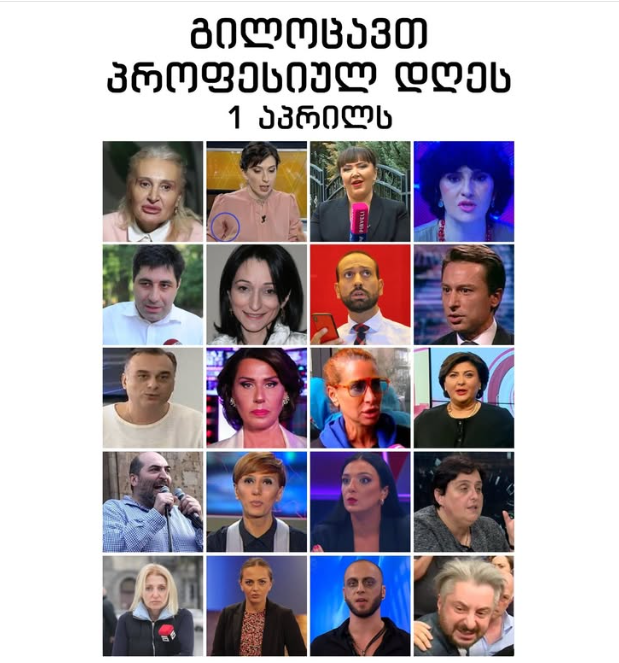
A Facebook page titled “Media,” which is affiliated with the “Georgian Dream” party, is actively discrediting independent journalists. On April 1, the page published a poster featuring journalists from TV Pirveli, Mtavari Arkhi, and Formula, accompanied by the caption: “Happy Professional Day—April 1st.” (In Georgian society, April 1st is associated with lying and is considered April Fools’ Day).
The “Media” page was created on December 25, 2024. Its original name was “Borotmokmedia” (a play on words meaning “Evildoer”), but on September 9, 2025, it was renamed “Media.” The page is primarily engaged in discrediting independent journalists, the opposition, and the family members of prisoners of conscience. According to the fact-checking platform “Myth Detector,” this page is linked to “Georgian Dream” and operates in coordination with media outlets that follow a pro-government editorial policy (such as POSTV and Imedi).
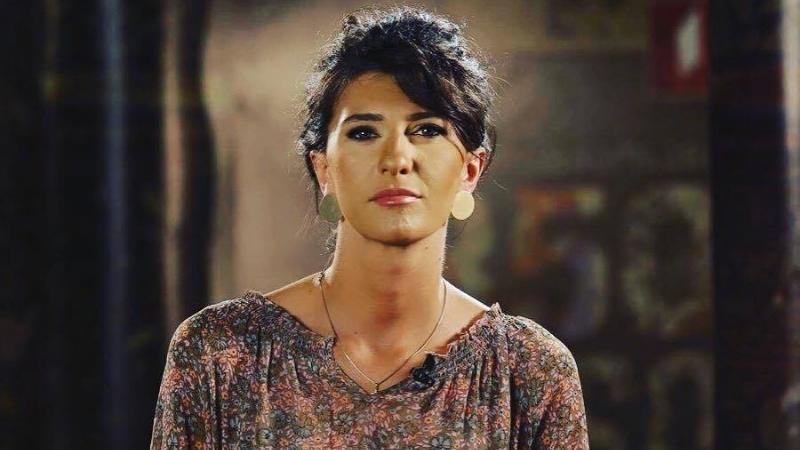
Shalva Ramishvili, the director and host of the pro-government outlet POSTV—which has been sanctioned by Britain for spreading Russian propaganda—is attempting to disparage TV Pirveli journalist Vika Bukia based on her geographical background.
Ramishvili refers to Vika Bukia as a “girl from the provinces” and an “aggressive provincial.” In the same context, he mentions her sister, Sopho Bukia—also a journalist and an editor at JAMnews—labeling her a provincial as well.
Vika Bukia is originally from the Samegrelo region. Ramishvili views this as a point of inferiority and uses it specifically to insult the journalist. Furthermore, he openly admits that he is doing this intentionally:
“You represent the class of jooooournalists (pronouncing the word with a specific derisive connotation) that I have fought since birth. I am fighting you not just as the provincial Vika Bukia, but as representatives of the joooournalist class—the collective Inga Grigolia and Nodar Meladze—so that your authority, if you even have any, is completely destroyed,” the propagandist Ramishvili stated openly.
This is not the first time that POSTV and its affiliates have attempted to insult and discredit independent and critical journalists. On March 4, Shalva Ramishvili also attempted to humiliate investigative journalist Keti Tutberidze by using sexist epithets against her.
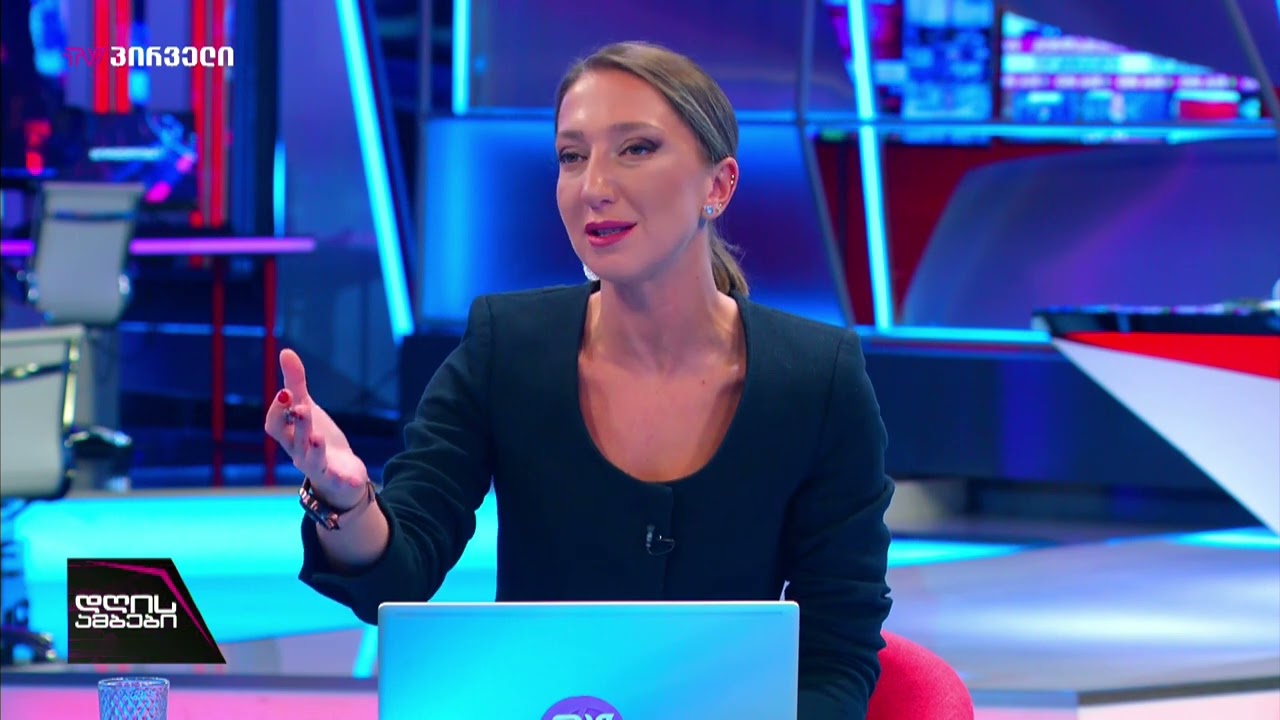
Liza Gegechkori, a host for the pro-government outlet POSTV—which has been sanctioned by Britain for spreading Russian propaganda—is attempting to discredit TV Pirveli investigative journalist Maka Andronikashvili. The individual, who is closely affiliated with “Georgian Dream,” is spreading disinformation claiming that Maka Andronikashvili changed her last name:
“I just found out—you might think it’s a joke, but it isn’t—her real name was Nabichvrishvili. The woman changed her own last name because she was a Nabichvrishvili by birth, and then, without a second thought, she ‘became’ an Andronikashvili,” the propagandist wrote.
This is not the first time that POSTV and its affiliates have attempted to insult and discredit independent and critical journalists. This attitude has become a trend on the channel and is systematic in nature. The channel’s director, Shalva Ramishvili, is particularly active in these efforts.
Director Goga Khaindrava, a supporter of “Georgian Dream,” is calling on the Prosecutor’s Office of Georgia, the State Security Service (SSG), and the Ministry of Internal Affairs of Georgia to investigate a report about him that aired on Formula TV.
The report in question was broadcast on Formula TV on January 17, 2026. It claimed that between 2016 and 2017, in coordination with the State Security Service and in exchange for payment, Goga Khaindrava facilitated the entry of Indian and Pakistani citizens into Georgia.
“The report suggested that, in agreement with the SSG, I intentionally committed a very serious crime. To me, this crime is equivalent to treason against the state. It is treason when you illegally bring potential criminals into the country’s territory in exchange for bribes. Therefore, in addition to filing a lawsuit in court, I am appealing to the Prosecutor’s Office and asking them to conduct an investigation into the matter to determine who is at fault: myself, the SSG, the Border Police, or ‘Falsehood Formula’ LLC,” Khaindrava stated during a press conference.
Following the airing of this report in January of this year, Goga Khaindrava announced that he would take legal action against Formula TV. It is worth noting that after the segment was broadcast, the program’s host, Davit Kashiashvili, received a threatening message from an unidentified individual. The author of the threat wrote to the journalist: “Tbilisi is a small city… take care of yourself, buddy.” Davit Kashiashvili announced this himself during a live broadcast, thereby notifying the Ministry of Internal Affairs of Georgia about the incident.
“Georgian Dream” propagandist Shalva Ramishvili, the director of the pro-government and British-sanctioned channel POSTV, addressed Formula TV journalist Keti Tutberidze with a sexist epithet in an attempt to humiliate her.
The incident occurred when the journalist approached him to ask questions regarding the British sanctions. In response to Tutberidze’s remark that she was not satisfied with his answer to a specific question, the propagandist mockingly addressed her and repeatedly called her “unsatisfied” (daukmaqobilebeli), despite the journalist ethically pointing out the lewd connotations of the word.
On February 24, 2026, four years after Russia’s full-scale invasion of Ukraine, Great Britain imposed sanctions on the pro-government television stations Imedi and POSTV for spreading disinformation against Ukraine. The sanctions were announced as part of a broad package released by the United Kingdom’s Foreign Office.
Pro-government television stations—Imedi, Rustavi 2, and POSTV—are labeling independent online publications Netgazeti, Publika, and On.ge as anti-Georgian media, discrediting and stigmatizing them because these outlets refer to high-ranking officials as the “Georgian Dream” Prime Minister and Minister.
All three channels published nearly identical text on social media, accompanied by a short screenshot of a text prepared by these online media outlets regarding the visit of Armenian Prime Minister Nikol Pashinyan to Georgia.
“So-called online media outlets funded by foreign countries refer to Nikol Pashinyan as Prime Minister, while referring to Irakli Kobakhidze and Maka Bochorishvili as the ‘Georgian Dream’ Prime Minister and Minister,” states Rustavi 2, referring to the online outlets as “so-called” media. POSTV also places the term online media in quotation marks: “The anti-Georgian policy of ‘online media’ funded from abroad: publications refer to Nikol Pashinyan as the Prime Minister of Armenia, while referring to the Prime Minister and the Foreign Minister of Georgia as the ‘Georgian Dream’ Prime Minister and Minister.” Imedi goes even further, calling these publications tools of hybrid warfare: “Another anti-Georgian act by the anti-Georgian online ‘media’ in Georgia—all three tools of hybrid warfare refer to Nikol Pashinyan as the Armenian Prime Minister, while referring to Irakli Kobakhidze and Maka Bochorishvili as the ‘Georgian Dream’ Prime Minister and Minister.”
Notably, all three channels published this visual material almost simultaneously on the same day that “Georgian Dream” passed the law in its third and final reading, which made the “systemic non-recognition of Georgian Dream” a criminal offense.
On February 24, the pro-government outlet “Postv” produced a report against the investigative journalists’ association “iFact.”
The “Postv” report focused on an episode from a video series produced by “iFact” about the property of Minister of Internal Affairs Gela Geladze.
The “iFact” video included a list of Gela Geladze’s declared assets.
“Gela Geladze’s narrated property declaration provided a good basis for opposition media hysteria and another attempt to discredit the government,” the “Postv” report stated.
The report’s author also claimed that the “iFact” video “led to misperceptions, manipulations, and misleading the public,” and accused “iFact” itself of “disinformation” and “speculation.”
“Postv” frequently publishes materials critical of independent media, which is continuously documented by CMIS.
On February 21, 2026, during a debate broadcast on the pro-government TV company “Imedi,” Shalva Papuashvili made a manipulative statement regarding the sentence of Mzia Amaghlobeli. He compared the journalist’s verdict to the sentence of a person convicted for slapping French President Emmanuel Macron.
“In France, a person attacked Macron do you know how much he was sentenced to? 18 months,” Shalva Papuashvili stated.
However, according to information published by “Netgazeti,” in reality the French man who slapped the president spent only 4 months in prison and the remaining term was suspended, whereas Mzia Amaghlobeli was sentenced to two years in prison. The journalist has already been in prison for more than one year.
On February 12, POST TV Analitika disseminated visual material about journalist Nanuka Zhorzholiani via social media, aimed at damaging her professional reputation and discrediting her. The content and format of the material contain degrading messages that go beyond the standards of expression permissible within the bounds of public interest and indicate an attempt to discredit the journalist.
A week earlier, an attempt to discredit Nanuka Zhorzholiani was also made by Georgian Dream MP Tea Tsulukiani, who shared an AI-generated image along with a text written in offensive language, falsely depicting her as being photographed with the American financier Epstein, who was convicted of pedophilia.
On January 28, a post was published on the Facebook page of the pro–“Georgian Dream” TV company Imedi, showing a photo that included TV Pirveli journalist and producer Nodar Meladze alongside the Executive Director of Transparency International Georgia. Imedi accused TV Pirveli of spreading false propaganda and called it a “propaganda tool.”
Like POSTV, Imedi is actively involved in promoting narratives created by Georgian Dream to discredit independent media, both on television broadcasts and on social media accounts.