On May 7, in Khelvachauri, Sulkhan Meskhidze, the founder of Adjara Times, and Lela Dumbadze, a journalist for Batumelebi, were obstructed from performing their professional duties, allegedly by public officials. The individuals verbally abused the journalists. According to the journalists, there were also threats and attempts at physical retaliation.
The journalists were covering a meeting between the parents of prisoners of conscience and local residents.
According to Batumelebi, among the aggressive individuals was Jumber (Genadi) Diasamidze, the deputy director of the Khelvachauri Municipality Sanitation and Utility Service, who is the cousin of Khelvachauri Mayor Zaza Diasamidze.
“The Charter of Journalistic Ethics calls on the Ministry of Internal Affairs to immediately investigate the obstruction of journalists Sulkhan Meskhidze and Lela Dumbadze while performing their professional duties in Khelvachauri,” reads the statement released by the Georgian Charter of Journalistic Ethics.
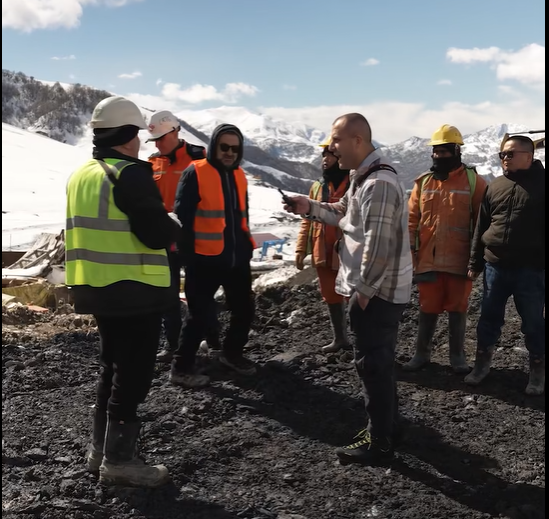
The film crew of the online publication Mtis Ambebi was unlawfully obstructed while working in the village of Tskere, in the Khada Gorge. Under threats of violence and death, the journalists were forced to stop filming and leave the village.
The incident occurred on April 1. The crew traveled to the gorge after reports emerged that a landslide, caused by the construction of the Kvesheti-Kobi road, had swept away several local graves.
The crew was on-site to document the unfolding events in the village. The journalists arrived just as the relocation of a young man’s body from the collapsed cemetery was about to begin. However, they were prevented from moving freely. According to the publication, representatives of a Chinese company, along with supervisors and employees of the Roads Department, insistently demanded that they stop filming. On the orders of their manager, the company’s hired workers physically obstructed the crew, prevented them from operating a drone, and threatened to smash their equipment.
According to Mtis Ambebi, the Shida Kartli Regional Prosecutor’s Office has launched an investigation into the attack and the unlawful interference with the journalists’ professional activities under Article 154, Part 2 of the Criminal Code of Georgia. This article pertains to the unlawful interference with a journalist’s professional duties through threats of violence or abuse of official position. The crime is punishable by a fine or imprisonment for up to two years.
The Georgian Charter of Journalistic Ethics expressed deep concern over the incident. In a statement, they noted that the attack bears clear signs of a criminal offense. The Charter calls on the Prosecutor’s Office to investigate the case quickly and effectively, and urges the Ministry of Internal Affairs to ensure a safe working environment for journalists.
On March 25, 2026, Monitor published an investigative report stating that they were unable to interview Member of the Georgian Parliament Zaal Dugladze because the Parliament refused to issue a special entry pass for their journalist.
“We were unable to go to the Parliament of Georgia and pose questions to a Member of Parliament. According to the new rules, before entering the Parliament, it is necessary to specify a concrete reason to obtain a special pass. When they learned that we wanted to record an interview with Zaal Dugladze, the Parliament refused to issue the pass,” the Monitor investigation states.
Monitor first applied to the Parliament for a special pass on February 17, and again on February 19. In both instances, the pass was denied. No explanation for the refusal was provided to the outlet.
A new rule for issuing one-day special accreditations came into effect on January 1, 2026. Under this rule, the Head of the Staff makes a decision regarding the issuance of special accreditation no later than five working days after receiving the application. This one-day special accreditation is a mechanism that allows journalists who do not hold permanent parliamentary accreditation to enter the Parliament building and carry out professional activities for a specific purpose. According to these special rules, an application must be submitted to the Speaker of the Parliament, specifying the exact reason for the request. Previously, no such requirement existed in the law.
The imposition of restrictions on journalists within the Parliament building by “Georgian Dream” began on February 6, 2023, when the initial media accreditation rules for the Parliament of Georgia were first approved.
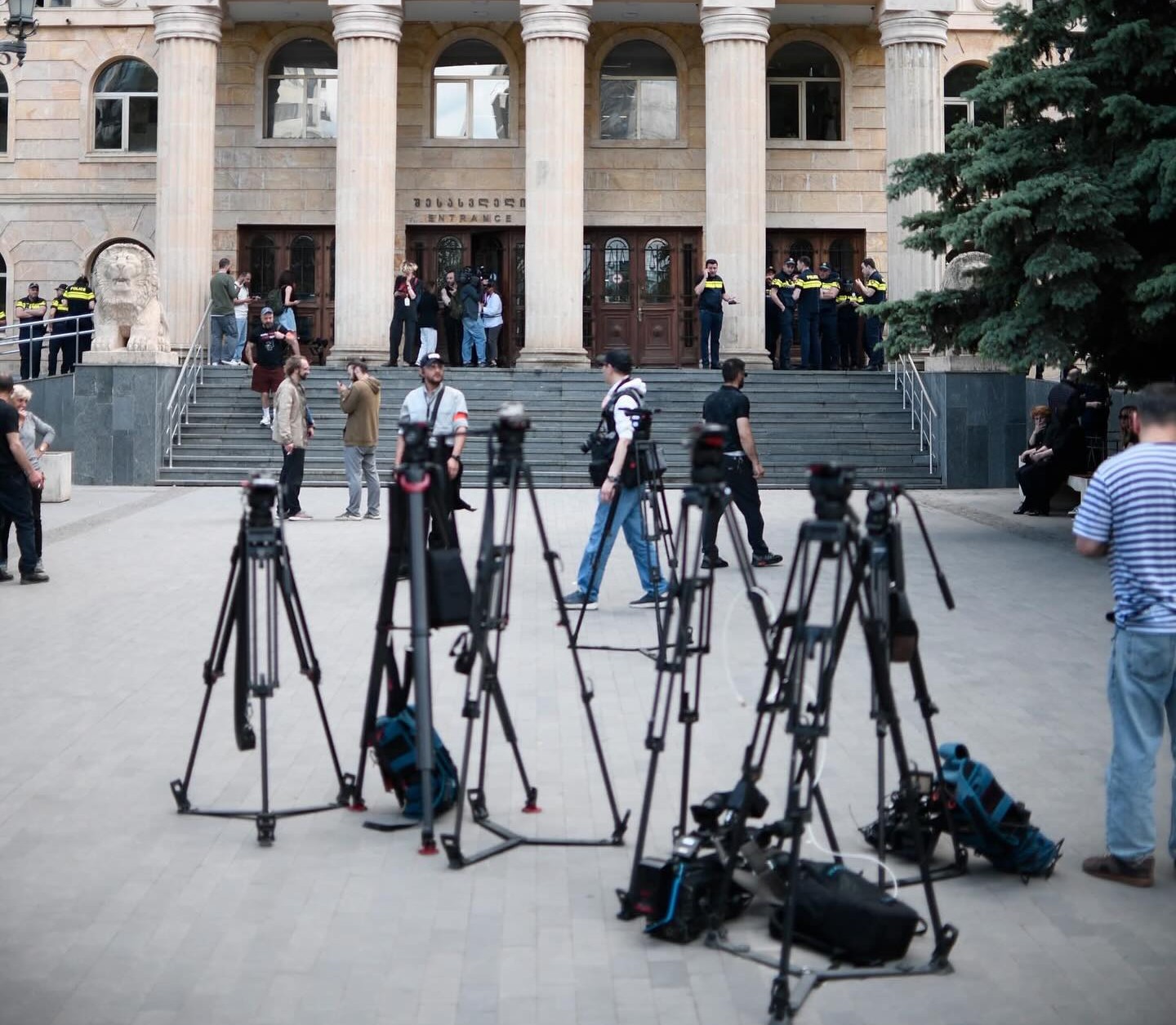
Given the ban on photography, video, and audio recording in courtrooms, sketches produced by artists remain one of the few ways to visually document legal proceedings. Despite this, during the March 18 hearing for Anton Chechin, Sergei Kukharchuk, and Artyom Gribul, Judge Nato Khujadze attempted to restrict an artist’s work, directing that “faces should not be flaunted.” After defense lawyers clarified that sketching is not prohibited—a point the prosecutor also conceded—the artist was allowed to continue working, though with the restriction that faces not be depicted.
This situation unfolds against the backdrop of legislative amendments passed in June 2025, which effectively banned recording in courtrooms. These changes have significantly complicated media coverage of trials and diminished the public’s access to information.
The court is currently holding a pretrial hearing for a new case involving Anton Chechin, Sergei Kukharchuk, and Artyom Gribul. The Russian and Ukrainian nationals, who have already been convicted in cases related to protest rallies, are now being accused of “group playing of handmade cards” while in the penitentiary facility. This charge carries a sentence of 3 to 5 years in prison. Chechin and Gribul are already serving 8.5-year sentences, while Kukharchuk is serving a 2-year sentence. Following the new charges, the prisoners were transferred to separate cells.
Pro-government television stations—Imedi, Rustavi 2, and POSTV—are labeling independent online publications Netgazeti, Publika, and On.ge as anti-Georgian media, discrediting and stigmatizing them because these outlets refer to high-ranking officials as the “Georgian Dream” Prime Minister and Minister.
All three channels published nearly identical text on social media, accompanied by a short screenshot of a text prepared by these online media outlets regarding the visit of Armenian Prime Minister Nikol Pashinyan to Georgia.
“So-called online media outlets funded by foreign countries refer to Nikol Pashinyan as Prime Minister, while referring to Irakli Kobakhidze and Maka Bochorishvili as the ‘Georgian Dream’ Prime Minister and Minister,” states Rustavi 2, referring to the online outlets as “so-called” media. POSTV also places the term online media in quotation marks: “The anti-Georgian policy of ‘online media’ funded from abroad: publications refer to Nikol Pashinyan as the Prime Minister of Armenia, while referring to the Prime Minister and the Foreign Minister of Georgia as the ‘Georgian Dream’ Prime Minister and Minister.” Imedi goes even further, calling these publications tools of hybrid warfare: “Another anti-Georgian act by the anti-Georgian online ‘media’ in Georgia—all three tools of hybrid warfare refer to Nikol Pashinyan as the Armenian Prime Minister, while referring to Irakli Kobakhidze and Maka Bochorishvili as the ‘Georgian Dream’ Prime Minister and Minister.”
Notably, all three channels published this visual material almost simultaneously on the same day that “Georgian Dream” passed the law in its third and final reading, which made the “systemic non-recognition of Georgian Dream” a criminal offense.
Following the amendments passed in June 2025, which prohibited the media from taking photos, filming videos, or making audio recordings inside court buildings and courtyards, journalists have repeatedly applied to the High Council of Justice for filming permits, but to no avail. According to the law, the High Council of Justice is the body authorized to grant such permissions.
For instance, on March 2, Publika journalist Natia Amiranashvili wrote that since the ban took effect, the outlet’s journalists have submitted approximately 20 applications to the High Council of Justice. However, they have received no response, not even regarding whether their applications contained any formal errors. According to Amiranashvili, they received a reply only once—an notification stating that applications should not be sent via email but must be physically delivered to the High Council of Justice. She noted that they complied with this requirement, yet still received no further response. Such restrictions mean that the media is unable to photograph, film, or record court proceedings, including those of high public interest.
Since “Georgian Dream” passed this restrictive media law last year, the High Council of Justice has granted permission to film a court hearing in only one instance. The “Georgian Dream”-controlled television stations Imedi and the Public Broadcaster received the right to film the trial of businessman Giorgi Bachiashvili, who is considered a “personal prisoner” of Bidzina Ivanishvili.
On February 23, a judge closed the court hearing of eight opposition politicians in the so-called sabotage case.
“At this moment, the judge has closed the hearing to both the media and NGO observers simply because lawyer Beka Basilaia told the judge, ‘Please stop banging that gavel back and forth,” wrote lawyer Tamta Kakhidze.
The opposition politicians — Mikheil Saakashvili, Giorgi Vashadze, Nika Gvaramia, Nika Melia, Zurab Girchi Japaridze, Elene Khoshtaria, Mamuka Khazaradze, and Badri Japaridze — are accused by the Prosecutor’s Office of assisting a foreign country in hostile activities, financing activities directed against the constitutional order and national security, and calling for the overthrow of the state government.
It should be noted that due to restrictive laws, the media already faces obstacles in covering court hearings. Fully closing the hearings creates an informational vacuum.
On February 11, 2026, in Tbilisi, at the Paragraph Hotel, during an event organized by the Iranian Embassy to mark the 47th anniversary of the Islamic Revolution in Iran, unknown individuals obstructed a journalist from the online outlet “Publika” while performing their professional duties. A man dressed in traditional attire seized the journalist’s phone and threw it, then forced them to delete the recorded material. To ensure the journalist had complied, the individuals accessed their personal information without permission, including private photos, videos, and mobile applications. According to the outlet, the journalist’s press ID and personal identification were also confiscated, and photos were taken of both the journalist and the documents.
The journalist was covering the event and a protest performance by an Iranian activist woman. “Publika” suspects that representatives of the State Protection Service or the State Security Service may have witnessed the incident. However, since the individuals were in civilian clothing and gave vague answers to questions, the outlet was unable to determine their identities or official positions.
The Georgian Charter of Journalistic Ethics has called on the State Security Service, the Ministry of Internal Affairs, and the Ministry of Foreign Affairs to immediately investigate the obstruction of the “Publika” journalist in performing professional duties and to take appropriate measures to ensure a safe and dignified working environment for journalists.
On January 26, 2026, Formula TV journalist Nano Chakvetadze had her phone confiscated, the footage recorded on site was deleted, and she was threatened with arrest.
According to information reported by the media, a Formula journalist was covering the death of an employee of the Anti-Corruption Agency near the building of the State Security Service (SSS), when the media representative was obstructed while performing her professional duties.
“We tried to film footage and ask questions to investigators, but first they forcibly took our phone, and then, again using force, made us leave the area,” says Formula TV journalist Nano Chakvetadze.
The incident was addressed by the Media Advocacy Coalition. “Pressure on journalists and the unlawful restriction of their work constitute a gross violation of media freedom. We stand in solidarity with Nano Chakvetadze and all representatives of independent media who are forced to work and inform the public in an extremely challenging environment,” the coalition’s statement reads.
From January 1, 2026, a new rule for issuing one-time special accreditation came into effect, according to which the head of the apparatus makes a decision on granting special accreditation no later than 5 working days from the submission of the application. The one-time special accreditation is a mechanism that allows journalists who do not hold parliamentary accreditation to enter the Parliament of Georgia and carry out their professional activities for a specific purpose.
Considering the operational nature of media work, this deadline may create practical difficulties for journalists in terms of timely coverage of ongoing events in Parliament. The issue gains additional significance in the context where the current regulations already set quantitative limits on accredited parliamentary journalists based on the type of media outlet. For example, for online publications, the maximum number of parliamentary accreditations is set at 4 journalists. This change negatively affects the efficiency of media work and creates additional barriers to accessing information in Parliament.
From the perspective of “Georgian Dream,” the imposition of additional restrictions on journalists in the Parliament building is related to the approval of the accreditation rules for media in the Parliament of Georgia on February 6, 2023. Among other provisions, the accreditation rules stipulate that video and photo recording of sessions is allowed only with the permission of the session chairperson, a journalist must stop an interview if the respondent refuses, and the head of the apparatus has the authority to restrict the access, movement, or placement of equipment of accredited journalists based on the “specificity of the event” or “security regime.” These criteria are not specified in the document, which creates a risk of broad discretion. Violations of the rules may result in suspension of accreditation for one to six months.
These regulations have been criticized by the Georgian Charter of Journalistic Ethics, which assesses that such norms negatively affect the ability to obtain and provide information to the public. Practice has shown that the media accreditation rules have been repeatedly used in the context of restricting the activities of independent journalists.