“Georgian Dream” Tbilisi mayoral candidate Kakha Kaladze called journalists ill-mannered 

On October 4, 2025, the day of the local self-government elections (which were boycotted by a large part of the pro-Western opposition), while at a polling station, Tbilisi mayoral candidate Kakha Kaladze called journalists ill-mannered.

The incident took place in Tbilisi, at the 64th polling station. After voting, Kakha Kaladze spoke about the protection of freedom of speech and expression in the country. A journalist from Formula asked him what this meant, to which he replied, “There is some decency, there is ethics, I understand that you have neither the one nor the other.”

Photographer Mariam Giunashvili injured while covering protest on October 4

According to the Charter of Journalistic Ethics, documentary photographer, Mariam Giunashvili, suffered burns after allegedly being pepper-sprayed. “They sprayed me [with pepper spray] from three different directions, from the front right in the face and from the sides all over my body. I got particularly bad burns on my hands and arms,” Giunashvili told Mediachecker.

A “Publika” journalist was threatened and an attempt was made to physically assault him by a Tbilisi City Court bailiff, who also threatened to call the police

On October 1, 2025, Publika’s journalist, Mindia Gabadze, was threatened with police intervention and faced an attempted physical assault by a Court bailiffl. Gabadze was covering the court hearing of activist Gela Khasaia.

According to Gabadze, before the hearing began, the head of the court bailiff’ service, Davit Matiashvili, threatened him that if he tried to record, he would “call the police and take him into the next room.”

Gabadze says he did not film anything inside the court building. After the hearing ended, when the Court bailiff began forcibly removing attendees and journalists, Gabadze was leaving the building calmly and peacefully. Nevertheless, according to him, Davit Matiashvili made three attempts (twice inside the building and once in the yard) to physically assault him — by kicking and grabbing him by the hand.

“There were two other incidents when another, inexperienced bailiff grabbed me by the neck. Each time, I was frozen in shock, and my editor was pulling me away from the Court bailiffs. Activists were also helping me,” the journalist wrote.

The Georgian Charter of Journalistic Ethics emphasized that recent amendments to the Organic Law on Common Courts of Georgia have severely restricted the media’s ability to cover court proceedings. According to the organization, the media lack even the most basic working conditions in the courts, and the environment has become extremely hostile and dangerous.

“Every time journalists perform their professional duties in court, their health and lives are at serious risk. While working in the courts, journalists also risk losing their freedom — even when they are merely trying to protect themselves or a colleague from violence. Such treatment of journalists bears all the signs of targeted persecution,” the organization’s statement reads.

The Media Advocacy Coalition added:

“The ‘Georgian Dream’ judiciary has become a place of injustice and violence. Violence and brutal incidents against journalists have become a regular part of their professional experience.”

A bailiff from the Tbilisi City Court damaged the phone of a journalist from the TV “Formula”

On October 1, 2025, a bailiff of the Tbilisi City Court confiscated the phone of Natali Jakhutashvili, a journalist for the TV company “Formula”, and returned it broken.

The incident occurred when the trial of opposition activist Gela Khasaia in the City Court ended. The imposition of imprisonment as a preventive measure for Gela Khasaia was followed by a confrontation in court. Court bailiffs physically assaulted the detainee’s friends. The journalist was trying to cover these processes.

According to her, after the bailiff confiscated her phone, she tried to return it for 15 minutes. In the end, the bailiff handed over the broken phone.

This is not the first time that media representatives have been targeted by violence in court. With the amendments to the Law on Common Courts, starting from June 30, it is forbidden to take photos/videos and make audio recordings in courtrooms, corridors or courtyards. After the new rule came into effect, media outlets applied to the Council of Justice – a legally established body – for the right to record, but so far none of them have received a response.

Before the adoption of the repressive legislation, independent media representatives were illegally hindered in the performance of their professional duties in court buildings. Since the amendment, the bailiff’s office has been using disproportionate and unjustified force, including against the media, to enforce the repressive legislation.

Anti-Corruption Bureau requests information from media to enforce repressive laws

Since May 2025, after the repressive laws came into force, the Anti-Corruption Bureau has requested large amounts of information from more than 60 non-governmental organizations, including several media outlets. The basis for this request is the Law on Grants. The Georgian Dream adopted an amendment to the Law on Grants on April 16, 2025. According to the amendments, the grantor (donor) must apply to the Government of Georgia for consent to issue a grant; the grantee, if receiving a grant without consent, will be fined double the amount of the grant.

On September 29, Razhden Kuprashvili’s bureau applied to the independent investigative journalism association iFact and GMC and requested information about grants, donors, financial transactions and contracts.

Previously, on September 26, Kuprashvili’s bureau sent a letter to the publication “Mountain News”.

“You are in a hurry to put us down. The answer is urgent! We will continue our work! “To create investigative films about government violations of laws, corruption, environmental destruction, and violations of fundamental human rights,” wrote Gela Mtivlishvili, founder and editor-in-chief of “Mountain News.”

On September 28, “Mountain Community” received a letter from the Anti-Corruption Bureau with the same demands. Nugzar Suaridze, the organization’s director, wrote about this on Facebook.

Project 64 also received a letter from the Anti-Corruption Bureau. “We have never faced a crisis of this magnitude, and this is not just a financial crisis,” said Giorgi Gogua, editor-in-chief of Project 64.

The Anti-Corruption Bureau also sent a letter to the Georgian Charter of Journalistic Ethics.

“The proceeding initiated by the Anti-Corruption Bureau is the first practical step under the new legislation to destroy a highly reputable organization, created through the great efforts of many good journalists,” — reads the statement of the Charter of Journalistic Ethics.

Three foreign reporters faced problems entering Georgia, and two of them were turned away

In the last week of September 2025, three foreign photographers were denied entry into Georgia. Two of them were scheduled to cover the planned local self-government elections in the country. All three photojournalists had been to Georgia before, and they had covered the pro-European protests.

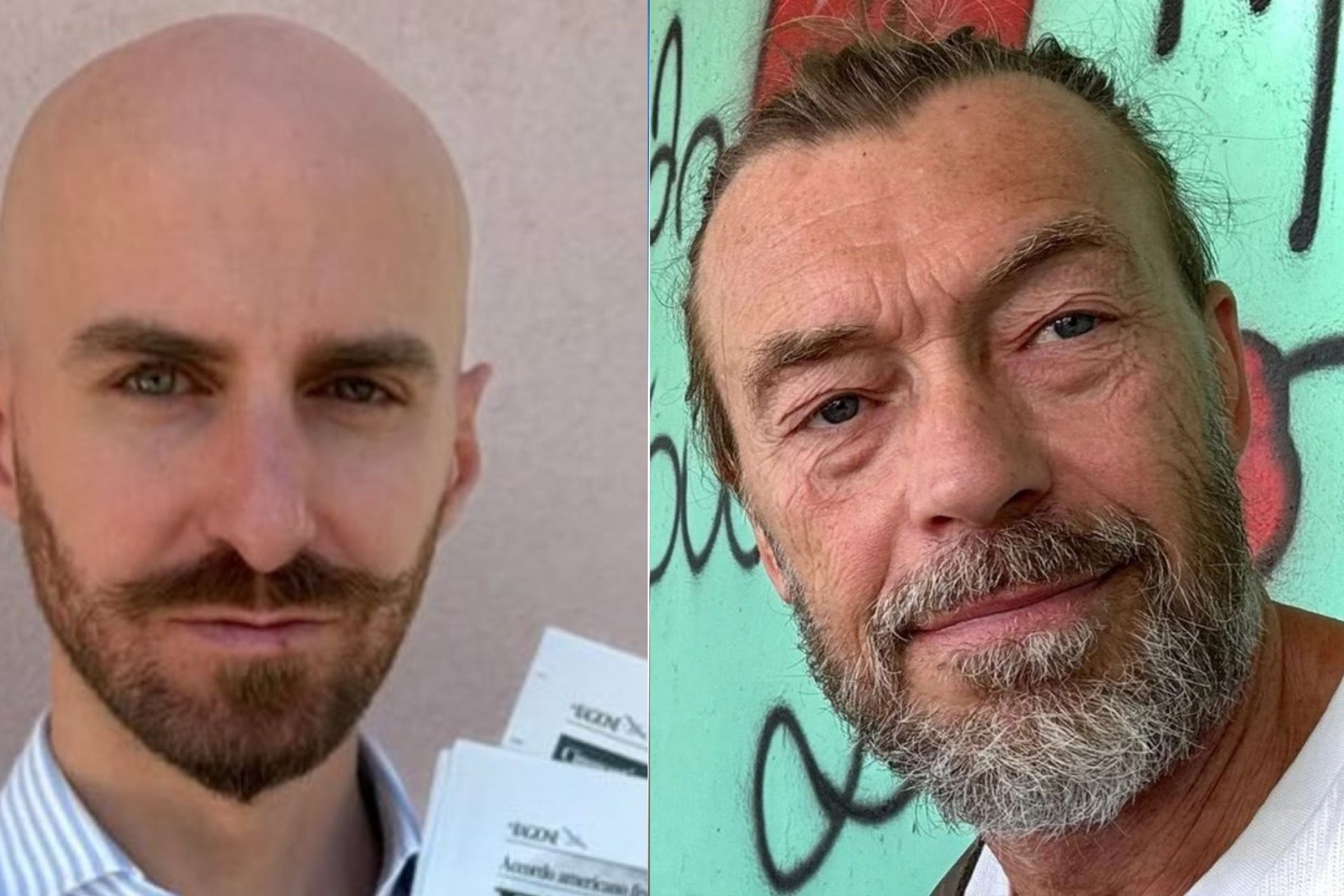
Specifically, on September 28, 2025, Swiss photojournalist Gregor Ziemer was not allowed into Georgia. At the border, he was informed that two fines totaling 10,000 GEL (approx. $3,700) were registered in his name “on the grounds of artificially blocking the road” and that he would not be allowed into the country until he paid this amount. The photojournalist refused to pay the fine and was turned back from the country. Speaking to OC Media, the photojournalist recounts that after the refusal, he was taken to “some room” and detained there for eight hours: “I had to book a return flight. After that, they took my phone away. I tried to get the phone back, but they did not return it. I tried to ask to make a call, but they told me it was impossible and took my phone away.”

On September 29, Italian journalist Giacomo Ferrara was denied entry into Georgia. He was entering Georgia from Armenia. At the border, the police told him that he was subject to a 5,000 GEL (approx. $1,900) fine and would not be allowed into the country without payment. Ferrara said this information was unexpected for him. According to his account, he was fined for being at a protest rally in Tbilisi on March 31, but the argument that he was not participating in the demonstration and was only covering it did not work. The journalist refused to pay the fine and requested his passport, which was returned to him after 2 hours. The journalist says he informed the Italian Embassy in Georgia and the International Federation of Journalists about the incident.

According to Mari Nikuradze, founder of OC Media, on October 1, a German journalist was also detained at the border in Georgia for 6 hours. The reason given was also a fine registered in their name—5,000 GEL ($1,900), for “artificially blocking the road.” The German journalist was only able to enter the country after paying the amount.

This is not the first time foreign reporters have faced problems entering Georgia. Based on publicly available sources, the “Center for Media, Information and Social Studies” has registered more than 10 such cases in the last two years.

Shalva Papuashvili Continues Attacks on Independent Outlet Netgazeti

On September 22, 2025, Shalva Papuashvili, Speaker of Parliament from Georgian Dream, referred to the independent online outlet Netgazeti as propaganda media.

Shalva Papuashvili shared the statement against Netgazeti on his social media page. In his post, Papuashvili attached a screenshot of a Netgazeti article in which Mikheil Kavelashvili was referred to as “Georgian Dream’s president.”

“There is no test that would show that media covering news in this manner is not propaganda. There is no test that would show that whoever pays them is not financing propaganda…” Papuashvili wrote.

Recently, Shalva Papuashvili has often attacked Netgazeti with similar posts. He made a similar statement against Netgazeti on September 9. In the archive of the Center for Media, Information, and Social Studies, his verbal attacks can also be found against the outlets Publika, On.ge, and Tabula, as well as against Gela Mtivlishvili, editor of the outlet Mtis Ambebi. Papuashvili also tried to discredit Netgazeti/Batumelebi’s imprisoned manager, Mzia Amaghlobeli, referring to her as an “inciter of violence.”

“Georgian Dream’s Tbilisi mayoral candidate, Kakha Kaladze, called journalists ‘abusers’ and verbally insulted them

On September 21, 2025, Kakha Kaladze, the current mayor of Tbilisi and mayoral candidate from Georgian Dream, called journalists “abusers” and verbally insulted them.

“You are the first abusers, you are the ones who abuse and who try to… then you’re surprised when sometimes a microphone is hit against your head… then you wonder why.”

After this comment, a journalist asked Kaladze whether his statement was an encouragement of violence. The Georgian Dream mayoral candidate replied that he had not attempted to encourage violence and continued verbally insulting the journalists.

“This kind of politeness, generally, is taught in the family… It is clear and obvious what you represent, who you are, what you are, and that’s why you are so miserable, wretched, and degraded.”

Pro-government media tries to discredit TV Pirveli

On September 17, 2025, the Georgian Dream-supporting propaganda television station – Post TV published a Facebook post stating that TV Pirveli did not cover the fact that the government was transferring apartments to Internally Displaced families. The post also accused TV Pirveli of reporting

“only fake news.” It included a call to “turn off TV Pirveli.”

The publication of such material clearly shows how pro-government media uses the strategy of discrediting opposition media to deepen distrust towards and boycott critical media.

The independent TV company TV Pirveli has repeatedly become the target of attacks by Georgian Dream representatives, supporters, and state agencies.

Georgian Dream Chair of the Parliament, Shalva Papuashvili, Continues Attack on Netgazeti

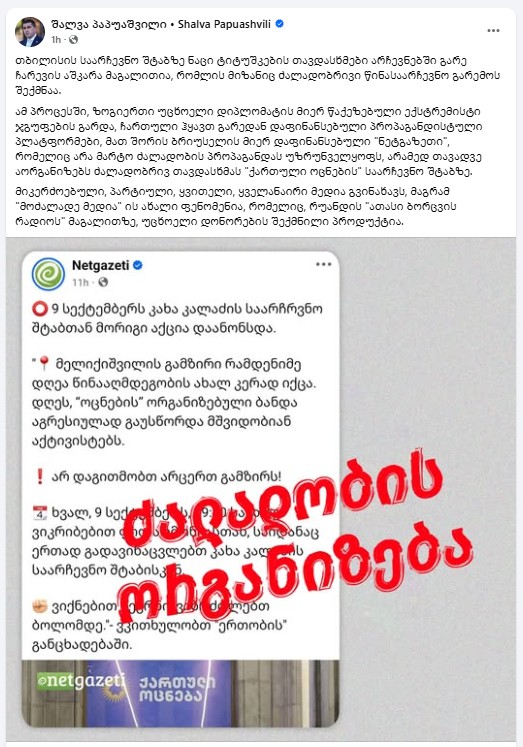
On September 9, 2025, Georgian Dream parliamentary chair, Shalva Papuashvili, called the independent online publication Netgazeti.ge “a platform for inciting violence, a propaganda platform, and a violent media outlet.”

His statement followed Netgazeti’s reporting on a protest rally announced for September 9 by Kakha Kaladze, Georgian Dream’s Tbilisi mayoral candidate. In the same post, Papuashvili employed anti-Western rhetoric and attacked donor organizations.

“Netgazeti, funded by Brussels, not only provides propaganda for violence, but also organizes a violent attack on the election headquarters of Georgian Dream. We have seen biased, partisan, yellow, all kinds of media, but ‘violent media’ is a new phenomenon that, like Rwanda’s ‘Radio of a Thousand Hills,’ is a product of foreign donors,” wrote the parliamentary chairman.

This is not the first time Papuashvili has targeted independent online media as propagandist outlets. The archive of the Center for Media, Information and Social Studies records his verbal attacks on Publika, On.ge, and Tabula, as well as on Gela Mtivlishvili, editor of Mtis Ambebi. Papuashvili has also attempted to discredit the imprisoned manager of Netgazeti/Batumelebi, Mzia Amaglobeli, referring to them as an “inciter of violence.”