Parliament Speaker Shalva Papuashvili responded to reports concerning the one-year suspension of TV company “Imedi’s” accreditation at the European Parliament, stating that the ruling team will discuss whether to apply similar rules in Georgia.
Papuashvili’s statement points to a potential further tightening of rules for media access to the Parliament. This comes against the backdrop of recent and repeated restrictions on journalist accreditation in the Georgian Parliament, including those introduced in January 2026.
“We saw it in the European Parliament, we’ve seen other countries too; the most lenient rules are the ones introduced here. Now you see what the European Parliament’s rule actually entails. We will definitely consider whether or not to apply those same rules here,” Papuashvili stated.
He assessed the European Parliament’s decision as a step taken “against free media” and remarked that “Brussels is replacing the Soviet Union step by step.”
TV company “Imedi,” which was recently sanctioned by the UK for spreading Russian disinformation, claims that the European Parliament has banned its operations for a year. Meanwhile, Moldova denied accreditation to three pro-government channels—”Imedi,” “Rustavi 2,” and “POSTV”—to cover the 135th session of the Committee of Ministers of the Council of Europe.
According to Radio Liberty, Marina Klimchuk, an 8-month pregnant journalist and German citizen, was denied entry to Georgia. On May 11, she was stopped at Tbilisi International Airport and informed that she had an outstanding fine of 5,000 GEL for an administrative offense. Klimchuk spent almost 24 hours in the airport’s temporary holding room. According to her, the room lacked both a blanket and a pillow. She was escorted by a law enforcement officer to purchase food but was not allowed to eat it there and was sent back to the holding room. After a nearly 24-hour wait, Klimchuk was sent back to Germany.
Klimchuk states that she had no prior knowledge of the fine and was not shown the penalty protocol at the airport. She suspects that the reason for her denial of entry may be linked to her journalistic work. During her time in Georgia last year, the journalist worked on several articles, including reports on the developments surrounding the Anaklia deep-sea port.
According to Klimchuk, she was willing to pay the so-called fine and even transferred 3,000 GEL to an account provided by the border guards. However, she was later told that paying the fee was pointless because she would not be allowed into the country anyway. The transferred funds were subsequently returned to her.
The journalist’s lawyer, Mariam Jikia, states that Klimchuk was not provided with the necessary documentation, including the penalty protocol, and that the official decision denying her entry cited the non-payment of the fine as the reason. The lawyer announced plans to appeal to the Public Defender to investigate the possible mistreatment of the 8-month pregnant woman.
Judge Manuchar Tsatsua of Tbilisi City Court found Duta Javakhishvili, a person with a disability, liable for an administrative offence and imposed a fine of GEL 5,000. The Ministry of Internal Affairs alleged that Javakhishvili had blocked the roadway on 7 February.
In the case of persons with disabilities, the law provides for a GEL 5,000 fine instead of administrative detention. According to Duta Javakhishvili, the decision will be appealed.
Judge Tornike Kapanadze of Tbilisi City Court imposed three days of administrative detention on Aleksi (Buka) Petriashvili, former State Minister for European Integration, for standing on the sidewalk. The Ministry of Internal Affairs alleged that, on 17 December, Petriashvili had created an obstruction to pedestrian movement on the sidewalk in front of Parliament.
Before the decision was announced, Petriashvili told the court that the video did not show any indication that anyone’s movement on the sidewalk had been obstructed. According to him, there was sufficient space around him and people were moving freely. Petriashvili also stated that, on 17 December, there had been no instruction from the Ministry of Internal Affairs at the location, and argued that the law in question contradicts the Constitution of Georgia and international standards.On the same day, Judge Kapanadze also heard the case of another protest participant, Sandro Sekhniashvili, and issued him a verbal warning. The Ministry of Internal Affairs alleged that Sekhniashvili had blocked the roadway in front of Parliament on 7 February.
Judge Tornike Kapanadze of Tbilisi City Court imposed two days of administrative detention on protest participant Natia Chelidze for blocking a roadway. The Ministry of Internal Affairs alleged that Chelidze had blocked the roadway in front of Parliament on 31 January.
The case concerns Article 174¹(10) of the Code of Administrative Offences, which covers the artificial blocking of a roadway and the creation of an obstruction to pedestrian movement on the sidewalk. The provision provides for administrative detention of up to 15 days, and up to 20 days in the case of an organizer. Repeated violation of the same provision entails criminal liability.
Tbilisi City Court imposed two days of administrative detention on Nino Saghiridze for standing on the sidewalk. The decision was delivered by Judge Tornike Kapanadze.
Elene Gelashvili, a participant in the ongoing protest, was also subjected to two days of administrative detention for standing on the sidewalk. The decision was delivered by Judge Zviad Tsekvava. The Ministry of Internal Affairs alleged that, on 18 December, Gelashvili had obstructed pedestrian movement on the sidewalk in front of Parliament. Elene Gelashvili was detained by police in the courtyard of the Agricultural University.
The administrative offence reports were drawn up under a provision that provides for administrative detention of up to 15 days as a sanction, and up to 20 days in the case of an organizer. Repeated commission of an offence under the same provision entails criminal liability and is punishable by imprisonment for up to one year.

On May 4, the television network Formula issued a statement regarding a partial interruption in its broadcasting.
“We would like to inform Formula viewers that a segment of our audience is currently experiencing a temporary broadcast interruption. This is due to an outstanding balance with Stereo+—the company responsible for providing Formula’s free-to-air signal to viewers who do not have cable television and receive the channel via digital multiplex. The network’s management is actively working to mobilize the necessary financial resources to fully restore broadcasting as soon as possible. Your support during this process is incredibly important to us. If you wish to help, you can support Formula by making a donation. Thank you for your trust and solidarity,” the statement read.
On May 13, Formula released a follow-up statement announcing that its broadcasting had resumed.

The Prosecutor’s Office has summoned Eliso Jariashvili, a journalist and TV host for the television network Formula, for questioning. As the journalist explained, the investigative agency requested her questioning following a report she aired on Formula. Specifically, Jariashvili had prepared an investigative report regarding an assault on journalist Guram Rogava, which took place during the mass protests in November 2024. As it is known, Formula reportedly uncovered the identity of the attacker. According to the online publication Netgazeti, the network states that the identity of Guram Rogava’s attacker was revealed by an employee of the Special Tasks Department.
According to Eliso Jariashvili: “Even though there is no legal necessity for this – since they already know the identity of Guram Rogava’s alleged attacker and can proceed with investigative actions anyway” – she still intends to go to the investigative agency.
On November 29, 2024, a masked law enforcement officer assaulted journalist Guram Rogava during a live broadcast. Rogava was officially recognized as a victim in 2024, yet the investigation failed to identify the attacker.
Following the airing of Formula’s report, Tbilisi District Court Judge Valerian Bugianishvili ordered pretrial detention as a preventative measure for three former employees of the Special Tasks Department. They were arrested in connection with the physical assault against journalist Guram Rogava and protester Zviad Maisashvili. One of the detainees is a current employee of the Security Police. They are being charged with physical violence committed against Rogava and protester Zviad Maisashvili.
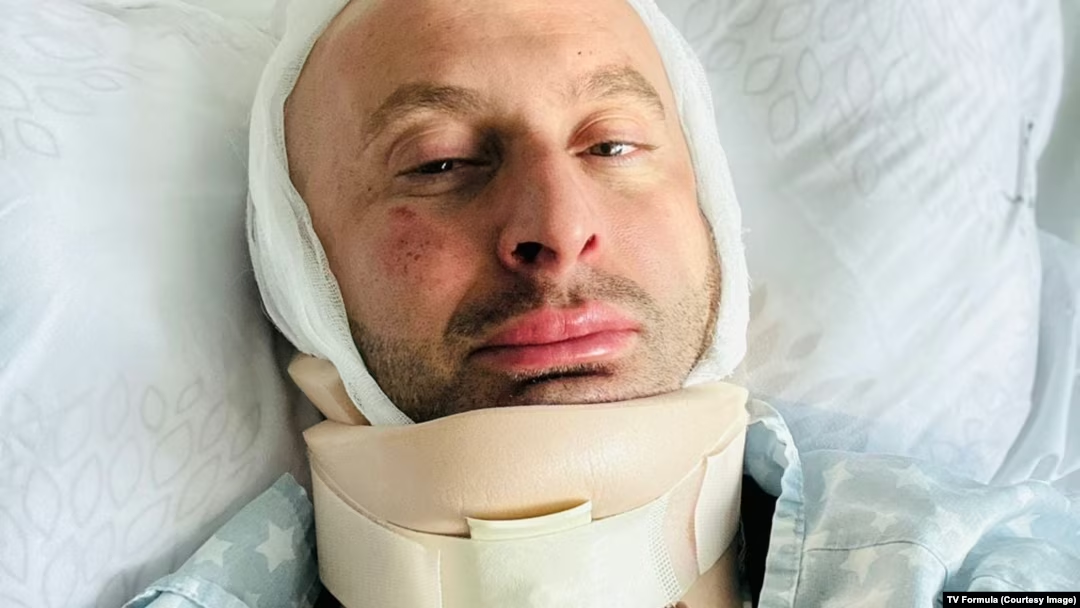
On May 6, journalist Guram Rogava was summoned to the Prosecutor’s Office for questioning.
“Tomorrow, at 12:00 PM Tbilisi time, I will be questioned,” Guram Rogava wrote on social media.
The Prosecutor’s Office also summoned Eliso Jariashvili, a journalist and TV host for the television network Formula, for questioning. As the journalist explained, the investigative agency requested her questioning following a report she aired on Formula. Specifically, Jariashvili had prepared an investigative report regarding the assault on journalist Guram Rogava, which took place during the mass protests in November 2024. Formula reportedly uncovered the identity of the attacker. According to the online publication Netgazeti, the network states that the identity of Rogava’s attacker was revealed by an employee of the Special Tasks Department.
On November 29, 2024, a masked law enforcement officer assaulted Guram Rogava while he was covering the protest live on air.
Guram Rogava was officially recognized as a victim shortly after, yet the investigation failed to identify the attacker.
Following the airing of Formula’s report, Tbilisi District Court Judge Valerian Bugianishvili ordered pretrial detention as a preventative measure for three former employees of the Special Tasks Department. One of the detainees is a current employee of the Security Police. They are being charged with physical violence committed against Rogava and protester Zviad Maisashvili.
Judge Paata Silagadze of the Tbilisi Court of Appeals upheld the convictions of eight people detained during the December 2024 protests.
At first instance, Judge Tamar Mchedlishvili sentenced Vepkhia Kasradze, Vasil Kadzelashvili, and Zviad Tsetskhladze to 2 years and 6 months’ imprisonment, while the other five convicted individuals — Irakli Miminoshvili, Tornike Goshadze, Insaf Aliyev, Nikoloz Javakhishvili, and Giorgi Gorgadze — were sentenced to 2 years’ imprisonment.
The first-instance court reclassified the charges from Article 225 of the Criminal Code of Georgia to Article 226. Article 226 concerns the organization of group actions, or participation in such actions, that seriously disrupt public order.
Judge Tamar Mchedlishvili found Zviad Tsetskhladze, Vepkhia Kasradze, and Vasil Kadzelashvili to be the organizers of the group action, while the remaining five individuals were found to be participants.
In their appeal, the convicted individuals sought the annulment of the first-instance judgment and requested an acquittal. The prosecution, for its part, challenged the judgment with respect to the legal qualification of the offence and sought the conviction of the individuals under the provision concerning participation in group violence.