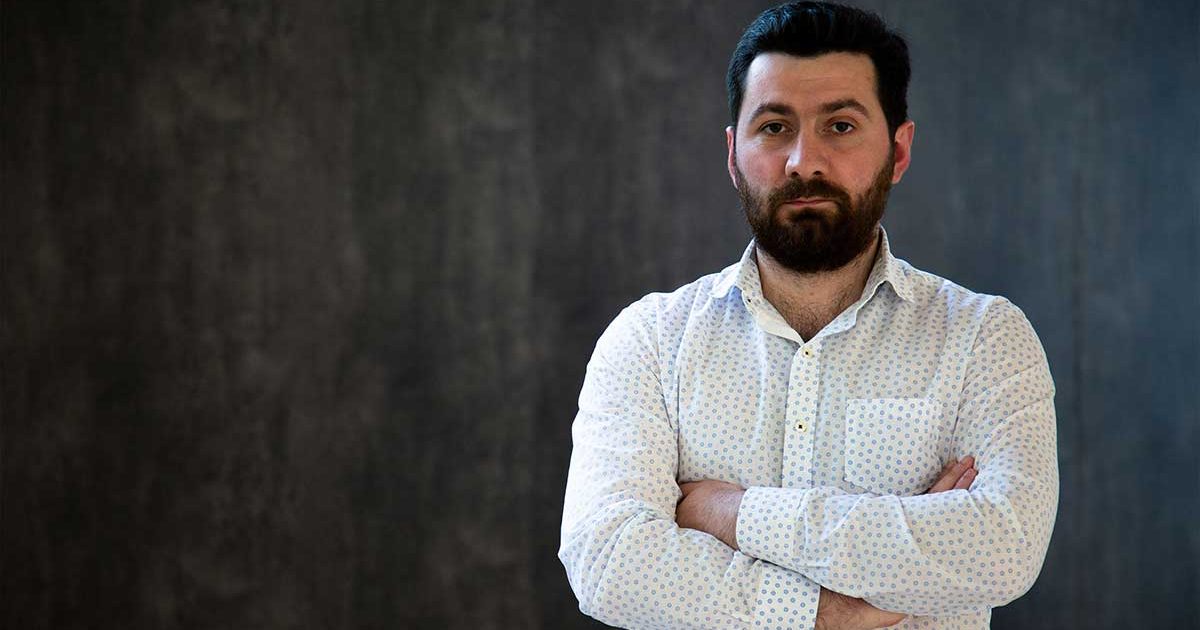
On July 30, 2025, it was announced that starting from the autumn season, the Public Broadcaster’s Channel One will no longer air the segment “People from History.” The host of the segment, Dimitri Silakadze, declined an offer to move to another program and decided to leave the channel. Silakadze is a participant and supporter of the ongoing pro-European protests in the country and is among those who have criticized the editorial policy of the Public Broadcaster.
“This was my last program on the Public Broadcaster… I wish our audience success. I also wish our country unity, strength, the establishment of a just state, and all the good that one can wish for their own country,” said the host to viewers in the season finale on July 29.
His segment “People from History” was initially broadcast on the program “This Weekend” and, since 2024, had moved to the Public Broadcaster’s radio show “Midday Peak Hour.”
In the past week, this is the third instance in which management has halted an ongoing project or segment: as of August 1, the program “This Weekend” will no longer air, and journalist Ia Antadze’s authorial project a series of profiles called “Interesting People”—will also end. All other members of “This Weekend” (seven journalists) and Ia Antadze have left the channel. The team also declined the offer to be redistributed across various TV and radio programs.
Earlier, in May, the Public Broadcaster closed its most well-known social program, “Real Space,” and terminated the employment contract of its host, Nino Zautashvili.
The dismissal or disciplining of employees critical of the channel’s editorial policy coincided with the pro-European protests. To date, more than 20 employees have been either dismissed or subjected to disciplinary sanctions at the Public Broadcaster through disciplinary proceedings.

On July 25, 2025, it was announced that the Public Broadcaster’s Channel One would close the program “This Weekend.” The channel’s management offered the program’s team producers, journalists, and hosts positions in other programs. Otherwise, they were informed that their cooperation with the channel would end.
The employees affected are: executive producers Tamar Chincharauli and Mariam Firtshalava, producer Nia Barabadze, journalist Ana Abakelia, and hosts Lika Evgenidze and Giorgi Sharvashidze.
In a letter sent by the broadcaster’s director, Tina Berdzenishvili, to the program team, it was stated that the program’s contract would expire on August 1 and would not be renewed, as the broadcaster no longer required the program: “From the new television season, the refreshed midday schedule will be dedicated to a new project covering every day of the week. Accordingly, there is no longer a need for a separate program solely for the weekend.”
All six employees declined to move to other programs. As a result, they were dismissed from their positions on August 1. All six journalists are part of the “Guardians of the Public Broadcaster” and have been criticizing the broadcaster’s biased editorial policy for eight months.
On the same day, it was also announced that Channel One had closed journalist Ia Antadze’s project “Interesting People.” “Of course, this decision was not unexpected, as I see it as a natural consequence of my choices and responsibilities,” Antadze wrote on social media.
The dismissal or disciplining of employees critical of the channel’s editorial policy began at the Public Broadcaster alongside the pro-European protests. To date, through disciplinary proceedings, 13 employees have been either dismissed or subjected to disciplinary sanctions.
On July 10, 2025, disinformation was spread against media platform “ChaiKhana” on the broadcast of “Imedi,” a broadcaster supporting “Georgian Dream.” Specifically, the discussion was about “ChaiKhana” receiving 532,117 euros from the European Commission. Media platform “ChaiKhana” issued a statement that the story aired on “Imedi” does not correspond to the truth.
“The amount mentioned in the story, 532,117 euros, is the amount allocated for 6 beneficiary countries… Accordingly, 94% of the amount mentioned by TV company ‘Imedi,’ 532,117 euros, does not represent ChaiKhana’s budget; the mentioned amount is actually the budget of organizations operating in European Union countries. According to ChaiKhana’s information, moreover, within the framework of the project, ChaiKhana could not receive the 31,947 euros initially allocated to it, because the contract was terminated early due to the adoption of the ‘Russian law.’ Accordingly, the actual amount received by ChaiKhana is only 5,581 euros and not 31,947 euros, as TV company ‘Imedi’ claims” – the statement reads.
On July 8, 2025, Prime Minister Irakli Kobakhidze of the “Georgian Dream” government attempted to discredit independent broadcasters “TV Pirveli” and “Formula.” He made a comment to the media about the alleged suicide attempt of former Chairman of the Adjara Government, Tornike Rizhvadze, according to the official version of the investigation. According to his statement, he “generally” linked the incident to opposition television stations and accused critical television stations of “defamation” and “sowing hatred.”
When asked who, according to his information, was accusing Tornike Rizhvadze of “corruption” and “patronage of drug dealers” – as written in the circulated letter – Kobakhidze said: “I don’t know, there were specific television stations that were doing this. In general, the life of a person involved in politics is stressful. Including when they no longer hold a position. Countless lies are spread, there is countless insult, countless defamation. I can name specific television stations… for example, ‘TV Pirveli’, ‘Formula’” – Irakli Kobakhidze declared.
Later, however, he denied the statement and noted that “No, I didn’t say this. I didn’t say this, of course. I gave one example. The rest should be determined by the investigation” – Kobakhidze said.
On July 3, 2025, the Communications Commission found TV companies “TV Pirveli”, “Mtavari Arkhi” and “Formula” to be violators of the law. The case concerns a complaint by “Georgian Dream” against the television stations. The party appealed to the commission on June 1 and complained about terms such as: “illegitimate parliament”, “oligarch’s regime”, “regime prisoners”, “illegitimate government”, “clan’s court” and others. The complaints submitted by “Georgian Dream” are based on amendments to Georgia’s Law on Broadcasting. These amendments were approved by parliament on April 1, as a result of which the Communications Commission’s powers were expanded.
The Media Advocacy Coalition called on the Communications Commission to be independent and a defender of free speech.
“The Commission should take into account that the public interest in critical assessment of political forces is higher. The media should have the right to give appropriate characterization and assessment to the processes taking place in the country. This is the essence of journalism” – the statement reads.
On July 15, 2025, “Georgian Dream” Prime Minister Irakli Kobakhidze accused Nodar Meladze, head of the news service of independent broadcaster “TV Pirveli,” of being “financed by specific individuals.” According to the disinformation statement: “There are specific people who some think are ‘Nationals’ and in reality they are financed by specific persons who were suspected of corruption and who had to leave the team… Nodar Meladze, who receives directives from this specific group suspected of corruption regarding the dissemination of specific information.”
On July 14, “Georgian Dream” Executive Secretary Mamuka Mdinaradze also made a statement against Nodar Meladze and accused him of “agency speculation.”
On July 14, 2025, “Georgian Dream” Executive Secretary Mamuka Mdinaradze accused “TV Pirveli” news service head Nodar Meladze of “agency speculation.” “This question serves your agency speculation, in connection with blaming others for your crime” – Mamuka Mdinaradze told the journalist.
This was preceded by the events of July 8, when “Georgian Dream” Prime Minister Irakli Kobakhidze linked the suicide attempt of the former head of the Adjara government to critical media “TV Pirveli” and “Formula.”
When asked who, according to his information, was accusing Tornike Rizhvadze of “corruption” and “patronage of deals” – as written in the circulated letter – Kobakhidze said: “I don’t know, there were specific television stations that were doing this. In general, the life of a person involved in politics is stressful. Including when they no longer hold a position. Countless lies are spread, there is countless insult, countless defamation. I can name specific television stations… for example, ‘TV Pirveli’, ‘Formula’” – Irakli Kobakhidze declared.
On June 19, 2025, the Media Development Fund (MDF) received a court order informing them that the Anti-Corruption Bureau had launched an investigation into the organization’s activities. The Bureau is demanding a large amount of information, including the personal data of beneficiaries and partner organizations.
Documents show that one of the reasons for the court order was the publication of joint statements by non-governmental organizations about the state of media freedom and pressure on journalists. MDF has appealed the decision.
MDF is a member of the European Fact-Checking Standards Network (EFCSN). EFCSN issued a public statement expressing solidarity with fact-checking platforms in Georgia. The statement notes that Myth Detector (a project by MDF) operates with high standards of transparency and journalistic methodology.
In addition to MDF, the Anti-Corruption Bureau has opened proceedings against three other member organizations of the Media Advocacy Coalition: Transparency International Georgia, Civil Society Foundation, and ISFED. In total, the court has already issued orders concerning seven civil society organizations.
The Media Advocacy Coalition views the adoption of the so-called “Russian laws” as a coordinated attack on civil society organizations. The Coalition is calling on all democratic forces in Georgia—including media outlets, civil society representatives, and individual citizens—to come together in defense of media freedom and civil society.
“Protecting media freedom and civil society is the foundation of democratic liberty,” the statement reads.
On June 18, 2025, Tbilisi City Court Judge Davit Tetraul fined “TV Pirveli” host Vika Bukia 4,000 GEL for a critical comment she posted on social media directed at a Georgian Dream MP.
Vika Bukia, along with five other journalists from critical media outlets, was summoned to Tbilisi City Court on June 12. All six were accused of insulting a member of the ruling Georgian Dream government. Out of the six, the court found four journalists guilty of an administrative offense and fined them. The hearings for the remaining two—Nanuka Zhorzholiani and Vakho Sanaia—were postponed, and no verdict has yet been issued in their cases.
In all six cases, the legal basis for the complaints was a newly enacted article of the Administrative Offenses Code—Article 173¹⁶(e). This article introduces liability for actions such as verbal insult, offensive language, degrading treatment, or other forms of offensive conduct directed at political officials, public servants, or equivalent positions, committed during or in connection with their official duties. Penalties include a fine ranging from 1,500 to 4,000 GEL or up to 45 days of detention.
According to the Georgian Young Lawyers’ Association, social media posts that do not contain threats posing a real risk and are directed at politicians—who are expected to have a high tolerance for criticism—are protected under freedom of expression. “Any court interpretation contradicting this standard would set a precedent for mass censorship,” the organization said in a statement.
On June 18, Parliament initiated amendments to the Organic Law on Common Courts, which were reviewed under an accelerated procedure and adopted in the third reading on June 26. Among the changes is a ban on photo and video recording by the media during court hearings. The amendments fundamentally change the rules for media coverage of court proceedings and, in effect, make it nearly impossible for journalists to report on them. The new regulations restrict recording not only inside courtrooms but also in court yards and hallways.
Key Changes:
- Restrictions on Recording in Courts:
Photo, video, and audio recording or broadcasting is prohibited within court buildings, courtrooms, and court yards—except in cases where such actions are authorized by the court or an authorized official. Video and audio recording or broadcasting of a hearing may be allowed only if the High Council of Justice of Georgia issues a specific decision authorizing it for that particular court hearing.
- Limitations on Broadcaster Access:
The provision that previously allowed the Public Broadcaster to cover court hearings without restriction has been abolished. Under the previous rule, if the Public Broadcaster did not exercise this right, another broadcaster could record the hearing with prior written permission from the judge.
- Right to Confiscate Personal Devices:
Courts are granted the authority to confiscate mobile phones, computers, photo/video/audio equipment, and other personal items from individuals entering the court building.
- Restriction on Public Access to Court Decisions:
Court decisions will only be made public after they have entered into legal force. Any person, including the media, is prohibited from publishing decisions without depersonalization. Access to information permitted only through procedures established by the General Administrative Code of Georgia.
- Liability for Disrespecting the Court:
Any act of disrespect toward a judge—whether verbal, obscene, or otherwise—by parties, other individuals involved in the case, or any third person, in any context (courtroom or public space), if related to the judge’s status, will be subject to legal liability.
These amendments significantly undermine the principle of transparency in court proceedings and impose unjustified restrictions ont media access to open hearings, in contradiction with democratic principles of openness and accountability.