On September 9, 2026, the Speaker of the Parliament of Georgia, Shalva Papuashvili, once again discredited Mzia Amaghlobeli, founder of the publications “Batumelebi” and “Netgazeti.” Additionally, he referred to her as a violent offender and called her a “prisoner of shamelessness.”
At a special briefing held in Parliament, Papuashvili called slapping a police officer a “violent attack” and stated that she was given the “lightest punishment.” “As for the punishment, Mzia Amaghlobeli is a prisoner of the opposition’s and Brussels’ shamelessness. Mzia Amaghlobeli was given the lightest sentence that could possibly be imposed by the court. A lesser sentence than this under the procedural code is only possible in the event of a plea agreement – this is both the law and the practice,” Papuashvili stated.
In reality, Part 1 of Article 353 of the Criminal Code, under which Mzia Amaghlobeli was convicted, provides for a fine or house arrest in addition to a prison sentence. However, Judge Nino Sakhelashvili sentenced Mzia Amaghlobeli to two years in prison.
This is not the first time Mzia Amaghlobeli has been the target of verbal attacks and discreditation by high-ranking officials of “Georgian Dream.” Immediately upon her arrest, Mzia Amaghlobeli became the target of propagandistic and disinformation attacks by the “Georgian Dream” party.
Parliament Speaker Shalva Papuashvili responded to reports concerning the one-year suspension of TV company “Imedi’s” accreditation at the European Parliament, stating that the ruling team will discuss whether to apply similar rules in Georgia.
Papuashvili’s statement points to a potential further tightening of rules for media access to the Parliament. This comes against the backdrop of recent and repeated restrictions on journalist accreditation in the Georgian Parliament, including those introduced in January 2026.
“We saw it in the European Parliament, we’ve seen other countries too; the most lenient rules are the ones introduced here. Now you see what the European Parliament’s rule actually entails. We will definitely consider whether or not to apply those same rules here,” Papuashvili stated.
He assessed the European Parliament’s decision as a step taken “against free media” and remarked that “Brussels is replacing the Soviet Union step by step.”
TV company “Imedi,” which was recently sanctioned by the UK for spreading Russian disinformation, claims that the European Parliament has banned its operations for a year. Meanwhile, Moldova denied accreditation to three pro-government channels—”Imedi,” “Rustavi 2,” and “POSTV”—to cover the 135th session of the Committee of Ministers of the Council of Europe.
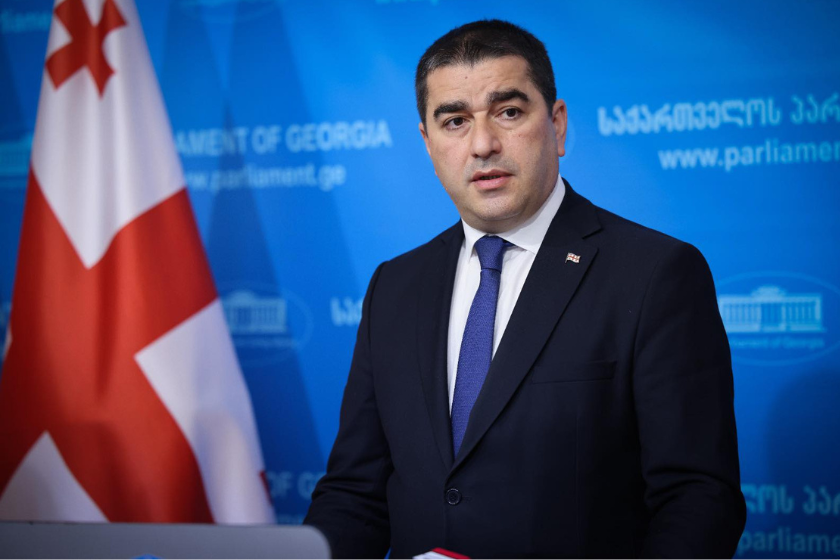
On April 2, 2026, during a briefing held in Parliament, the Speaker of the Parliament from “Georgian Dream,” Shalva Papuashvili, referred to online outlets Radio Free Europe/Radio Liberty (RFE/RL), Tabula, Publika, and Netgazeti as “foreign-funded party propaganda groups.” He accused them of interfering in the activities of the Holy Synod of the Georgian Patriarchate and threatened them with “consequences.”
“We see that, for example, foreign-funded party propaganda groups like Radio Liberty and Tabula are directly interfering in the activities of the Synod. They have launched direct campaigns against specific clerics; Radio Liberty, Tabula, and other online outlets such as Publika, Netgazeti, etc., are conducting direct election campaigns for or against various clergy members. We are monitoring all of this, and there will be an appropriate reaction,” Papuashvili stated.
His statement followed media coverage and public interest regarding the election of a new Patriarch after the passing of Ilia II, the Catholicos-Patriarch of All Georgia.
The Georgian Charter of Journalistic Ethics reminds Papuashvili that the role and duty of the media is to cover all significant issues unfolding in the country.
“The election of a new Patriarch is among such issues, and the Georgian media is currently doing exactly what it should be doing—investigating information and gathering comments on this matter to share with its audience,” the Charter’s statement reads. The Charter calls on high-ranking officials to stop the harassment and intimidation of media outlets and journalists aimed at suppressing critical voices, and to allow the media to contribute fully to the formation of public discourse.
The Speaker of Parliament from “Georgian Dream,” Shalva Papuashvili, verbally insulted the television company “Formula” and journalist Salome Labadze.
The question posed by the “Formula” journalist concerned Georgia’s national hero, Maro Makashvili.
In response to the question, “Who killed Maro Makashvili?”, Shalva Papuashvili called the “Formula” journalist “shameful” and “funded by Kezerashvili.”
“You and your television channel spread shameful propaganda that seeks political speculation. I will not answer any such questions,” Papuashvili said (5:29 min).
Among politicians from “Georgian Dream” who verbally insult journalists from critical media, Shalva Papuashvili is the most active, and CMIS has documented numerous examples of this behavior.
On February 21, 2026, during a debate broadcast on the pro-government TV company “Imedi,” Shalva Papuashvili made a manipulative statement regarding the sentence of Mzia Amaghlobeli. He compared the journalist’s verdict to the sentence of a person convicted for slapping French President Emmanuel Macron.
“In France, a person attacked Macron do you know how much he was sentenced to? 18 months,” Shalva Papuashvili stated.
However, according to information published by “Netgazeti,” in reality the French man who slapped the president spent only 4 months in prison and the remaining term was suspended, whereas Mzia Amaghlobeli was sentenced to two years in prison. The journalist has already been in prison for more than one year.
On February 2, 2026, during a live broadcast on the pro-government “Rustavi 2,” Georgian Dream’s Parliament Speaker Shalva Papuashvili referred to Radio Liberty as a tool of Western propaganda and spread misinformation about the media outlet’s funding sources.
Papuashvili spoke about alleged foreign interference in the country and attempts to stage a revolution, claiming that these interventions were being attempted through various channels. “You talk as if the USAID in the American administration hasn’t been closed, as if funding for Radio Liberty hasn’t been stopped. Radio Liberty, funded by the central intelligence agencies of the United States and an instrument of official propaganda, had its funding cut by America. And who funds it now? European sources. Don’t you wonder? How was this propaganda instrument taken over?” [Timecode: 51:34 – 51:55]
This is not the first time Papuashvili has attacked Radio Liberty. On November 24, 2025, he referred to the outlet in exactly the same way and called its journalists propagandists. Radio Liberty is not the only target of Papuashvili’s discrediting efforts; over time, he has targeted multiple media outlets, including “Publika,” “Netgazeti,” “Mtis Ambebi,” TOK.TV, “Tabula,” On.ge, and the media solidarity campaign “Sinatle Media.”
The Chair of Parliament from “Georgian Dream,” Shalva Papuashvili, has once again engaged in discrediting independent online media, first on the air of TV company “Imedi,” and later on his personal social media page.
On Imedi’s broadcast, Papuashvili referred to the publication “Publika” as a “so-called media outlet that is in reality an instrument of propaganda.”
Shalva Papuashvili attempted to discredit independent media in the context of organizations being registered abroad.
Along with “Publika,” he mentioned other media outlets in the same context, specifically on.ge and “Tabula.”
Quotes discrediting “Publika” by the Chair of Parliament from “Georgian Dream” were published as separate Facebook cards, including by TV company “Imedi.” Subsequently, the broadcaster dedicated separate reports to this topic in the first block of various news programs.
The same narrative was once again spread by Shalva Papuashvili via his own social media, where this time the names of “Publika” editors Lika Zakashvili and Zurab Vardiashvili were mentioned on the organization’s registration document.
High-ranking officials of “Georgian Dream” are actively attempting to discredit independent media.
On November 24, the Speaker of Parliament from “Georgian Dream,” Shalva Papuashvili, issued a statement against “Radio Liberty” and said that the media outlet was created by the “Central Intelligence Agency.” He also called the journalists “propagandists.”
“Radio Liberty is media?! It was created by the Central Intelligence Agency. It is an organization created by an intelligence service, funded by the U.S. budget. The current U.S. government stopped its funding because it said they are a tool of propaganda.”
At the same press conference, Papuashvili spoke in detail about a report aired on the pro-government channel “Imedi,” against “Light Media.” According to Papuashvili, independent online media “put criminal energy into their work and commit criminal offenses, including tax evasion and other types of crimes.”
On November 24, the Speaker of Parliament from “Georgian Dream,” Shalva Papuashvili, accused the online media outlet “Mtis Ambebi” of hiding finances. He said that donors, by funding “Mtis Ambebi,” are financing xenophobia. This is how Shalva Papuashvili responded to a question from a pro-government television station about “Mtis Ambebi.” The journalist was asking Papuashvili about “Mtis Ambebi’s” coverage of the Eagle Hills project. Eagle Hills has been presented by the “Georgian Dream” government as an unprecedented, multimillion-dollar project.
Shalva Papuashvili frequently makes disinformative statements against independent online media. Among them, he actively refers to “Mtis Ambebi,” “Netgazeti/Batumelebi,” and “Publika” in a negative context.
The Speaker of Parliament from “Georgian Dream“, Shalva Papuashvili, responded to a report aired on the pro-government TV channel Imedi targeting the association of independent online media outlets, Light Media, attempting to discredit and intimidate them.
Shalva Papuashvili said that online media outlets are bypassing the law and accused them of committing “criminal” offenses.
“[Online media outlets] invent schemes to circumvent legislation, and part of this scheme involves violating restrictions when money moves undeclared across the territory of Georgia. Therefore, of course, attention must be paid to all of this. Those whose competence this falls under are monitoring these processes. Wherever they detect signs of a crime, there will be an appropriate response,” said Shalva Papuashvili.
On November 23, the pro-government TV channel Imedi aired a propagandistic report against Light Media. Light Media is a coalition of 22 independent online media outlets formed after laws and legislative changes adopted by the Georgian Dream parliament placed online media in a dire situation. The report broadcast on Imedi, aimed at discrediting these outlets, claimed that the media were supposedly working on the orders of “foreign intelligence services” and were engaged in “anti-state” activities.