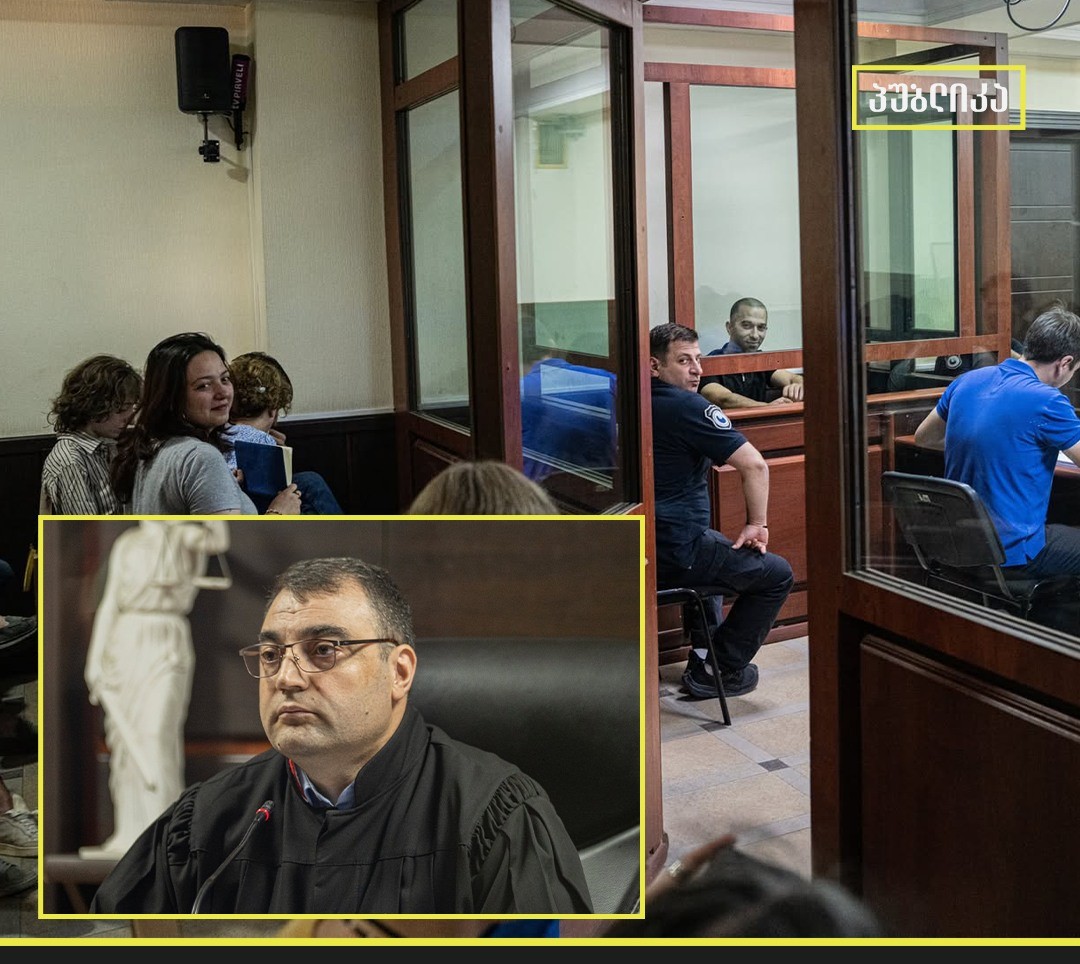
On July 14, 2025, Judge Nino Sakhelashvili moved the court proceedings of journalist Mzia Amaghlobeli, who is in illegal imprisonment, to a smaller courtroom. According to information from online media “Batumelebi,” the judge made the decision after, according to her, shouts could be heard from the street in the courtroom – “Freedom for Mzia! Freedom for political prisoners!” According to the online media’s information, a large part of those wishing to attend the court session could not enter the proceedings, among them were members of Mzia Amaghlobeli’s family, colleagues, and representatives of the diplomatic corps.
The judge also did not satisfy the defense’s request that journalist Mzia Amaghlobeli be allowed to testify from the witness stand. In the end, the journalist testified from a glass-enclosed booth.
For more than 6 months, journalist and media manager Mzia Amaghlobeli, founder of “Batumelebi” and “Netgazeti,” has been in illegal imprisonment. On July 9, the European Parliament adopted a resolution on Georgia, demanding Mzia Amaghlobeli’s release. Her release is also demanded by local and international organizations.
On July 10, 2025, due to the distribution of photos from the courtroom, Judge Nino Galustashvili closed the Lomidze-Zasokhashvili trial and had everyone present, including journalists, leave the courtroom.
On June 26, the “Georgian Dream” parliament adopted amendments to the Organic Law on Common Courts through an expedited procedure. Under the new norms, which came into force immediately upon publication of the law, photo-video recording for media at court sessions was prohibited. As a result of the changes, recording is restricted both inside the courtroom space, as well as in the yard and corridors.
On July 14, 2025, the court hearing of journalist Mazia Amaglobeli, who is being held in unlawful detention, was moved to a small courtroom by Judge Nino Sakhelashvili. According to the online media outlet Batumelebi, the judge made this decision after stating that shouts could be heard from the street in the courtroom “Freedom for Mazia! Freedom for political prisoners!”
According to the online media, a large number of people who wished to attend the hearing were unable to enter, including members of Mazia Amaglobeli’s family, colleagues, and representatives of the diplomatic corps.
The judge also denied the defense’s request for journalist Mazia Amaglobeli to give her testimony from the witness stand. Ultimately, she gave her testimony from a booth enclosed in glass.
For more than six months, Mazia Amaglobeli, founder of Batumelebi and Netgazeti, journalist, and media manager, has been held in unlawful detention. On July 9, the European Parliament adopted a resolution on Georgia, calling for Mazia Amaglobeli’s release. Her release is also being demanded by local and international organizations.
On June 21, 2025, a court hearing was held at Tbilisi City Court in the case of activist Nino Datashvili, related to a criminal investigation stemming from an incident that took place at the court building on May 9 of this year.
Judge Eka Barbakadze prohibited photo and audio recording during the session without providing any explanation or justification. Only video cameras were allowed to be present in the courtroom.
“At the start of the hearing, Barbakadze said she had received media requests for permission to record video, take photos, and make audio recordings, but she only granted permission for video recording and gave no explanation for denying photo and audio access,” reported the news outlet Publika.
This is not the first instance of media restrictions in courtrooms. Just a few days earlier, Tbilisi City Court Judge Giorgi Arevadze also did not allow the media to operate freely.
On June 19, 2025, Tbilisi City Court Judge Giorgi Arevadze hampered media representatives’ work during the trial of a “prisoner of conscience”, Archil Muselianti.
According to journalists, the trial was held in a hall divided by a glass door and window, the voices of the speakers could not reach beyond the dividing wall, which is why media representatives asked the judge to place microphones inside, but the judge did not allow them to do so.
Media representatives left the trial because, according to them, there was no sound in the hall and it was impossible to understand the content of the session.
Recently, the judicial system has significantly restricted the activities of the media in relation to the coverage of court proceedings. Between May 22 and June 19, 2025, four cases (on May 22, 23, 29, and 30)were recorded at the Tbilisi City Court when reporters with photo/video cameras were not allowed into the building. On June 10 and 11, the hearing was completely closed to the media, including those who had the right to film. Also on June 11, Judge Tamar Mchedlishvili threatened a Public journalist with a ban on taking photos during the trial. All cases occurred during trials of high public interest, which are considered political cases.
The Media Advocacy Coalition considers the court’s new practice to be illegal. According to the organization, this sets a dangerous precedent and reveals the Georgian Dream’s deliberate restrictive policy towards the media. “Banning media access to court proceedings is not only a violation of the rights of journalists, but also an infringement of the entire society’s right to information,” the statement says.
On June 11, 2025, Tbilisi City Court Judge Mikheil Jinjolia unexpectedly announced the closure of the court session during the trial of Giorgi Akhobadze, who was arrested at a protest. Journalists were once again forced to leave the courtroom without any explanation, including those who had been granted permission to film the proceedings.
Natia Amiranashvili, a journalist from the online outlet Publika, wrote on social media that no order had been disrupted during the hearing: “I have a strong suspicion that the court’s main concern is to silence and neutralize the media — and these steps are being taken to prepare the ground for that.”
In recent months, Georgia’s court system has increasingly restricted the media’s ability to cover legal proceedings. Between May 22 and June 11, 2025, there were four recorded incidents at Tbilisi City Court (on May 22, 23, 29, and 30) in which reporters equipped with photo and video cameras were denied access. On June 10, a court session was completely closed to the media — including to journalists who had previously received permission to record. All these incidents occurred during hearings of high public interest, widely considered to be political cases.
The Media Advocacy Coalition has warned that these actions set a dangerous precedent and reflect a deliberate strategy by the ruling Georgian Dream party to restrict media access.
“Barring media from court proceedings not only violates the rights of journalists but also infringes on the public’s right to be informed. Through such actions, Georgian Dream is attempting to withhold information on critical court decisions from the public and limit citizens’ ability to demand accountability,” the coalition’s statement reads.
On June 10, 2025, Judge Nino Galustashvili closed the hearing of 11 individuals detained during pro-European protests and expelled media representatives from the courtroom without any explanation. Notably, even those journalists who had official permission to film were asked to leave.
Previously, during earlier stages of the same case, some hearings at the Tbilisi City Court had been partially closed — barring supporters, family members, and friends of the defendants from attending — but media outlets with filming accreditation were still allowed to cover the proceedings.
According to the online outlet Publika, the judge’s decision followed a comment made from the courtroom, noting that participants had not been allowed to eat during the hearing. Despite journalists requesting clarification, the judge only announced the decision, providing no further explanation.
In recent months, the courts have increasingly imposed unjustified barriers on the media, hindering journalists from fulfilling their professional duties.
On February 12, 2025, a journalist from Batumelebi was denied entry to a public meeting held at Batumi City Hall on the issue of homelessness. According to the outlet, homeless individuals had informed them about the event. However, when the Batumelebi journalist arrived at the entrance of City Hall, security police officers told them they would not be allowed to attend the meeting. The outlet attempted to clarify the reason with the City Hall’s Public Relations Office but received no response.
The Charter of Journalistic Ethics of Georgia stated it has reasonable grounds to believe that the discriminatory treatment of Batumelebi and the restriction of their legal rights are directly connected to the unlawful detention and imprisonment of Mzia Amaghlobeli, and are part of a broader effort to pressure the outlet:
“By refusing to allow a journalist into an open commission meeting in a public building, the security police and Batumi City Hall violated the Batumi Municipal Council’s regulations, which require the creation of working conditions for journalists in public institutions,” the organization’s statement reads.
Mzia Amaghlobeli, co-founder and media manager of Batumelebi and Netgazeti, is the first woman journalist in Georgia considered a prisoner of conscience. She was arrested on January 11, 2025, accused of slapping a law enforcement officer, and faces a prison sentence of 4 to 7 years.
On March 19, 2025, Judge Tamar Makharoblidze of Tbilisi City Court ordered TV Pirveli journalists Mariam Gaprindashvili and Nanuka Kajaia to leave the courtroom.
The judge made this decision after the journalists inquired why they had not been granted permission to photograph the proceedings — a request they had submitted officially and in accordance with the law.
“The judge did not allow the journalists to finish speaking, told them they were not parties to the case and therefore had no right to speak. She first issued them a warning, and then expelled them from the courtroom,” according to a report by Radio Liberty.
The court session was related to a deliberate murder case that occurred on March 15 on Ilia Chavchavadze Avenue.
On March 26, 2025, the Parliament of Georgia suspended the accreditation of TV Pirveli journalist Nata Kajaia for six months.
The suspension is related to a report she produced about individuals detained during pro-European protests. Kajaia had approached parliamentary staff for interviews. After being refused, she continued trying to obtain answers from public officials.
“The reaction from Georgian Dream shows that they did not like the segment aired on Saturday, because we told the audience how the persecution is based on falsehoods — in a criminal case involving prisoners of conscience. I approached a parliamentary employee for an interview — the man whose testimony is part of the case against the prisoners of conscience,” Kajaia said in an interview with TV Pirveli.
The incident drew a response from the Media Advocacy Coalition, which stated:
“The regime is systematically abusing independent media. Journalists are being unlawfully obstructed in their professional work. There is a pattern of continuous attacks, intimidation, insults, and disinformation. To this day, no one has been held accountable — neither those who ordered nor those who carried out these systemic crimes.”
The rules for journalist accreditation in the legislature are defined by a decree issued by the Speaker of Parliament on February 6, 2023.