On February 11, 2026, in Tbilisi, at the Paragraph Hotel, during an event organized by the Iranian Embassy to mark the 47th anniversary of the Islamic Revolution in Iran, unknown individuals obstructed a journalist from the online outlet “Publika” while performing their professional duties. A man dressed in traditional attire seized the journalist’s phone and threw it, then forced them to delete the recorded material. To ensure the journalist had complied, the individuals accessed their personal information without permission, including private photos, videos, and mobile applications. According to the outlet, the journalist’s press ID and personal identification were also confiscated, and photos were taken of both the journalist and the documents.
The journalist was covering the event and a protest performance by an Iranian activist woman. “Publika” suspects that representatives of the State Protection Service or the State Security Service may have witnessed the incident. However, since the individuals were in civilian clothing and gave vague answers to questions, the outlet was unable to determine their identities or official positions.
The Georgian Charter of Journalistic Ethics has called on the State Security Service, the Ministry of Internal Affairs, and the Ministry of Foreign Affairs to immediately investigate the obstruction of the “Publika” journalist in performing professional duties and to take appropriate measures to ensure a safe and dignified working environment for journalists.
On January 26, 2026, Formula TV journalist Nano Chakvetadze had her phone confiscated, the footage recorded on site was deleted, and she was threatened with arrest.
According to information reported by the media, a Formula journalist was covering the death of an employee of the Anti-Corruption Agency near the building of the State Security Service (SSS), when the media representative was obstructed while performing her professional duties.
“We tried to film footage and ask questions to investigators, but first they forcibly took our phone, and then, again using force, made us leave the area,” says Formula TV journalist Nano Chakvetadze.
The incident was addressed by the Media Advocacy Coalition. “Pressure on journalists and the unlawful restriction of their work constitute a gross violation of media freedom. We stand in solidarity with Nano Chakvetadze and all representatives of independent media who are forced to work and inform the public in an extremely challenging environment,” the coalition’s statement reads.
On January 8, 2026, the website of the news agency CNews went offline. When attempting to access the site, a message appeared stating, “Disconnected due to outstanding debt.” On the same day, employees of the agency and of the newspaper Kronika Plus (which share the same founder) were unable to enter the editorial office building, as they found that the door lock had been changed.
The founder of the outlets, Eliso Kiladze, blamed the incident on her former business partner, who is also the owner of the business center where the newsrooms are located. According to her, the website had no outstanding debts, and its shutdown could have been carried out by the former business partner, who had access to the site. Eliso Kiladze linked the problem to a dispute with her former business partner and described it as an act of retaliation.
The organization “Journalistic Ethics Charter” called on the relevant authorities to promptly look into the incident and to “immediately ensure that the journalistic staff of CNews and the newspaper Kronika Plus are granted access to their workplace, that their computers are not damaged, and that unauthorized individuals do not gain access to the information stored on their electronic devices.”
In November, at the Zugdidi District Court, a “TV Pirveli” journalist had their mobile phone confiscated. According to the television company, the journalist was only allowed to attend the court hearing after the court’s security service sealed their phone. “As an alternative, they were only offered paper and a pen,” stated TV Pirveli.
On June 30, 2025, amendments to the Law on Common Courts came into effect, significantly restricting media rights. Specifically:
- Photography, video recording, and audio recording were prohibited inside court buildings, courtrooms, and courtyards;
- The previous provision that prohibited confiscating personal items, including phones, computers, or other devices capable of recording audio or video, was repealed.
Following these changes, the media’s ability to freely cover important proceedings has been severely limited, including cases such as the trial of Mzia Amaghlobeli, founder of Netgazeti, and other conscientious objectors.
It is noteworthy that recently, several individuals have reported instances of violence, as well as physical and verbal abuse by court ushers at the Tbilisi City Court. The legislative amendments adopted on June 30 now further restrict the media’s ability to report on such unlawful actions within the justice system.
While covering the protest on October 4, 2025, the online media outlet Mauwkebeli lost its drone. “The drone suddenly malfunctioned during filming, as happened with other media outlets,” a journalist from Mauwkebeli told MediaChecker.
Project 64 and Netgazeti also lost control of their drones that day.
At the October 4, 2025 rally, “Netgazeti” lost its drone. According to the information released by the publication, they lost their drone on Rustaveli Avenue. “Netgazeti’s” drones, as well as those of other media outlets, were allegedly specially shot down on Rustaveli Avenue, where we were trying to film the demonstration,” the publication said in the information released.
On the same day, “Project 64” and “Mauwkebeli” lost their drones too.
Project 64 lost its drone camera during the October 4, 2025 rally. Project 64 founder and journalist Giorgi Gogua wrote on social media that the camera was filming near the parliament building when it suddenly started flying erratically and lost control.
“I was only controlling the direction of the camera, but I couldn’t control the trajectory of the drone. The last shot before the signal was lost was somewhere from Rustaveli to Mtatsminda. The flight history on the map shows that the drone flew towards the airport.”
On the same day, the media outlets Netgazeti and Mauwyebeli lost control of their drones.
On October 4, 2025, a large-scale protest rally in Tbilisi witnessed numerous cases of verbal and physical attacks on media representatives, obstruction of their work, and damage to equipment. For the first time during this rally, some online media outlets were unable to operate their Drone cameras, likely due to an artificial disruption.
Publicly reported incidents:
- For Studio Monitor journalist Keti Tutberidze, two employees of the criminal police tried to interfere with her work and take away her phone. The incident occurred when the journalist was trying to film the arrest of citizens. “Special forces rushed to Orbeliani Square to arrest two citizens, one of whom is Irakli Tsulaia. “I was filming and two employees of the criminal police rushed at me with a roar, grabbed my hand and tried to take away my phone,” Tutberidze wrote in a post.
- A tear gas canister was allegedly fired at the camera crew of TV Pirveli – journalist Irakli Bakhtadze and his cameraman, reportedly hitting the helmet Bakhtadze was wearing. The incident occurred while they were broadcasting live from the Presidential Palace on Orbeliani Square. In the video footage released by the TV company, the sound of tear gas being fired and canisters falling and exploding can be heard. At that time, the protesters had already left the surrounding area. There was no prior warning before the shooting. The journalist and cameraman were not injured.
- Radio Liberty journalist Giorgi Diasamidze was physically and verbally assaulted by police. In a video released by the publication, the journalist can be heard explaining to the law enforcement officer that he is a journalist and asking why he is interfering with his work.
- Niko Kokaia, a cameraman for TV Pirveli, was injured twice while covering the events at the rally. The first incident, as the TV company reports, occurred on Atoneli Street, near the presidential residence. Kokaia became incapacitated after the Special Tasks Department fired tear gas canisters. He required emergency medical assistance.
- The second incident occurred at Orbeliani Square. According to information released by the TV company, the cameraman was allegedly hit in the leg by a gas capsule.
- According to information released by the Public Broadcaster, a protester allegedly threw an “unknown liquid” at the news program “Moambe,” injuring journalist Shalva Sumbadze and cameraman Nika Tsirekidze.
- According to Mediacheker, documentary photographer, Mariam Giunashvili, suffered burns after allegedly being pepper-sprayed. “They sprayed me [with pepper spray] from three different directions, from the front right in the face and from the sides all over my body. I got particularly bad burns on my hands and arms,” Giunashvili told Mediachecker.
- The publications “Project 64”, “Netgazeti” and “Mautskebeli” have lost their aerial cameras. The founder and journalist of “Project 64”, Giorgi Gogua, writes on social networks that the camera was filming near the parliament, when suddenly the camera started flying strangely, and he lost control. “I was only controlling the direction of the camera, but I could not control the trajectory of the drone. The last shot, before the signal was lost, is somewhere from Rustaveli to Mtatsminda. The flight history on the map shows that the drone flew towards the airport.”
According to information disseminated by “Netgazeti”, they lost their drone on Rustaveli Avenue. “Netgazeti’s” drones, as well as those of other media outlets, were allegedly specially shot down on Rustaveli Avenue, where we were trying to film a demonstration,” the publication said in the information.
According to information, the publication “Mautskebeli” also lost its drone. During filming, the drone suddenly malfunctioned, like other media outlets,” a journalist from “Maudereli” told MediaChecker.
On October 4, 2025, during the local government elections (which the opposition and a large part of society consider illegitimate), numerous cases of obstruction of work, threats, and verbal and physical abuse against media representatives were recorded.
Publicly reported incidents:
- Verbal attack on journalists
- Kakha Kaladze, the candidate for mayor of Tbilisi from the Georgian Dream, called journalists “impudent”. The incident took place at the 64th polling station in Tbilisi. After voting, Kakha Kaladze was talking about the protection of freedom of speech and expression in the country. A “Formula” journalist asked him what this meant, to which he replied – “There is some politeness, there is ethics, I understand that you have neither one nor the other.”
- The president of the Georgian Dream, Mikheil Kavelashvili, called TV Pirveli journalist Ina Tsartsidze a “liar” and a representative of a “liar television.” “You, your bosses, are deceiving the youth, the society, that we are illegitimate,” Kavelashvili replied to the journalist, who was trying to get an answer from him whether US President Donald Trump had contacted him.
- Former Prime Minister of the Georgian Dream, Irakli Gharibashvili, called journalists from TV Pirveli and Formula “scoundrels” and “main fakers” at the 11th polling station in Tbilisi. His response followed questions from journalists about whether he himself was expecting to be arrested, since everyone around him is being detained.
- Cases of interference with work of journalists were reported
4. At Akhaltsikhe polling station No. 6, the chairman of the precinct commission restricted journalist Nuka Stepnadze of the publication “Samkhretis Karibche” from filming at the polling station. He told the journalist that he could only film for 10 minutes. According to the publication, the chairman of the commission only allowed the journalist to continue working after the district commission contacted him and explained the rules.
5. In Batumi, at one of the polling stations, a journalist from “TV Pirveli” journalist, Nato Gogelia, was verbally confronted by agitators from the “Georgian Dream”. They first tried to prevent him from filming by covering his camera with their hands, and then cursed at the journalist. Their irritation followed the journalist’s attempt to find out why they were standing at the polling station with lists and why they were registering voters.
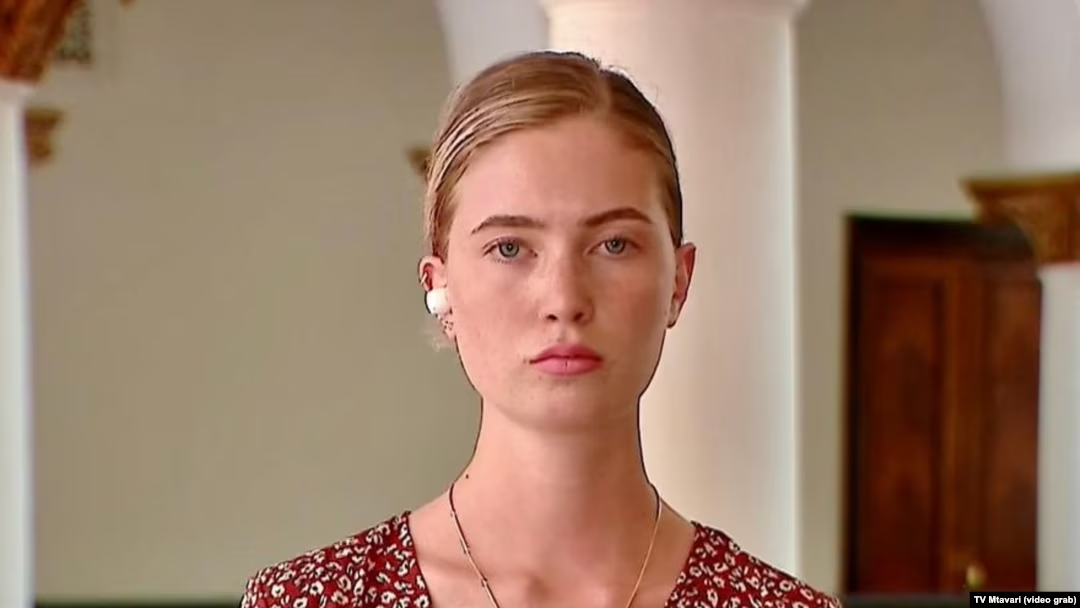
On October 1, 2025, a bailiff of the Tbilisi City Court confiscated the phone of Natali Jakhutashvili, a journalist for the TV company “Formula”, and returned it broken.
The incident occurred when the trial of opposition activist Gela Khasaia in the City Court ended. The imposition of imprisonment as a preventive measure for Gela Khasaia was followed by a confrontation in court. Court bailiffs physically assaulted the detainee’s friends. The journalist was trying to cover these processes.
According to her, after the bailiff confiscated her phone, she tried to return it for 15 minutes. In the end, the bailiff handed over the broken phone.
This is not the first time that media representatives have been targeted by violence in court. With the amendments to the Law on Common Courts, starting from June 30, it is forbidden to take photos/videos and make audio recordings in courtrooms, corridors or courtyards. After the new rule came into effect, media outlets applied to the Council of Justice – a legally established body – for the right to record, but so far none of them have received a response.
Before the adoption of the repressive legislation, independent media representatives were illegally hindered in the performance of their professional duties in court buildings. Since the amendment, the bailiff’s office has been using disproportionate and unjustified force, including against the media, to enforce the repressive legislation.