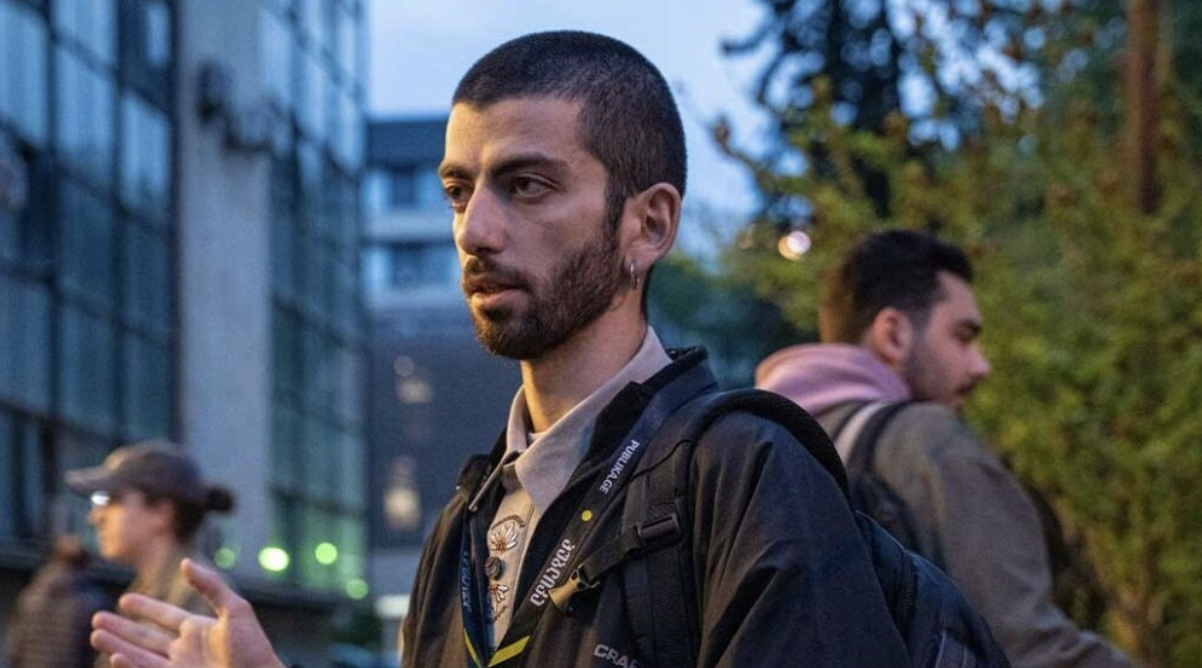
The Parliament has denied one-time special accreditation to Mindia Gabadze, a photojournalist for the online media outlet “Publika.”
In a corresponding application sent to the Chairman of the Parliament on June 16, 2026, “Publika” requested the issuance of a one-time special accreditation for photojournalist Mindia Gabadze for the period of June 22–26, so that he could cover Irakli Kobakhidze presenting his report in Parliament.
A month earlier, on May 21, the Parliament also revoked the one-year accreditation of four “Publika” reporters, including Mindia Gabadze. At the time, the reason given was that the accredited journalists from “Publika” had not visited the legislative body for ten consecutive weeks.
For the same reason, the accreditation of four journalists from “Monitor” was also revoked.
The tightening of rules for the media in the legislative body began in February 2023. Several security measures were introduced in the Parliament, during which non-accredited journalists are banned from entering the Parliament. Also, it became possible to suspend a journalist’s accreditation based on a Member of Parliament’s request. Furthermore, from January 1, 2026, a new rule for issuing one-time special accreditation came into force, which also created additional barriers for journalists. All these measures have been repeatedly used against journalists.
On March 25, 2026, Monitor published an investigative report stating that they were unable to interview Member of the Georgian Parliament Zaal Dugladze because the Parliament refused to issue a special entry pass for their journalist.
“We were unable to go to the Parliament of Georgia and pose questions to a Member of Parliament. According to the new rules, before entering the Parliament, it is necessary to specify a concrete reason to obtain a special pass. When they learned that we wanted to record an interview with Zaal Dugladze, the Parliament refused to issue the pass,” the Monitor investigation states.
Monitor first applied to the Parliament for a special pass on February 17, and again on February 19. In both instances, the pass was denied. No explanation for the refusal was provided to the outlet.
A new rule for issuing one-day special accreditations came into effect on January 1, 2026. Under this rule, the Head of the Staff makes a decision regarding the issuance of special accreditation no later than five working days after receiving the application. This one-day special accreditation is a mechanism that allows journalists who do not hold permanent parliamentary accreditation to enter the Parliament building and carry out professional activities for a specific purpose. According to these special rules, an application must be submitted to the Speaker of the Parliament, specifying the exact reason for the request. Previously, no such requirement existed in the law.
The imposition of restrictions on journalists within the Parliament building by “Georgian Dream” began on February 6, 2023, when the initial media accreditation rules for the Parliament of Georgia were first approved.
From January 1, 2026, a new rule for issuing one-time special accreditation came into effect, according to which the head of the apparatus makes a decision on granting special accreditation no later than 5 working days from the submission of the application. The one-time special accreditation is a mechanism that allows journalists who do not hold parliamentary accreditation to enter the Parliament of Georgia and carry out their professional activities for a specific purpose.
Considering the operational nature of media work, this deadline may create practical difficulties for journalists in terms of timely coverage of ongoing events in Parliament. The issue gains additional significance in the context where the current regulations already set quantitative limits on accredited parliamentary journalists based on the type of media outlet. For example, for online publications, the maximum number of parliamentary accreditations is set at 4 journalists. This change negatively affects the efficiency of media work and creates additional barriers to accessing information in Parliament.
From the perspective of “Georgian Dream,” the imposition of additional restrictions on journalists in the Parliament building is related to the approval of the accreditation rules for media in the Parliament of Georgia on February 6, 2023. Among other provisions, the accreditation rules stipulate that video and photo recording of sessions is allowed only with the permission of the session chairperson, a journalist must stop an interview if the respondent refuses, and the head of the apparatus has the authority to restrict the access, movement, or placement of equipment of accredited journalists based on the “specificity of the event” or “security regime.” These criteria are not specified in the document, which creates a risk of broad discretion. Violations of the rules may result in suspension of accreditation for one to six months.
These regulations have been criticized by the Georgian Charter of Journalistic Ethics, which assesses that such norms negatively affect the ability to obtain and provide information to the public. Practice has shown that the media accreditation rules have been repeatedly used in the context of restricting the activities of independent journalists.
On May 22, 2025, a court hearing for politician Zurab “Girchi” Japaridze was held at Tbilisi City Court. The case has drawn significant public attention, and with it, strong interest from the media. Nevertheless, correspondents who arrived to cover the hearing and were carrying photo or video cameras were not allowed inside the court building. According to the journalists, the rules for entering the building had been changed without any prior notice.
Security personnel at the Tbilisi City Court did not provide an explanation for why the journalists were denied entry. Instead, they referred media representatives to the court’s press office, which did not respond to phone calls.
The issue of media representatives being denied access to court hearings and other public institutions appears to be becoming a recurring trend.

