On October 5, the Ministry of Internal Affairs stated that the October 4 gathering “aimed at overthrowing the government” and “soon acquired an unlawful character,” after which the ministry took “proportionate measures.” According to the agency, “based on yesterday’s events,” any gathering from October 5 will be considered a “continuation of an attempted overthrow” and the ministry will take appropriate measures “to protect public order and security.” In effect, this means that peaceful protesters may face legal prosecution simply for participating in the gathering. The statement came after the arrest of five organizers of the October 4 rally and a few hours before the announcement of a new rally by citizens and the Federalist Party.
Such rhetoric threatens both freedom of assembly and expression and freedom of the media. The wording used by the Ministry creates a vague legal framework, under which journalists’ coverage of protests or voicing critical positions may be perceived as support for an “attempted coup.” Such a statement creates a chilling effect and violates the activities of the media and the right of the public to freely receive and disseminate information, which contradicts fundamental rights guaranteed by both the Constitution of Georgia and international conventions.
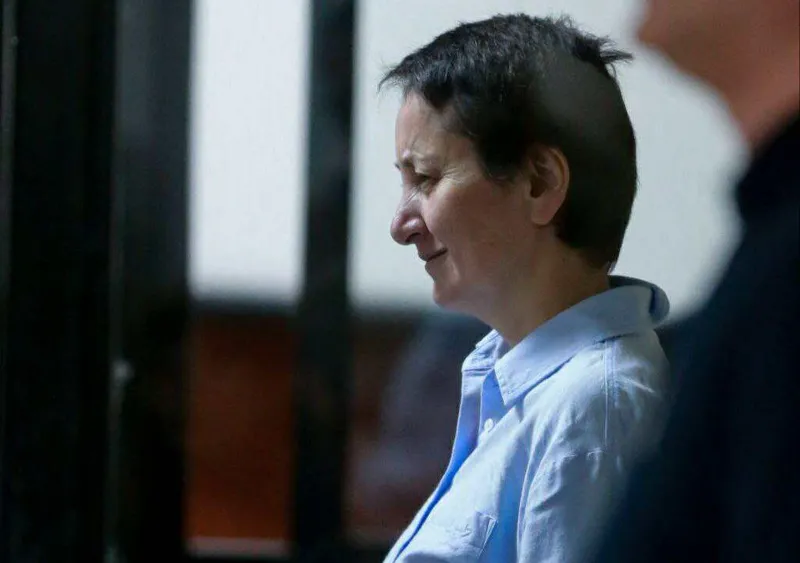
On October 10, 2025, the Georgian Dream referred to the founder of “Batumelebi”/“Netgazeti”, the prisoner Mzia Amaglobeli, as a perpetrator and “executor of the tasks of the deep state”. This statement by the Georgian Dream followed the presentation of the IPI-IMS World Press Freedom Hero Award to Mzia Amaglobeli.
“The decision to present the Hero Award to a criminal who deliberately attacked the police and with this action slapped not one specific law enforcement officer, but the entire system and the state, is another act of impudence, a mockery of Georgian society, a mockery of free speech and free media”, – said the press service of the Georgian Dream, Giorgi Grdzelishvili, at a briefing.
It is worth noting that this briefing was largely devoted to the topic of presenting the award to Mzia Amaglobeli. “The presentation of the Hero Award to Mzia Amaglobeli clearly shows the difficult situation of the international media, the international press…”, – said the spokesperson of the “Georgian Dream” at a special briefing.
On October 9, 2025, it became known that Mzia Amaglobeli, who was sentenced to 2 years in prison by the “Georgian Dream” court for slapping a police officer, is among the winners of the 2025 World Press Freedom Hero Award. The award is established by the International Press Institute IPI-IMS. A total of 7 journalists were named as the winners of the 2025 award. “This year’s award winners are examples of the threats facing journalists around the world, as authoritarianism takes hold, impunity prevails, and new challenges arise for freedom of expression,” – said the Executive Director of the IPI.
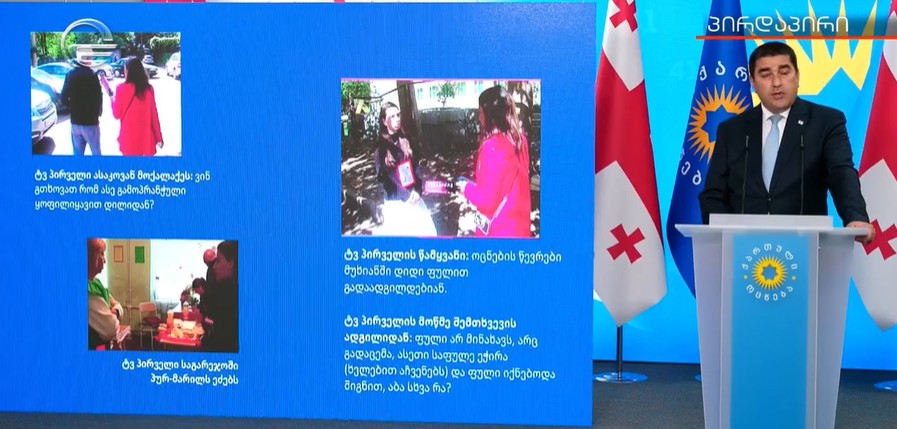
On October 4, 2025, the day of the local self-government elections (which were boycotted by a large part of the pro-Western opposition and the public), the Chairman of the Georgian Dream Parliament, Shalva Papuashvili, called some of the information disseminated by TV Pirveli from the polling stations “funny and curious” and referred to the TV company as “Khazaradze’s TV.”
“Today, all day long, Khazaradze’s TV, TV Pirveli, has been trying to stir up scandals, although I think they are making a mockery of themselves,” Shalva Papuashvili said at a special briefing. He then listed several TV Pirveli stories from the polling stations, which, in his opinion, were just funny. Among these materials were a table at a polling station and the alleged case of bribery. “I don’t know if Khazaradze is feeding his journalists now,” Papuashvili added, noting that there is nothing strange about someone taking care of feeding the election administration. After discussing the alleged bribery case, he said again: “Here, Khazaradze has sunk to such a level that not only did he violate journalistic ethics for all members of his television, but there are now funny curiosities in general” (timecode 5:52–8:16).
As a reminder, on October 4, a number of independent media outlets became targets of Shalva Papuashvili’s attacks for spreading information related to election violations. Among them were TOK2regions and Publika. More broadly, recently, Shalva Papuashvili’s attacks on the media and efforts to discredit them have become a worrying trend.
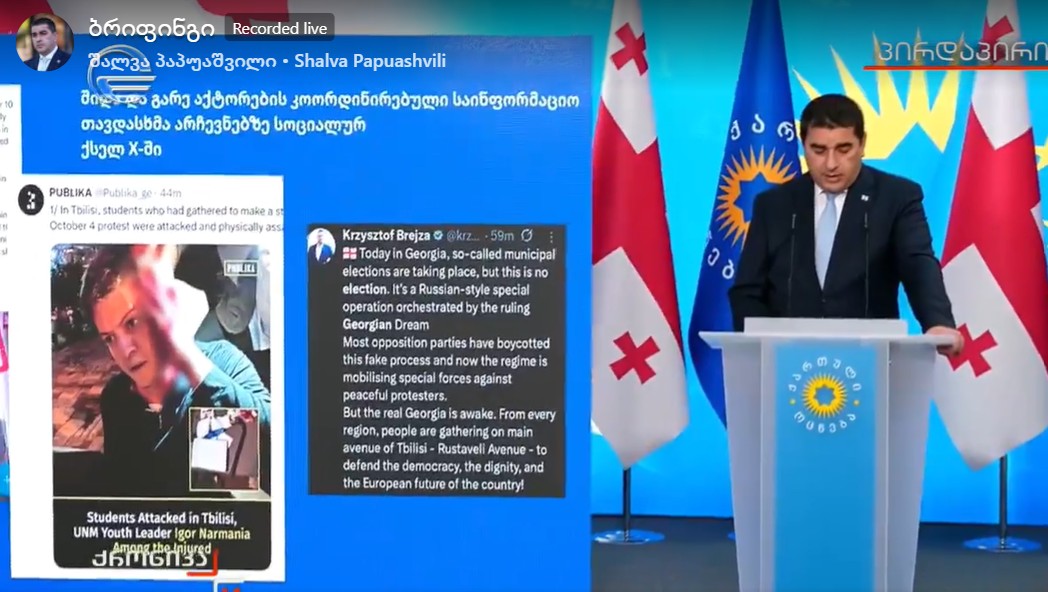
On October 4, 2025, the day of local elections (which were boycotted by a large part of the pro-Western opposition and the public), the Chairman of the Georgian Dream Parliament, Shalva Papuashvili, referred to the independent publication Publica as a “foreign-funded, propaganda” media outlet and accused it of a coordinated campaign of disinformation.
Shalva Papuashvili attacked Publica for its coverage of an attack on an opposition activist. (The day before the election, Igor Narmania, a young member of the United National Movement, was attacked and physically injured by several people in Tbilisi.) “Publica”, a foreign-funded propaganda media that spreads false information about Igor Narmania” (timecode: 3:55 – 4:37) – With this text, Shalva Papuashvili lists “Publica” among those actors who “act in a coordinated manner and spread disinformation, thereby interfering in the Georgian elections”.
Publica assessed Shalva Papuashvili’s next attack against them as incitement to hatred and violence. “We have already responded to Shalva Papuashvili’s attack once and we remind you again: “Publica” covers the current events in the country, including protest rallies, announcements, etc., within the framework of its journalistic activities. Shalva Papuashvili is trying to put pressure on our editorial independence, “Incites hatred and violence against us. If anything happens to any of our journalists, Papuashvili will be responsible,” – the editor of the publication Lika Zakashvili responded to Shalva Papuashvili with this post.
Recently, “Publica” has repeatedly become the target of Shalva Papuashvili’s attacks. For example, on May 19, 2025, Papuashvili attacked “Publica” for spreading information about MP Mariam Lashkh. Earlier, on February 1, he accused it of inciting to commit a criminal offense for spreading information about the rally.
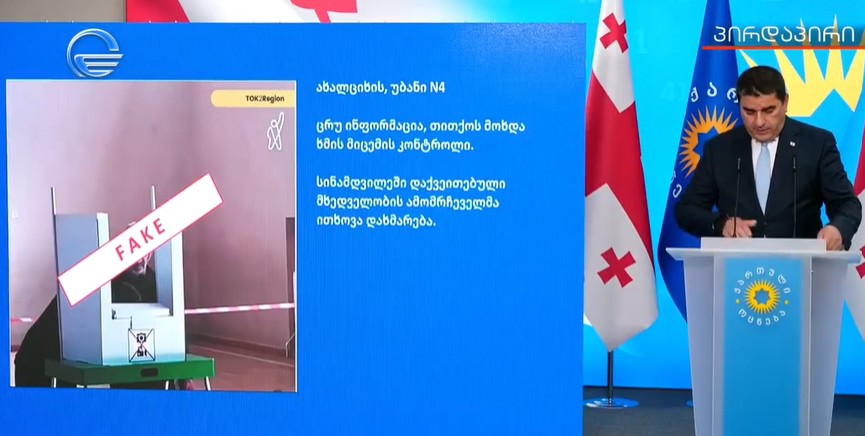
On October 4, 2025, the day of local elections (which were boycotted by much of the pro-Western opposition and the public), Georgian Dream Parliamentary Speaker Shalva Papuashvili accused the independent studio TOK2region of spreading disinformation and referred to it as “partisan media.” Papuashvili’s statement followed a video released by TOK2region from the 4th polling station in Akhaltsikhe, showing two voters in a single polling booth.
The Georgian Dream parliamentary speaker claimed that one of the voters actually needed assistance from the other due to vision problems. “Akhaltsikhe, precinct 4, where disinformation was also spread by partisan media claiming that voting control had taken place. In fact, the case concerned a voter with impaired vision, who asked for help and was assisted while filling out the ballot,” said Papuashvili, with TOK2region footage in the background labeled FAKE [timecode: 1:11–1:41].
Following Papuashvili’s statement, TOK2region released the full video footage, which shows that the voter did not ask for help. On the contrary, after the precinct commission chairman noticed that the media was recording the incident, he issued a warning to the voters. “The accusations that Shalva Papuashvili himself is spreading about our media—calling the independent editorial office ‘party media’ and accusing it of distributing content that TOK2region never published—are, in our view, yet another attack on our outlet,” TOK2region said in a statement.
Shalva Papuashvili’s attacks on independent media and efforts to discredit them have long been a persistent trend. The CMIS incident archive contains more than 10 documented cases of media attacks by the Chairman of the Georgian Dream Parliament. Independent and critical media were also a particular target of Papuashvili on October 4.
TV Pirveli cameraman Niko Kokaia was injured twice while covering the October 4, 2025 rally. The first incident, as the TV company reports, occurred on Atoneli Street, near the President’s Residence. Kokaia became incapacitated after the Special Tasks Department fired gas canisters. He required emergency medical assistance.
The second incident occurred on Orbeliani Square. According to the TV company, the cameraman was allegedly hit in the leg by a gas canister.
On October 4, 2025, while covering a protest rally in Tbilisi, Radio Liberty journalist Giorgi Diasamidze was physically and verbally assaulted by police.
In a video released by the outlet, Diasamidze can be heard telling a law enforcement officer that he is a journalist and asking why his work is being obstructed. Despite showing his press credentials, he was still targeted and attacked by the officer.
A tear gas capsule was allegedly fired at the TV Pirveli camera crew, journalist Irakli Bakhtadze, and his cameraman. The incident occurred while they were broadcasting live from the Presidential Palace on Orbeliani Square.
In the video footage released by the TV company, the sound of tear gas being fired and capsule exploding capsule can be heard in the area where the TV Pirveli camera crew was working. According to the Charter of Journalistic Ethics, the capsule hit the journalist’s helmet. At that time, the protesters had already left the surrounding area. There was no prior warning before the shots were fired. The journalist and cameraman were not injured.
On October 4, 2025, during a large-scale protest in Tbilisi, two criminal police officers attempted to interfere with Studio Monitor journalist Keti Tutberidze’s work and seize her phone.
The incident occurred when the journalist was trying to film the arrest of citizens. “Squad units rushed to Orbeliani Square to arrest two citizens, one of whom was Irakli Tsulaia. “I was filming and two criminal police officers rushed at me, screaming, grabbing my hand and trying to take my phone,” Tutberidze wrote in a post.
On October 4, 2025, on the day of the local government elections (which were boycotted by a large part of the pro-Western opposition), agitators from the Georgian Dream, Nato Gogelia, verbally confronted a journalist from TV Pirveli at one of the polling stations in Batumi. They first tried to prevent him from filming by covering his camera with their hands, and then cursed at the journalist.
Their irritation followed the journalist’s attempt to find out why they were standing at the polling station with lists and why they were registering voters.