According to Achara Times, Sulkhan Meskhidze, the founder and journalist of the online publication, became the target of aggression while covering the election for the head of the Adjara branch of the Union of the Blind.
The publication reports that the incident occurred in the courtyard during the coverage of the election process. While he was performing his journalistic duties, an attempt was made to snatch and smash Meskhidze’s phone. According to the outlet, police officers present at the scene witnessed the aggression and the attempt to confiscate the journalist’s phone, but they failed to react.
Achara Times stated that they were unable to capture complete video footage of the incident, as the recording stopped during the struggle to prevent the mobile phone from being damaged. The publication further noted that representatives of the Union of the Blind also refused to allow journalists to enter the voting area to film the proceedings.
On May 7, in Khelvachauri, Sulkhan Meskhidze, the founder of Adjara Times, and Lela Dumbadze, a journalist for Batumelebi, were obstructed from performing their professional duties, allegedly by public officials. The individuals verbally abused the journalists. According to the journalists, there were also threats and attempts at physical retaliation.
The journalists were covering a meeting between the parents of prisoners of conscience and local residents.
According to Batumelebi, among the aggressive individuals was Jumber (Genadi) Diasamidze, the deputy director of the Khelvachauri Municipality Sanitation and Utility Service, who is the cousin of Khelvachauri Mayor Zaza Diasamidze.
“The Charter of Journalistic Ethics calls on the Ministry of Internal Affairs to immediately investigate the obstruction of journalists Sulkhan Meskhidze and Lela Dumbadze while performing their professional duties in Khelvachauri,” reads the statement released by the Georgian Charter of Journalistic Ethics.
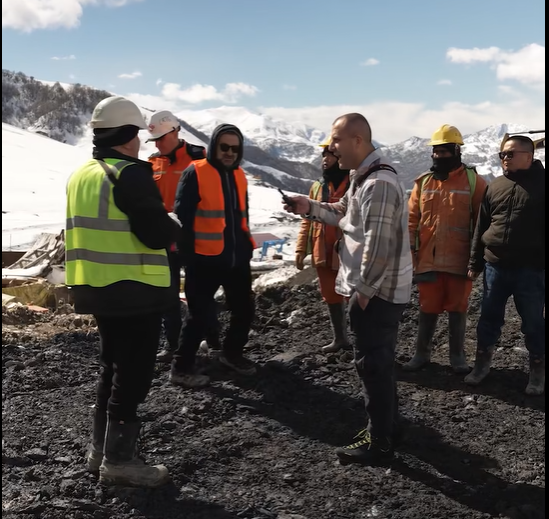
The film crew of the online publication Mtis Ambebi was unlawfully obstructed while working in the village of Tskere, in the Khada Gorge. Under threats of violence and death, the journalists were forced to stop filming and leave the village.
The incident occurred on April 1. The crew traveled to the gorge after reports emerged that a landslide, caused by the construction of the Kvesheti-Kobi road, had swept away several local graves.
The crew was on-site to document the unfolding events in the village. The journalists arrived just as the relocation of a young man’s body from the collapsed cemetery was about to begin. However, they were prevented from moving freely. According to the publication, representatives of a Chinese company, along with supervisors and employees of the Roads Department, insistently demanded that they stop filming. On the orders of their manager, the company’s hired workers physically obstructed the crew, prevented them from operating a drone, and threatened to smash their equipment.
According to Mtis Ambebi, the Shida Kartli Regional Prosecutor’s Office has launched an investigation into the attack and the unlawful interference with the journalists’ professional activities under Article 154, Part 2 of the Criminal Code of Georgia. This article pertains to the unlawful interference with a journalist’s professional duties through threats of violence or abuse of official position. The crime is punishable by a fine or imprisonment for up to two years.
The Georgian Charter of Journalistic Ethics expressed deep concern over the incident. In a statement, they noted that the attack bears clear signs of a criminal offense. The Charter calls on the Prosecutor’s Office to investigate the case quickly and effectively, and urges the Ministry of Internal Affairs to ensure a safe working environment for journalists.
Following the amendments passed in June 2025, which prohibited the media from taking photos, filming videos, or making audio recordings inside court buildings and courtyards, journalists have repeatedly applied to the High Council of Justice for filming permits, but to no avail. According to the law, the High Council of Justice is the body authorized to grant such permissions.
For instance, on March 2, Publika journalist Natia Amiranashvili wrote that since the ban took effect, the outlet’s journalists have submitted approximately 20 applications to the High Council of Justice. However, they have received no response, not even regarding whether their applications contained any formal errors. According to Amiranashvili, they received a reply only once—an notification stating that applications should not be sent via email but must be physically delivered to the High Council of Justice. She noted that they complied with this requirement, yet still received no further response. Such restrictions mean that the media is unable to photograph, film, or record court proceedings, including those of high public interest.
Since “Georgian Dream” passed this restrictive media law last year, the High Council of Justice has granted permission to film a court hearing in only one instance. The “Georgian Dream”-controlled television stations Imedi and the Public Broadcaster received the right to film the trial of businessman Giorgi Bachiashvili, who is considered a “personal prisoner” of Bidzina Ivanishvili.
On February 11, 2026, in Tbilisi, at the Paragraph Hotel, during an event organized by the Iranian Embassy to mark the 47th anniversary of the Islamic Revolution in Iran, unknown individuals obstructed a journalist from the online outlet “Publika” while performing their professional duties. A man dressed in traditional attire seized the journalist’s phone and threw it, then forced them to delete the recorded material. To ensure the journalist had complied, the individuals accessed their personal information without permission, including private photos, videos, and mobile applications. According to the outlet, the journalist’s press ID and personal identification were also confiscated, and photos were taken of both the journalist and the documents.
The journalist was covering the event and a protest performance by an Iranian activist woman. “Publika” suspects that representatives of the State Protection Service or the State Security Service may have witnessed the incident. However, since the individuals were in civilian clothing and gave vague answers to questions, the outlet was unable to determine their identities or official positions.
The Georgian Charter of Journalistic Ethics has called on the State Security Service, the Ministry of Internal Affairs, and the Ministry of Foreign Affairs to immediately investigate the obstruction of the “Publika” journalist in performing professional duties and to take appropriate measures to ensure a safe and dignified working environment for journalists.
While covering the protest on October 4, 2025, the online media outlet Mauwkebeli lost its drone. “The drone suddenly malfunctioned during filming, as happened with other media outlets,” a journalist from Mauwkebeli told MediaChecker.
Project 64 and Netgazeti also lost control of their drones that day.
At the October 4, 2025 rally, “Netgazeti” lost its drone. According to the information released by the publication, they lost their drone on Rustaveli Avenue. “Netgazeti’s” drones, as well as those of other media outlets, were allegedly specially shot down on Rustaveli Avenue, where we were trying to film the demonstration,” the publication said in the information released.
On the same day, “Project 64” and “Mauwkebeli” lost their drones too.
On October 4, 2025, during a large-scale protest in Tbilisi, two criminal police officers attempted to interfere with Studio Monitor journalist Keti Tutberidze’s work and seize her phone.
The incident occurred when the journalist was trying to film the arrest of citizens. “Squad units rushed to Orbeliani Square to arrest two citizens, one of whom was Irakli Tsulaia. “I was filming and two criminal police officers rushed at me, screaming, grabbing my hand and trying to take my phone,” Tutberidze wrote in a post.
On October 4, 2025, on the day of local elections (which were boycotted by a large part of the pro-Western opposition), the chairman of the polling station commission at Akhaltsikhe polling station No. 6 restricted journalist Nuka Stepnadze from filming at the polling station.
He told the journalist that he could only film for 10 minutes. According to the publication, the chairman of the commission only allowed the journalist to continue working after the district commission contacted him and explained the rules.
On October 4, 2025, a large-scale protest rally in Tbilisi witnessed numerous cases of verbal and physical attacks on media representatives, obstruction of their work, and damage to equipment. For the first time during this rally, some online media outlets were unable to operate their Drone cameras, likely due to an artificial disruption.
Publicly reported incidents:
- For Studio Monitor journalist Keti Tutberidze, two employees of the criminal police tried to interfere with her work and take away her phone. The incident occurred when the journalist was trying to film the arrest of citizens. “Special forces rushed to Orbeliani Square to arrest two citizens, one of whom is Irakli Tsulaia. “I was filming and two employees of the criminal police rushed at me with a roar, grabbed my hand and tried to take away my phone,” Tutberidze wrote in a post.
- A tear gas canister was allegedly fired at the camera crew of TV Pirveli – journalist Irakli Bakhtadze and his cameraman, reportedly hitting the helmet Bakhtadze was wearing. The incident occurred while they were broadcasting live from the Presidential Palace on Orbeliani Square. In the video footage released by the TV company, the sound of tear gas being fired and canisters falling and exploding can be heard. At that time, the protesters had already left the surrounding area. There was no prior warning before the shooting. The journalist and cameraman were not injured.
- Radio Liberty journalist Giorgi Diasamidze was physically and verbally assaulted by police. In a video released by the publication, the journalist can be heard explaining to the law enforcement officer that he is a journalist and asking why he is interfering with his work.
- Niko Kokaia, a cameraman for TV Pirveli, was injured twice while covering the events at the rally. The first incident, as the TV company reports, occurred on Atoneli Street, near the presidential residence. Kokaia became incapacitated after the Special Tasks Department fired tear gas canisters. He required emergency medical assistance.
- The second incident occurred at Orbeliani Square. According to information released by the TV company, the cameraman was allegedly hit in the leg by a gas capsule.
- According to information released by the Public Broadcaster, a protester allegedly threw an “unknown liquid” at the news program “Moambe,” injuring journalist Shalva Sumbadze and cameraman Nika Tsirekidze.
- According to Mediacheker, documentary photographer, Mariam Giunashvili, suffered burns after allegedly being pepper-sprayed. “They sprayed me [with pepper spray] from three different directions, from the front right in the face and from the sides all over my body. I got particularly bad burns on my hands and arms,” Giunashvili told Mediachecker.
- The publications “Project 64”, “Netgazeti” and “Mautskebeli” have lost their aerial cameras. The founder and journalist of “Project 64”, Giorgi Gogua, writes on social networks that the camera was filming near the parliament, when suddenly the camera started flying strangely, and he lost control. “I was only controlling the direction of the camera, but I could not control the trajectory of the drone. The last shot, before the signal was lost, is somewhere from Rustaveli to Mtatsminda. The flight history on the map shows that the drone flew towards the airport.”
According to information disseminated by “Netgazeti”, they lost their drone on Rustaveli Avenue. “Netgazeti’s” drones, as well as those of other media outlets, were allegedly specially shot down on Rustaveli Avenue, where we were trying to film a demonstration,” the publication said in the information.
According to information, the publication “Mautskebeli” also lost its drone. During filming, the drone suddenly malfunctioned, like other media outlets,” a journalist from “Maudereli” told MediaChecker.