Yellow Security Level in Parliament – Online Media Are Not Allowed in the Building

On November 26, the “yellow level” of security came into effect in the building of the Parliament of Georgia, which fully restricts online media from working in the Parliament. The restriction is linked to the speech of the “Georgian Dream” Prime Minister, Irakli Kobakhidze.

During the operation of the “yellow level” in Parliament, only journalists from TV broadcasters (no more than three groups from each broadcaster) and invited guests are allowed in the building.

The Parliament of Georgia approved the controversial restrictive rules for the media by Order N1/259/23 of September 4, 2023.

“TV Pirveli” journalist had their mobile phone confiscated in court

In November, at the Zugdidi District Court, a “TV Pirveli” journalist had their mobile phone confiscated. According to the television company, the journalist was only allowed to attend the court hearing after the court’s security service sealed their phone. “As an alternative, they were only offered paper and a pen,” stated TV Pirveli.

On June 30, 2025, amendments to the Law on Common Courts came into effect, significantly restricting media rights. Specifically:

  • Photography, video recording, and audio recording were prohibited inside court buildings, courtrooms, and courtyards;
  • The previous provision that prohibited confiscating personal items, including phones, computers, or other devices capable of recording audio or video, was repealed.

Following these changes, the media’s ability to freely cover important proceedings has been severely limited, including cases such as the trial of Mzia Amaghlobeli, founder of Netgazeti, and other conscientious objectors.

It is noteworthy that recently, several individuals have reported instances of violence, as well as physical and verbal abuse by court ushers at the Tbilisi City Court. The legislative amendments adopted on June 30 now further restrict the media’s ability to report on such unlawful actions within the justice system.

“TV Pirveli” journalist Giorgi Mamniashvili was fined 3,000 GEL by a judge

“TV Pirveli” journalist Giorgi Mamniashvili, who was accused by the Ministry of Internal Affairs of minor hooliganism and disobeying a lawful police order, was fined 3,000 GEL by Judge Zviad Tsekvava.

Mamniashvili was detained on November 22 while covering a protest. According to a police officer witness, Mamniashvili allegedly insulted and verbally abused them at the time of his arrest. However, in a video released by “TV Pirveli,” which Mamniashvili himself recorded, it is clear that the journalist was explaining to the police that he was performing his professional duties. According to the television company, footage retrieved from Mamniashvili’s phone confirms that he did not use any offensive language.

Mamniashvili’s lawyer stated that after the arrest, the journalist was subjected to degrading and humiliating treatment at the Dighomi pre-trial detention facility. Specifically, for several hours, his hands were cuffed behind his back, he was fully stripped, and forced to perform so-called “squats.”

The international press freedom organization Reporters Without Borders (RSF), together with the Center for Media, Information and Social Research(CMIS), released a review of the media environment in Georgia, noting that “these arrests reflect how Georgia has become a country where nearly 50 incidents against independent media outlets are recorded every month.”

TV Pirveli journalist Giorgi Mamniashvili was detained while carrying out his professional duties

On November 22, during a protest in Tbilisi, near Ingorokva Street, “TV Pirveli” journalist Giorgi Mamniashvili was detained. According to the television company, the journalist was performing his professional duties at the time of his arrest and was covering the protest. For several hours, the “TV Pirveli” newsroom was unable to get in touch with him.

At the moment of his detention, Mamniashvili was filming the police arresting other protesters on his mobile phone and sending the footage to the newsroom, when officers attempted to seize his phone. Shortly after, they ordered his arrest. In the video recorded by Mamniashvili, he can be heard telling the police that he is a journalist and is carrying out his professional duties.

According to the journalist’s lawyer, after the arrest, Mamniashvili was treated in a degrading and humiliating manner at the Dighomi pre-trial detention facility. Specifically, for several hours, his hands were cuffed behind his back, he was fully stripped, and forced to perform so-called “squats.”

Deputy Minister of Internal Affairs Aleksandre Darakhvelidze described the practice of strip-searching detainees upon admission to the detention facility as “a required procedure to document any possible injuries.” Public Defender Levan Ioseliani, however, calls the strip-searching of detainees “degrading and humiliating treatment.”

“The case of Giorgi Mamniashvili is a clear example of the repressive policies of Georgian Dream, aimed at restricting independent media and silencing critical voices,” the Media Advocacy Coalition stated.

The Penitentiary Service discredits “TV Pirveli” and “Formula”

On November 16, the Penitentiary Service released a public statement accusing the media outlets TV Pirveli and Formula of disseminating false information. The agency responded to stories circulated in the media, where prisoners spoke about the unbearable conditions in the prison, and their family members asked the Public Defender (Ombudsman) to start an urgent monitoring of the penitentiary system. They also demanded that the Ombudsman establish how many medical personnel serve the Gldani Prison and who is responsible for the spoiled food brought into the facility.

The Penitentiary Service responded to the prisoners’ accusations with a statement, noting that such problems do not exist in the system.

On November 15, the agency also dismissed as false a story aired on TV Pirveli’s Saturday program, in which a prisoner of conscience, Rezo Kiknadze, described the situation in the system in a letter.

This is not the first time that “Georgian Dream” and the institutions under its influence have attempted to discredit critical and independent media outlets.

The Parliament suspended the accreditation of a journalist from the TV “Formula” for a period of one month

On November 12, Tiko Eradze released a video filmed in the Parliament’s Plenary Hall, where she recorded “Georgian Dream” MP Eka Chichinadze listening to a video recording on her phone from the lodge designated for journalists. Shortly after the video was published, Tiko Eradze herself posted on Facebook, expressing her assumption that her accreditation would be suspended.

On November 13, the journalist was informed by a letter from the Head of the Parliament Apparatus that her accreditation had been suspended for a period of one month. The letter explained the grounds for the suspension: “You filmed the mobile phone screen of Member of Parliament Eka Chichinadze from the location designated for the media without permission.”

The restriction of journalists’ activities in the Parliament building by “Georgian Dream” is linked to the approval of the Rules of Accreditation for Media in the Parliament of Georgia on February 6, 2023. The new regulations included restrictions such as a ban on filming without prior permission, the journalist’s obligation to stop an interview if a Member of Parliament refuses, and the requirement that a journalist must not film a Member of Parliament’s phone or other electronic device screen without their consent in a way that allows the information or image on it to be perceived. These changes drew criticism from the Georgian Charter of Journalistic Ethics, which stated that such regulations made it impossible to obtain and deliver information to the public.

This is not the first time that the Parliament has used the media accreditation rules against representatives of independent media.

The Azerbaijani journalist, Afghan Sadygov, was sentenced to prison for the second time under the pretext of blocking a road

On November 12, 2025, Afghan Sadygov, an Azerbaijani journalist residing in Georgia, was sentenced to administrative imprisonment for the second time under the pretext of blocking a road—he will spend 7 days in prison. He is accused of blocking the road on October 19-21, 2025. Afghan Sadygov had already been imprisoned once on the same charge, having been sentenced to 14 days of administrative imprisonment. At that time, the exiled journalist was accused of blocking the road on October 18.

According to the “Social Justice Center,” the organization defending Sadygov’s interests, at the time of Afghan Sadygov’s first detention, the Ministry of Internal Affairs (MIA) already knew that the journalist would stand on the roadway during the protest on subsequent days, but did not merge the cases: “This circumstance once again indicates that the MIA intentionally did not appeal to the court regarding the remaining days, so that the court would have the opportunity to apply administrative imprisonment against Afghan Sadygov twice. It is obvious that the MIA is trying to make an example of an activist actively involved in the protests by punishing him through the court.”

Since October 19, 2025, after the “Georgian Dream” parliament adopted another set of repressive changes under an accelerated procedure, 13 media representatives have been detained for participating in, and in some cases covering, the ongoing protest on Rustaveli Avenue in Tbilisi. Administrative imprisonment was applied to most of them.

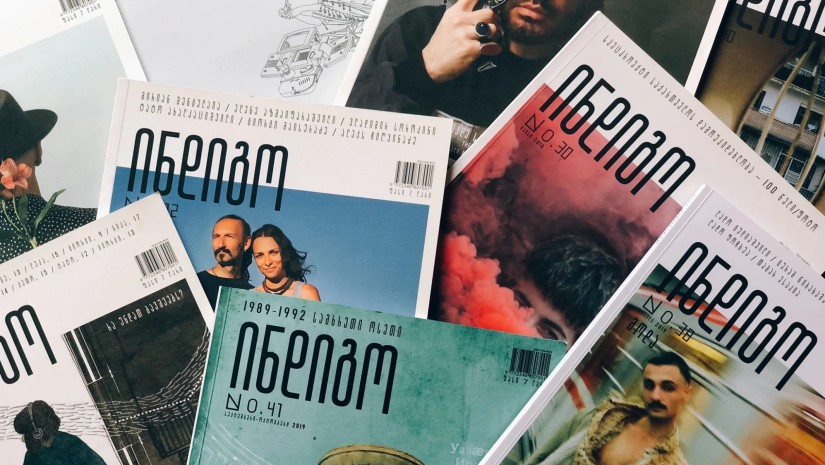
The Anti-Corruption Bureau is requesting information about grants from the publication “Indigo”

On November 11, 2025, the publication “Indigo” released a statement from which it became clear that the Anti-Corruption Bureau had initiated proceedings against them based on the so-called Law on Grants adopted by “Georgian Dream.” “Since our entire activity is based on open communication and only your trust, we want you to know this news as well. Obviously, we continue and serve the mission that created us—we continue working for free speech and expression, for free thoughts and ideas,” the publication writes.

The amendments to the “Law on Grants” are one of the repressive changes adopted by the “Georgian Dream” parliament in recent months to restrict the media. The law came into force in April. These amendments prohibited the issuance of foreign grants without the permission of the government. A grant received without consent leads to a fine equal to double the amount of the grant received.

The Anti-Corruption Bureau carries out the monitoring of the issuance and receipt of grants. This agency has already initiated proceedings against several media outlets based on this law, including: “Project 64,” the investigative media “iFact,” the publication “Mountain News,” GMC, which manages the publications “Realpolitika” and “Flangvis Detector” (Waste Detector), Georgian Media Group, and also the organization working on media rights, the “Georgian Charter of Journalistic Ethics.”

In addition to media outlets, the Anti-Corruption Bureau is requesting information about grants from civil and non-governmental organizations as well; in total, the agency’s letter has been received by more than 60 organizations, including member organizations of the “Media Advocacy Coalition.”

“Georgian Dream” adopted laws restricting independent media

The “Georgian Dream” parliament adopted new, restrictive laws against independent and critical media through an accelerated procedure. These are the “Foreign Agents Registration Act” [FARA] and amendments to the “Law on Broadcasting” and the “Law on Grants.” These laws were adopted against a background of repression and violence taking place against activists and the media.

What the Restrictive Laws Entail:

Amendment to the Law “On Grants”

On April 16, 2025, “Georgian Dream” adopted the amendment to the “Law on Grants” in the third reading. According to the amendments:

  • The grant provider (donor) must apply to the Government of Georgia to receive consent for the issuance of a grant;
  • The grant recipient, if receiving a grant without consent, will be fined double the amount of the grant;
  • The Anti-Corruption Bureau is granted additional powers, such as—the right to request a financial report from a person, as well as the right to question a physical person;
  • The Anti-Corruption Bureau will be able to request “special category personal data” from public institutions, physical persons, and legal entities.

Non-governmental organizations responded to the amendment to the “Law on Grants” with a joint statement. “This law, by its essence and expected result, is an act of persecution against the people and aims to leave citizens face-to-face with the ruling party’s punitive system and prohibit international society’s support for them,” states the NGO declaration.

“Foreign Agents Registration Act” [FARA]

On April 1, 2025, the “Georgian Dream” parliament approved the “Foreign Agents Registration Act” [FARA]. The new law introduces the term “agent of a foreign principal.” According to the law’s definition, this may include an employee of an information service who “acts in Georgia for the benefit or interest of a foreign principal.” According to the law’s requirement, the registration application must be submitted to the Anti-Corruption Bureau, which the law grants broad authority, including the right to request any information “based on national security and public interests.” Unlike other laws restricting media adopted by the “Georgian Dream” parliament, violation of FARA’s requirements will lead to both financial sanctions and up to five years of imprisonment. The adoption of FARA was assessed as a law restricting independent civil organizations and the media. “The ‘Georgian Dream,’ at first glance, appears to want to adopt the seemingly inappropriate FARA for controlling public and media organizations due to the strict criminal legal mechanisms provided for in the law and the selective and politically motivated application of the law at the individual level. Representatives of the ruling team openly point this out, including Irakli Kobakhidze, Shalva Papuashvili, and Mamuka Mdinaradze. In contrast to the American reality, the ruling team envisions and imagines that it will use the instrumentalization of the American-named law to damage civil society, without the firmly established guarantees of protecting independent courts and freedom of expression and association in Georgia,” states the declaration of the Social Justice Center.

Amendments to the Law “On Broadcasting”

On the very day FARA was adopted, April 1, 2025, “Georgian Dream” adopted amendments to the “Law on Broadcasting.” According to the amendment, foreign funding of broadcasters was completely prohibited, and the authority of the regulatory body, the National Communications Commission, was significantly increased, specifically bringing journalists’ professional activities into the sphere of regulation. According to the amendments introduced to the law, a broadcaster is prohibited from receiving direct or indirect funding and a foreign force is prohibited from purchasing services from a broadcaster, except for advertising or product placement. According to the amendment, broadcasters are prohibited from receiving direct or indirect funding in exchange for placing social advertising. According to the law, a foreign force is considered: a) a subject constituting a system of authority of a foreign state; b) a physical person who is not a citizen of Georgia; c) a legal entity that is not founded under the legislation of Georgia; d) an organizational unit or other type of association of persons that is founded under the law of a foreign state and/or international law. The amendment also introduces detailed regulations regarding television and radio broadcasting standards, including due accuracy of fact and the right of reply. Additionally, regulations are added concerning the fairness and impartiality of fact, the inviolability of private life, the obtaining and transmission of information using covert methods, the coverage of armed conflict, accidents and other emergency situations, and specific issues regarding the protection of minors.

“Transparency International Georgia” declares that these laws threaten the existence of critically-minded independent media.

Along with these laws, since 2024, the Law “On Transparency of Foreign Influence,” also known as the “Russian Law,” has been in effect in Georgia, which “Georgian Dream” adopted last year despite widespread public opposition and international criticism, and which aims to register non-governmental and media organizations whose income exceeds 20% from foreign organizations as organizations carrying out the interests of a “foreign force.”

While covering a protest rally, “Formula” journalist Liza Tsitsishvili was arrested and soon released

On November 5, 2025, during a protest rally in Tbilisi, the police arrested “Formula” TV company journalist Liza Tsitsishvili. At the time of the arrest, the journalist was performing her professional duties—interviewing rally participants. Video footage recorded by journalists present at the scene shows the police forcibly putting Liza Tsitsishvili into a car. The voices of other journalists can be heard in the video—they tell the police that Liza Tsitsishvili is their colleague; the police reply, “We’ll figure it out.” Liza Tsitsishvili was released ten minutes after her arrest. She says they apologized to her.

This is the second instance in a short period where a journalist is first detained and then released with an apology. On October 24, “Publika” online publication journalist Basti Mgaloblishvili was arrested near her home and released only a few hours later. She was told they had mistaken her for someone else. This is also the second instance where a journalist was detained while performing her professional duties at a rally. Two days before this incident, on November 3, “Media Checker” journalist Ninia Kakabadze was arrested on her way home, despite having a press badge, covering the rally, and having photo and video evidence confirming this.

Since October 19, 2025, after the “Georgian Dream” parliament adopted another set of repressive changes through an accelerated procedure, a total of 12 media representatives have been arrested for participating in, and in some cases covering, the ongoing protest on Rustaveli Avenue in Tbilisi. Administrative imprisonment was applied to most of them.

The Georgian Charter of Journalistic Ethics calls the frequent detentions of journalists “show detentions aimed at intimidating journalists” and urges the Ministry of Internal Affairs (MIA) to stop the persecution and harassment of journalists, and to properly inform its employees of journalists’ rights and instruct them to protect and respect those rights before sending them on assignment.