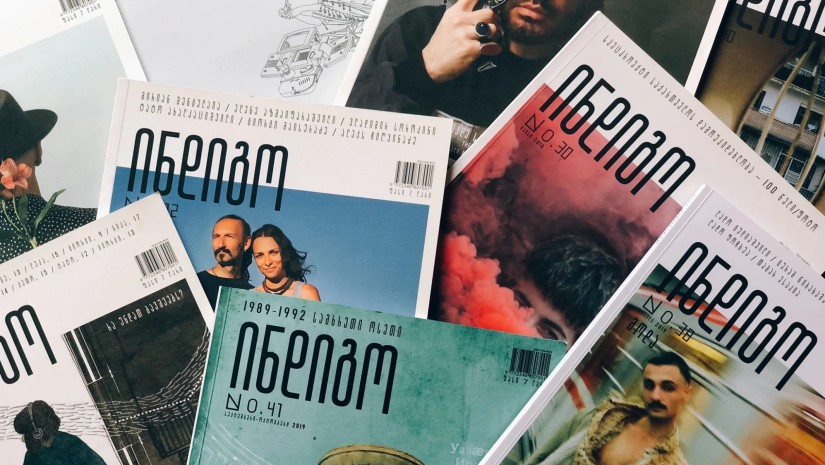
The Anti-Corruption Bureau is requesting information about grants from the publication “Indigo”

On November 11, 2025, the publication “Indigo” released a statement from which it became clear that the Anti-Corruption Bureau had initiated proceedings against them based on the so-called Law on Grants adopted by “Georgian Dream.” “Since our entire activity is based on open communication and only your trust, we want you to know this news as well. Obviously, we continue and serve the mission that created us—we continue working for free speech and expression, for free thoughts and ideas,” the publication writes.

The amendments to the “Law on Grants” are one of the repressive changes adopted by the “Georgian Dream” parliament in recent months to restrict the media. The law came into force in April. These amendments prohibited the issuance of foreign grants without the permission of the government. A grant received without consent leads to a fine equal to double the amount of the grant received.

The Anti-Corruption Bureau carries out the monitoring of the issuance and receipt of grants. This agency has already initiated proceedings against several media outlets based on this law, including: “Project 64,” the investigative media “iFact,” the publication “Mountain News,” GMC, which manages the publications “Realpolitika” and “Flangvis Detector” (Waste Detector), Georgian Media Group, and also the organization working on media rights, the “Georgian Charter of Journalistic Ethics.”

In addition to media outlets, the Anti-Corruption Bureau is requesting information about grants from civil and non-governmental organizations as well; in total, the agency’s letter has been received by more than 60 organizations, including member organizations of the “Media Advocacy Coalition.”

“Georgian Dream” adopted laws restricting independent media

The “Georgian Dream” parliament adopted new, restrictive laws against independent and critical media through an accelerated procedure. These are the “Foreign Agents Registration Act” [FARA] and amendments to the “Law on Broadcasting” and the “Law on Grants.” These laws were adopted against a background of repression and violence taking place against activists and the media.

What the Restrictive Laws Entail:

Amendment to the Law “On Grants”

On April 16, 2025, “Georgian Dream” adopted the amendment to the “Law on Grants” in the third reading. According to the amendments:

  • The grant provider (donor) must apply to the Government of Georgia to receive consent for the issuance of a grant;
  • The grant recipient, if receiving a grant without consent, will be fined double the amount of the grant;
  • The Anti-Corruption Bureau is granted additional powers, such as—the right to request a financial report from a person, as well as the right to question a physical person;
  • The Anti-Corruption Bureau will be able to request “special category personal data” from public institutions, physical persons, and legal entities.

Non-governmental organizations responded to the amendment to the “Law on Grants” with a joint statement. “This law, by its essence and expected result, is an act of persecution against the people and aims to leave citizens face-to-face with the ruling party’s punitive system and prohibit international society’s support for them,” states the NGO declaration.

“Foreign Agents Registration Act” [FARA]

On April 1, 2025, the “Georgian Dream” parliament approved the “Foreign Agents Registration Act” [FARA]. The new law introduces the term “agent of a foreign principal.” According to the law’s definition, this may include an employee of an information service who “acts in Georgia for the benefit or interest of a foreign principal.” According to the law’s requirement, the registration application must be submitted to the Anti-Corruption Bureau, which the law grants broad authority, including the right to request any information “based on national security and public interests.” Unlike other laws restricting media adopted by the “Georgian Dream” parliament, violation of FARA’s requirements will lead to both financial sanctions and up to five years of imprisonment. The adoption of FARA was assessed as a law restricting independent civil organizations and the media. “The ‘Georgian Dream,’ at first glance, appears to want to adopt the seemingly inappropriate FARA for controlling public and media organizations due to the strict criminal legal mechanisms provided for in the law and the selective and politically motivated application of the law at the individual level. Representatives of the ruling team openly point this out, including Irakli Kobakhidze, Shalva Papuashvili, and Mamuka Mdinaradze. In contrast to the American reality, the ruling team envisions and imagines that it will use the instrumentalization of the American-named law to damage civil society, without the firmly established guarantees of protecting independent courts and freedom of expression and association in Georgia,” states the declaration of the Social Justice Center.

Amendments to the Law “On Broadcasting”

On the very day FARA was adopted, April 1, 2025, “Georgian Dream” adopted amendments to the “Law on Broadcasting.” According to the amendment, foreign funding of broadcasters was completely prohibited, and the authority of the regulatory body, the National Communications Commission, was significantly increased, specifically bringing journalists’ professional activities into the sphere of regulation. According to the amendments introduced to the law, a broadcaster is prohibited from receiving direct or indirect funding and a foreign force is prohibited from purchasing services from a broadcaster, except for advertising or product placement. According to the amendment, broadcasters are prohibited from receiving direct or indirect funding in exchange for placing social advertising. According to the law, a foreign force is considered: a) a subject constituting a system of authority of a foreign state; b) a physical person who is not a citizen of Georgia; c) a legal entity that is not founded under the legislation of Georgia; d) an organizational unit or other type of association of persons that is founded under the law of a foreign state and/or international law. The amendment also introduces detailed regulations regarding television and radio broadcasting standards, including due accuracy of fact and the right of reply. Additionally, regulations are added concerning the fairness and impartiality of fact, the inviolability of private life, the obtaining and transmission of information using covert methods, the coverage of armed conflict, accidents and other emergency situations, and specific issues regarding the protection of minors.

“Transparency International Georgia” declares that these laws threaten the existence of critically-minded independent media.

Along with these laws, since 2024, the Law “On Transparency of Foreign Influence,” also known as the “Russian Law,” has been in effect in Georgia, which “Georgian Dream” adopted last year despite widespread public opposition and international criticism, and which aims to register non-governmental and media organizations whose income exceeds 20% from foreign organizations as organizations carrying out the interests of a “foreign force.”

New legislative changes further restrict the freedom of assembly and expression

On October 16, “Georgian Dream” passed another set of legislative changes in an accelerated procedure, within two days, which further tighten sanctions against citizens participating in protest demonstrations and significantly restrict the freedom of assembly and expression. Amendments have been introduced to both the Criminal Code of Georgia and the Code of Administrative Offenses.

According to the amendments, administrative detention of up to 15 days is now imposed without a fine for wearing masks at protests, possessing tear gas, or blocking roads. Furthermore, judges will no longer have the authority to impose fines as an administrative penalty in cases of administrative offenses, and demonstrators may face administrative detention of up to 60 days if:

  • Firearms, flammable substances, cold weapons, or pyrotechnics are found at the protest;
  • The police decide to disperse the assembly and the demonstrator does not comply.

Additionally, the changes also affected the Criminal Code, according to which the repeated commission of such actions will result in criminal liability and imprisonment of up to one year, and in each subsequent instance, up to two years.

Moreover, the amendments introduced criminal liability for repeated offenses against law enforcement officers. Specifically, if a citizen verbally insults a police officer multiple times or refuses to comply with their lawful order, this action will be punishable by imprisonment of up to one year. In cases of repetition, the punishment is stricter and may result in imprisonment of up to two years.

Non-governmental organizations have sharply criticized these changes, stating that they pose a threat to the fundamental principles of democracy. According to them, the new regulations not only restrict the right to peaceful protest but also create an atmosphere of fear and self-censorship in society, where citizens may be punished merely for expressing their opinions.

These changes are a continuation of the recent trend of repressive legislation adopted by “Georgian Dream.”

Communications Commission begins enforcing new media regulations

On October 9, 2025, the Communications Commission issued a written warning to the television broadcasters “Formula” and “Formula Multimedia”, as well as the radio broadcasters “Journalists’ Union Khalkis Khma”, “Radio-TV Nori” and “Systema Gama” and ordered them to cease receiving funding from foreign powers for violating the Law of Georgia “On Broadcasting”.

According to the Commission’s statement: “Based on the fact that the broadcasters have received the above-mentioned funding after the law was amended and funding from foreign powers was prohibited, and the funding cannot be used in exceptional cases specified by law (commercial advertising, teleshopping, sponsorship or product placement in the program)”, the Commission considered the broadcasters to be violators of the law.

This is the first precedent for the enforcement of the law, which concerns the new regulation included in the Law on Broadcasting, which prohibits direct or indirect funding of a broadcaster from a foreign power from April 1, 2025. Since the date of adoption, the amendments have caused public discussion and criticism, in particular, assessments that the new norm may become a tool for restricting the financial and editorial freedom of independent media. During the session, representatives of radio broadcasters noted that without the aforementioned funding, they may have to stop broadcasting.

MIA statement threatens freedom of assembly and expression

On October 5, the Ministry of Internal Affairs stated that the October 4 gathering “aimed at overthrowing the government” and “soon acquired an unlawful character,” after which the ministry took “proportionate measures.” According to the agency, “based on yesterday’s events,” any gathering from October 5 will be considered a “continuation of an attempted overthrow” and the ministry will take appropriate measures “to protect public order and security.” In effect, this means that peaceful protesters may face legal prosecution simply for participating in the gathering. The statement came after the arrest of five organizers of the October 4 rally and a few hours before the announcement of a new rally by citizens and the Federalist Party.

Such rhetoric threatens both freedom of assembly and expression and freedom of the media. The wording used by the Ministry creates a vague legal framework, under which journalists’ coverage of protests or voicing critical positions may be perceived as support for an “attempted coup.” Such a statement creates a chilling effect and violates the activities of the media and the right of the public to freely receive and disseminate information, which contradicts fundamental rights guaranteed by both the Constitution of Georgia and international conventions.

Journalist from Samkhretis Karibche banned from filming at Akhaltsikhe polling station No. 6

On October 4, 2025, on the day of local elections (which were boycotted by a large part of the pro-Western opposition), the chairman of the polling station commission at Akhaltsikhe polling station No. 6 restricted journalist Nuka Stepnadze from filming at the polling station.

He told the journalist that he could only film for 10 minutes. According to the publication, the chairman of the commission only allowed the journalist to continue working after the district commission contacted him and explained the rules.

Multiple cases of obstruction, threats, and physical confrontations against journalists during the October 4 elections

On October 4, 2025, during the local government elections (which the opposition and a large part of society consider illegitimate), numerous cases of obstruction of work, threats, and verbal and physical abuse against media representatives were recorded.

Publicly reported incidents:

  • Verbal attack on journalists
  1. Kakha Kaladze, the candidate for mayor of Tbilisi from the Georgian Dream, called journalists “impudent”. The incident took place at the 64th polling station in Tbilisi. After voting, Kakha Kaladze was talking about the protection of freedom of speech and expression in the country. A “Formula” journalist asked him what this meant, to which he replied – “There is some politeness, there is ethics, I understand that you have neither one nor the other.”
  2. The president of the Georgian Dream, Mikheil Kavelashvili, called TV Pirveli journalist Ina Tsartsidze a “liar” and a representative of a “liar television.” “You, your bosses, are deceiving the youth, the society, that we are illegitimate,” Kavelashvili replied to the journalist, who was trying to get an answer from him whether US President Donald Trump had contacted him.
  3. Former Prime Minister of the Georgian Dream, Irakli Gharibashvili, called journalists from TV Pirveli and Formula “scoundrels” and “main fakers” at the 11th polling station in Tbilisi. His response followed questions from journalists about whether he himself was expecting to be arrested, since everyone around him is being detained.
  • Cases of interference with work of journalists were reported

4. At Akhaltsikhe polling station No. 6, the chairman of the precinct commission restricted journalist Nuka Stepnadze of the publication “Samkhretis Karibche” from filming at the polling station. He told the journalist that he could only film for 10 minutes. According to the publication, the chairman of the commission only allowed the journalist to continue working after the district commission contacted him and explained the rules.

5. In Batumi, at one of the polling stations, a journalist from “TV Pirveli” journalist, Nato Gogelia, was verbally confronted by agitators from the “Georgian Dream”. They first tried to prevent him from filming by covering his camera with their hands, and then cursed at the journalist. Their irritation followed the journalist’s attempt to find out why they were standing at the polling station with lists and why they were registering voters.

Anti-Corruption Bureau requests information from media to enforce repressive laws

Since May 2025, after the repressive laws came into force, the Anti-Corruption Bureau has requested large amounts of information from more than 60 non-governmental organizations, including several media outlets. The basis for this request is the Law on Grants. The Georgian Dream adopted an amendment to the Law on Grants on April 16, 2025. According to the amendments, the grantor (donor) must apply to the Government of Georgia for consent to issue a grant; the grantee, if receiving a grant without consent, will be fined double the amount of the grant.

On September 29, Razhden Kuprashvili’s bureau applied to the independent investigative journalism association iFact and GMC and requested information about grants, donors, financial transactions and contracts.

Previously, on September 26, Kuprashvili’s bureau sent a letter to the publication “Mountain News”.

“You are in a hurry to put us down. The answer is urgent! We will continue our work! “To create investigative films about government violations of laws, corruption, environmental destruction, and violations of fundamental human rights,” wrote Gela Mtivlishvili, founder and editor-in-chief of “Mountain News.”

On September 28, “Mountain Community” received a letter from the Anti-Corruption Bureau with the same demands. Nugzar Suaridze, the organization’s director, wrote about this on Facebook.

Project 64 also received a letter from the Anti-Corruption Bureau. “We have never faced a crisis of this magnitude, and this is not just a financial crisis,” said Giorgi Gogua, editor-in-chief of Project 64.

The Anti-Corruption Bureau also sent a letter to the Georgian Charter of Journalistic Ethics.

“The proceeding initiated by the Anti-Corruption Bureau is the first practical step under the new legislation to destroy a highly reputable organization, created through the great efforts of many good journalists,” — reads the statement of the Charter of Journalistic Ethics.

Heads of non-governmental organizations summoned for questioning

Leaders of prominent Georgian non-governmental organizations, including members of the Media Advocacy Coalition, have been summoned for questioning by the prosecutor’s office. The questioning is related to the so-called “mask case,” which the prosecutor’s office began investigating in February 2025 on charges of “sabotage, attempted sabotage under aggravating circumstances, and other similar crimes.” According to the organizations, the investigation is unfounded and aims to persecute, intimidate, and dismantle the civil sector.

Based on publicly available information, those summoned for questioning include: Tamta Mikeladze, head of the Social Justice Center; former and current directors of the International Society for Fair Elections and Democracy (ISFED), Nino Dolidze and Levan Natroshvili; Giorgi Mshvenieradze, head of Guardians of Democracy; Baia Pataraia, director of the organization Safar; and Aleko Tskitishvili, head of the Human Rights Center. They have stated on social media that they will agree to questioning only before a magistrate judge. All of them have already been questioned in court.

It should be noted that, in connection with the same case, at the prosecutor’s request, on August 27, 2025, seven organizations’ accounts were frozen: members of the Media Advocacy Coalition – Civil Society Foundation, ISFED, IDFI, GDI – as well as organizations working on human rights and anti-corruption – Guardians of Democracy, Safar, and the Social Justice Center.

The accounts of the member organizations of the “Media Advocacy Coalition” were frozen

The Georgian Prosecutor’s Office launched an investigation against non-governmental organizations, including member organizations of the “Media Advocacy Coalition,” on charges of “sabotage, attempted sabotage under aggravating circumstances, assistance in hostile activities to a foreign organization and an organization under foreign control, and mobilization of funds for activities directed against the constitutional order and foundations of national security of Georgia.”

On August 27, 2025, Tbilisi City Court satisfied the Prosecutor’s Office’s request and froze the bank accounts of these organizations.

Minutes after the Prosecutor’s Office released its statement, the pro-government TV company “Imedi” broadcast a story supporting the investigation, specifically using comments from civil sector representatives from pro-European rallies. The Prosecutor’s Office’s accusation charges the organizations with mobilizing funds to purchase special equipment (such as special gas masks, helmets, face coverings, medical masks, protective goggles) for participants of the pro-European rallies.

More than 50 civil society and media organizations expressed solidarity with the seized organizations.

“Taking punitive steps against Georgian non-governmental organizations, similar to the Russian authorities, confirms that the Ivanishvili government’s interest is the complete destruction of dissenting opinion and pro-European groups in Georgia,” the statement said.

Based on the request of the Prosecutor’s Office, the accounts of seven organizations were seized on August 27. These are: “Civil Society Foundation,” “International Society for Fair Elections and Democracy” (ISFED), “Institute for Development of Freedom of Information” (IDFI), “Guardians of Democracy,” “Georgian Democratic Initiative” (GDI), “Sapari,” and “Social Justice Center.” Among these, “Civil Society Foundation,” ISFED, IDFI, and GDI are members of the “Media Advocacy Coalition.”