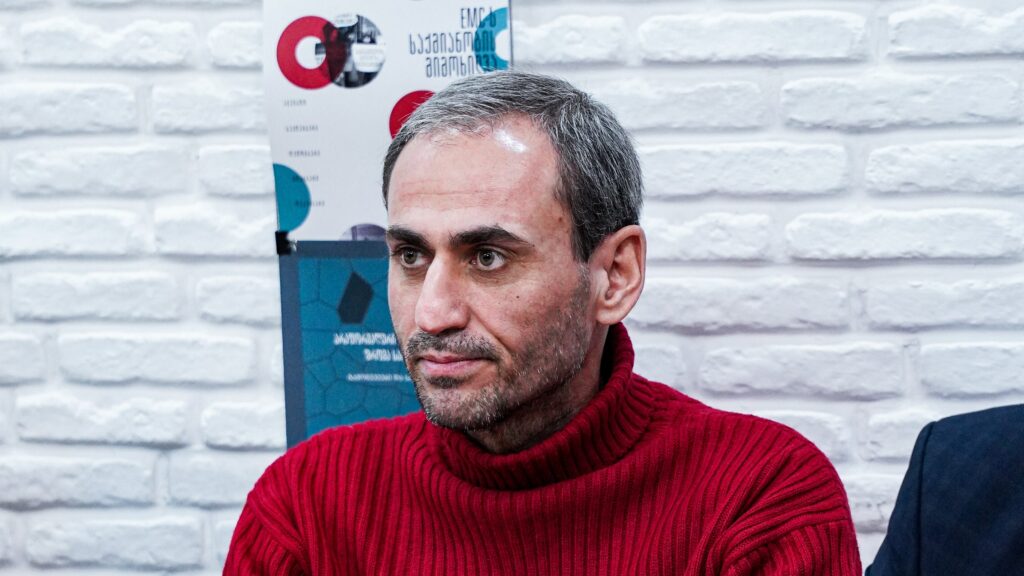
On November 12, 2025, Afghan Sadygov, an Azerbaijani journalist residing in Georgia, was sentenced to administrative imprisonment for the second time under the pretext of blocking a road—he will spend 7 days in prison. He is accused of blocking the road on October 19-21, 2025. Afghan Sadygov had already been imprisoned once on the same charge, having been sentenced to 14 days of administrative imprisonment. At that time, the exiled journalist was accused of blocking the road on October 18.
According to the “Social Justice Center,” the organization defending Sadygov’s interests, at the time of Afghan Sadygov’s first detention, the Ministry of Internal Affairs (MIA) already knew that the journalist would stand on the roadway during the protest on subsequent days, but did not merge the cases: “This circumstance once again indicates that the MIA intentionally did not appeal to the court regarding the remaining days, so that the court would have the opportunity to apply administrative imprisonment against Afghan Sadygov twice. It is obvious that the MIA is trying to make an example of an activist actively involved in the protests by punishing him through the court.”
Since October 19, 2025, after the “Georgian Dream” parliament adopted another set of repressive changes under an accelerated procedure, 13 media representatives have been detained for participating in, and in some cases covering, the ongoing protest on Rustaveli Avenue in Tbilisi. Administrative imprisonment was applied to most of them.
On October 24, 2025, the founder and director of TV Formula, Giorgi Liponava, was arrested for participating in a protest. He was sentenced to three days of administrative detention.
Giorgi Liponava, along with other detained citizens, including media representatives, is accused of blocking the road.
The Georgian Dream party has fast-tracked legislative amendments that significantly restrict freedom of assembly and expression. According to the amendments, administrative detention of up to 15 days, without the option of a fine, is imposed for wearing a mask at a rally, possessing tear gas, or blocking the road. In addition, judges will no longer have the right to impose fines as an administrative penalty in cases of administrative offenses.
The detention of journalists by the Georgian Dream party is a direct attack on freedom of the media and expression. “Under such conditions, the activities of independent media face serious threats, which significantly limits the right to information in a democratic society,” the Media Advocacy Coalition said in a statement.
On October 24, 2025, Zviad Kvaratskhelia, a writer, publisher, and editor-in-chief of Intellect, was arrested for participating in a protest. The court sentenced him to three days of administrative detention.
Zviad Kvaratskhelia, along with other detained citizens, including media representatives, is accused of blocking a road.
The Georgian Dream party has expedited legislative amendments that significantly restrict freedom of assembly and expression. According to the amendments, administrative detention of up to 15 days, without the option of a fine, is imposed for wearing a mask at a rally, possessing tear gas, or blocking a road. In addition, judges will no longer have the right to impose fines as an administrative penalty in cases of administrative offenses.
“The arrest of journalists by Georgian Dream is a direct attack on freedom of the media and expression. Under such conditions, the activities of independent media face serious threats, which significantly restricts the right of a democratic society to be informed,” the Media Advocacy Coalition said in a statement.
On October 25, 2025, TV company “Formula’s” cameraman Nika Pataraia was detained. The court sentenced Pataraia to 4 days of administrative detention for blocking the road.
A total of 7 journalists/cameramen have been detained for blocking the road, including 4 representatives of TV company “Formula.”
The new legislative changes adopted by “Georgian Dream” significantly restrict freedom of assembly and expression. Citizens and activists are also being arrested for participating in the pro-European protest.
On October 24, Publika journalist Basti Mgaloblishvili was arrested and released a few hours later.
According to Publika, Mgaloblishvili was told that he had been “mistaken for someone else” and was then released.
“They stopped a taxi near my house, dragged me out of the car like a terrorist. Two of them weren’t in uniform. Only the one in the car waiting for me was wearing one. They snatched my phone and locked me inside the vehicle. At the same time, they kept saying I wasn’t under arrest… They knew exactly who I was — this so-called ‘special operation’ was meant to intimidate me and pressure independent media,” Mgaloblishvili said after his release.
Similarly, several other journalists were arrested and sentenced to prison during protest demonstrations — including Formula TV reporters Vakho Sanaia, Keta Tsitskishvili, and Tsira Zhvania, as well as Georgian Public Broadcaster board member Lika Basialia-Shavgulidze and journalist Afgan Sadigov.
On October 21, 2025, journalist Vasil-Ivanov Chikovani was reportedly arrested for participating in a protest. According to media reports, his spouse was also detained. A judge imposed a fine of 5,000 GEL on him.
In the spring of 2025, Vasil-Ivanov Chikovani was dismissed from the Georgian Public Broadcaster due to his critical stance toward the broadcaster and his participation in protests.
New legislative changes introduced by the ruling party, Georgian Dream, have significantly restricted the freedoms of assembly and expression. Citizens and activists are being arrested for taking part in protests. In addition to Vasil-Ivanov Chikovani, Formula TV journalists Vakho Sanaia, Keta Tsitskishvili, and Tsira Zhvania were also detained. On October 22, Lika Basialia-Shavgulidze, a member of the Georgian Public Broadcaster Supervisory Board, was arrested. Azerbaijani journalist Afgan Sadigov was also detained for participating in protests.
The arrests of journalists by Georgian Dream have been widely criticized by both local and international organizations, which view them as an attack on media freedom and freedom of expression.
On October 22, 2025, Lika Basialia-Shavgulidze, a member of the Georgian Public Broadcaster Supervisory Board, was arrested at a protest.
Footage shows the journalist standing on the sidewalk, addressing the police. She was neither wearing a mask nor blocking the road.
Police used excessive force to detain Lika Basialia-Shavgulidze. Later, her lawyer reported that she sustained injuries to her neck during the arrest.
Lika Basialia-Shavgulidze is the fifth journalist to be detained since the ruling Georgian Dream party passed new restrictive legislative amendments in Parliament.
The Georgian Dream Parliament introduced several changes to laws that further limit the freedoms of assembly and expression. Over 80 people have been detained in the past few days under these changes.
The arrest of journalists by Georgian Dream is a direct attack on media freedom and freedom of expression. Under such conditions, the work of independent media faces serious threats, significantly restricting the public’s right to be informed, according to a statement by the Media Advocacy Coalition.
On Wednesday, October 22, Azerbaijani journalist Afgan Sadigov was detained at a protest for blocking the road.
Judge Zviad Tsekvava sentenced the journalist to 14 days of administrative imprisonment.
In recent days, journalists from the TV company “Formula” — Vakho Sanaia, Keta Tsitskishvili, and Tsira Zhvania — were detained on the grounds of blocking the road.
The Parliament of “Georgian Dream” passed amendments to the law that further restrict freedom of assembly and expression. Based on the amendment, more than 80 people have been detained in the past few days.
Both local and international organizations have reacted to the detention of journalists.
“The detention of journalists by ‘Georgian Dream’ is a direct attack on media and freedom of expression. Under such conditions, the work of independent media is under serious threat, which significantly limits the democratic society’s right to be informed,” states the Media Advocacy Coalition’s statement.
On Tuesday, October 21, Tsira Zhvania, a social media journalist for TV Company “Formula”, was detaned for blocking a road during a protest. According to the TV company, she was met by two police officers at her home.
The Tbilisi City Court sentenced the journalist to 10 days of administrative detention.
This is the third case when, based on the tightened legislation, journalists have been detained on the grounds of blocking a road during a protest. On October 19, Vakho Sanaia, a journalist and TV presenter for TV Company “Formula”, was arrested and sentenced to 6 days in prison. On October 20, Keta Tsitskishvili, a journalist for the same TV company, was arrested and sentenced to 5 days in prison. “The arrest of journalists by the Georgian Dream is a direct attack on the freedom of the media and expression. In such conditions, the activities of independent media are facing serious threats, which significantly restricts the right of a democratic society to be informed,” the Media Advocacy Coalition said in a statement.
On Monday, October 20, journalist and TV presenter Keta Tsitskishvili from the TV company Formula was detaned. According to media reports, she is accused of blocking a road. A day earlier, on October 19, journalist Vakho Sanaia was detaned on the same charge and sentenced to five days in prison.
The Media Advocacy Coalition condemned Tsitskishvili’s arrest, calling it an act of pressure and an attack on independent media.
“The arrest of journalists by Georgian Dream is a direct assault on the media and freedom of expression. Under such conditions, the work of independent media faces serious threats, severely limiting the public’s right to information in a democratic society,” the coalition said in a statement.