The Anti-Corruption Bureau is requesting information about grants from the publication “Indigo”

On November 11, 2025, the publication “Indigo” released a statement from which it became clear that the Anti-Corruption Bureau had initiated proceedings against them based on the so-called Law on Grants adopted by “Georgian Dream.” “Since our entire activity is based on open communication and only your trust, we want you to know this news as well. Obviously, we continue and serve the mission that created us—we continue working for free speech and expression, for free thoughts and ideas,” the publication writes.

The amendments to the “Law on Grants” are one of the repressive changes adopted by the “Georgian Dream” parliament in recent months to restrict the media. The law came into force in April. These amendments prohibited the issuance of foreign grants without the permission of the government. A grant received without consent leads to a fine equal to double the amount of the grant received.

The Anti-Corruption Bureau carries out the monitoring of the issuance and receipt of grants. This agency has already initiated proceedings against several media outlets based on this law, including: “Project 64,” the investigative media “iFact,” the publication “Mountain News,” GMC, which manages the publications “Realpolitika” and “Flangvis Detector” (Waste Detector), Georgian Media Group, and also the organization working on media rights, the “Georgian Charter of Journalistic Ethics.”

In addition to media outlets, the Anti-Corruption Bureau is requesting information about grants from civil and non-governmental organizations as well; in total, the agency’s letter has been received by more than 60 organizations, including member organizations of the “Media Advocacy Coalition.”

“Georgian Dream” adopted laws restricting independent media

The “Georgian Dream” parliament adopted new, restrictive laws against independent and critical media through an accelerated procedure. These are the “Foreign Agents Registration Act” [FARA] and amendments to the “Law on Broadcasting” and the “Law on Grants.” These laws were adopted against a background of repression and violence taking place against activists and the media.

What the Restrictive Laws Entail:

Amendment to the Law “On Grants”

On April 16, 2025, “Georgian Dream” adopted the amendment to the “Law on Grants” in the third reading. According to the amendments:

  • The grant provider (donor) must apply to the Government of Georgia to receive consent for the issuance of a grant;
  • The grant recipient, if receiving a grant without consent, will be fined double the amount of the grant;
  • The Anti-Corruption Bureau is granted additional powers, such as—the right to request a financial report from a person, as well as the right to question a physical person;
  • The Anti-Corruption Bureau will be able to request “special category personal data” from public institutions, physical persons, and legal entities.

Non-governmental organizations responded to the amendment to the “Law on Grants” with a joint statement. “This law, by its essence and expected result, is an act of persecution against the people and aims to leave citizens face-to-face with the ruling party’s punitive system and prohibit international society’s support for them,” states the NGO declaration.

“Foreign Agents Registration Act” [FARA]

On April 1, 2025, the “Georgian Dream” parliament approved the “Foreign Agents Registration Act” [FARA]. The new law introduces the term “agent of a foreign principal.” According to the law’s definition, this may include an employee of an information service who “acts in Georgia for the benefit or interest of a foreign principal.” According to the law’s requirement, the registration application must be submitted to the Anti-Corruption Bureau, which the law grants broad authority, including the right to request any information “based on national security and public interests.” Unlike other laws restricting media adopted by the “Georgian Dream” parliament, violation of FARA’s requirements will lead to both financial sanctions and up to five years of imprisonment. The adoption of FARA was assessed as a law restricting independent civil organizations and the media. “The ‘Georgian Dream,’ at first glance, appears to want to adopt the seemingly inappropriate FARA for controlling public and media organizations due to the strict criminal legal mechanisms provided for in the law and the selective and politically motivated application of the law at the individual level. Representatives of the ruling team openly point this out, including Irakli Kobakhidze, Shalva Papuashvili, and Mamuka Mdinaradze. In contrast to the American reality, the ruling team envisions and imagines that it will use the instrumentalization of the American-named law to damage civil society, without the firmly established guarantees of protecting independent courts and freedom of expression and association in Georgia,” states the declaration of the Social Justice Center.

Amendments to the Law “On Broadcasting”

On the very day FARA was adopted, April 1, 2025, “Georgian Dream” adopted amendments to the “Law on Broadcasting.” According to the amendment, foreign funding of broadcasters was completely prohibited, and the authority of the regulatory body, the National Communications Commission, was significantly increased, specifically bringing journalists’ professional activities into the sphere of regulation. According to the amendments introduced to the law, a broadcaster is prohibited from receiving direct or indirect funding and a foreign force is prohibited from purchasing services from a broadcaster, except for advertising or product placement. According to the amendment, broadcasters are prohibited from receiving direct or indirect funding in exchange for placing social advertising. According to the law, a foreign force is considered: a) a subject constituting a system of authority of a foreign state; b) a physical person who is not a citizen of Georgia; c) a legal entity that is not founded under the legislation of Georgia; d) an organizational unit or other type of association of persons that is founded under the law of a foreign state and/or international law. The amendment also introduces detailed regulations regarding television and radio broadcasting standards, including due accuracy of fact and the right of reply. Additionally, regulations are added concerning the fairness and impartiality of fact, the inviolability of private life, the obtaining and transmission of information using covert methods, the coverage of armed conflict, accidents and other emergency situations, and specific issues regarding the protection of minors.

“Transparency International Georgia” declares that these laws threaten the existence of critically-minded independent media.

Along with these laws, since 2024, the Law “On Transparency of Foreign Influence,” also known as the “Russian Law,” has been in effect in Georgia, which “Georgian Dream” adopted last year despite widespread public opposition and international criticism, and which aims to register non-governmental and media organizations whose income exceeds 20% from foreign organizations as organizations carrying out the interests of a “foreign force.”

“MediaChecker” journalist Ninia Kakabadze was arrested while covering a protest rally

On November 3, 2025, the police arrested Ninia Kakabadze, a journalist for the Media Platform “Media Checker” of the Georgian Charter of Journalistic Ethics. That day, the journalist was at the rally with a press identification badge; she was performing her professional duties. Ninia Kakabadze was arrested while returning home. She was taken to the building of the Ministry of Internal Affairs in Tbilisi. The journalist recounts that for a long time, she was not allowed to call her minor child. The journalist was released a few hours after the arrest. Ninia Kakabadze is accused of artificially blocking the road. The Tbilisi City Court started deliberation on her case on November 4, but postponed the hearing until November 12.

Since October 19, 2025, after the “Georgian Dream” parliament adopted another set of repressive changes through an accelerated procedure, 11 media representatives have been arrested for participating in, and in some cases covering, the ongoing protest on Rustaveli Avenue in Tbilisi. Administrative imprisonment was applied to most of them.

The Georgian Charter of Journalistic Ethics considers the arrest of Ninia Kakabadze and other journalists while performing their professional duties as an attempt to pressure independent media and suppress critical voices. The Charter demands the immediate cessation of administrative proceedings against its media platform “Media Checker’s” journalist, Ninia Kakabadze, and the annulment of the drawn-up administrative offense protocol.

TV Formula founder and director Giorgi Liponava arrested for participating in a protest

On October 24, 2025, the founder and director of TV Formula, Giorgi Liponava, was arrested for participating in a protest. He was sentenced to three days of administrative detention.

Giorgi Liponava, along with other detained citizens, including media representatives, is accused of blocking the road.

The Georgian Dream party has fast-tracked legislative amendments that significantly restrict freedom of assembly and expression. According to the amendments, administrative detention of up to 15 days, without the option of a fine, is imposed for wearing a mask at a rally, possessing tear gas, or blocking the road. In addition, judges will no longer have the right to impose fines as an administrative penalty in cases of administrative offenses.

The detention of journalists by the Georgian Dream party is a direct attack on freedom of the media and expression. “Under such conditions, the activities of independent media face serious threats, which significantly limits the right to information in a democratic society,” the Media Advocacy Coalition said in a statement.

Writer and host of one of TV Formula’s programs, Zviad Kvaratskhelia, was arrested for participating in a protest

On October 24, 2025, Zviad Kvaratskhelia, a writer, publisher, and editor-in-chief of Intellect, was arrested for participating in a protest. The court sentenced him to three days of administrative detention.

Zviad Kvaratskhelia, along with other detained citizens, including media representatives, is accused of blocking a road.

The Georgian Dream party has expedited legislative amendments that significantly restrict freedom of assembly and expression. According to the amendments, administrative detention of up to 15 days, without the option of a fine, is imposed for wearing a mask at a rally, possessing tear gas, or blocking a road. In addition, judges will no longer have the right to impose fines as an administrative penalty in cases of administrative offenses.

“The arrest of journalists by Georgian Dream is a direct attack on freedom of the media and expression. Under such conditions, the activities of independent media face serious threats, which significantly restricts the right of a democratic society to be informed,” the Media Advocacy Coalition said in a statement.

Another employee of TV “Formula,” Nika Pataraia was arrested

On October 25, 2025, TV company “Formula’s” cameraman Nika Pataraia was detained. The court sentenced Pataraia to 4 days of administrative detention for blocking the road.

A total of 7 journalists/cameramen have been detained for blocking the road, including 4 representatives of TV company “Formula.”

The new legislative changes adopted by “Georgian Dream” significantly restrict freedom of assembly and expression. Citizens and activists are also being arrested for participating in the pro-European protest.

Journalist Basti Mgaloblishvili from the online outlet Publika was arrested but released a few hours later

On October 24, Publika journalist Basti Mgaloblishvili was arrested and released a few hours later.

According to Publika, Mgaloblishvili was told that he had been “mistaken for someone else” and was then released.

“They stopped a taxi near my house, dragged me out of the car like a terrorist. Two of them weren’t in uniform. Only the one in the car waiting for me was wearing one. They snatched my phone and locked me inside the vehicle. At the same time, they kept saying I wasn’t under arrest… They knew exactly who I was — this so-called ‘special operation’ was meant to intimidate me and pressure independent media,” Mgaloblishvili said after his release.

Similarly, several other journalists were arrested and sentenced to prison during protest demonstrations — including Formula TV reporters Vakho Sanaia, Keta Tsitskishvili, and Tsira Zhvania, as well as Georgian Public Broadcaster board member Lika Basialia-Shavgulidze and journalist Afgan Sadigov.

Former Georgian Public Broadcaster journalist Vasil-Ivanov Chikovani was arrested for participating in a protest

On October 21, 2025, journalist Vasil-Ivanov Chikovani was reportedly arrested for participating in a protest. According to media reports, his spouse was also detained. A judge imposed a fine of 5,000 GEL on him.

In the spring of 2025, Vasil-Ivanov Chikovani was dismissed from the Georgian Public Broadcaster due to his critical stance toward the broadcaster and his participation in protests.

New legislative changes introduced by the ruling party, Georgian Dream, have significantly restricted the freedoms of assembly and expression. Citizens and activists are being arrested for taking part in protests. In addition to Vasil-Ivanov Chikovani, Formula TV journalists Vakho Sanaia, Keta Tsitskishvili, and Tsira Zhvania were also detained. On October 22, Lika Basialia-Shavgulidze, a member of the Georgian Public Broadcaster Supervisory Board, was arrested. Azerbaijani journalist Afgan Sadigov was also detained for participating in protests.

The arrests of journalists by Georgian Dream have been widely criticized by both local and international organizations, which view them as an attack on media freedom and freedom of expression.

Journalist Lika Basilaia-Shavgulidze, a member of the Board of Trustees of the Georgian Public Broadcaster, was arrested for participating in a protest

On October 22, 2025, Lika Basialia-Shavgulidze, a member of the Georgian Public Broadcaster Supervisory Board, was arrested at a protest.

Footage shows the journalist standing on the sidewalk, addressing the police. She was neither wearing a mask nor blocking the road.

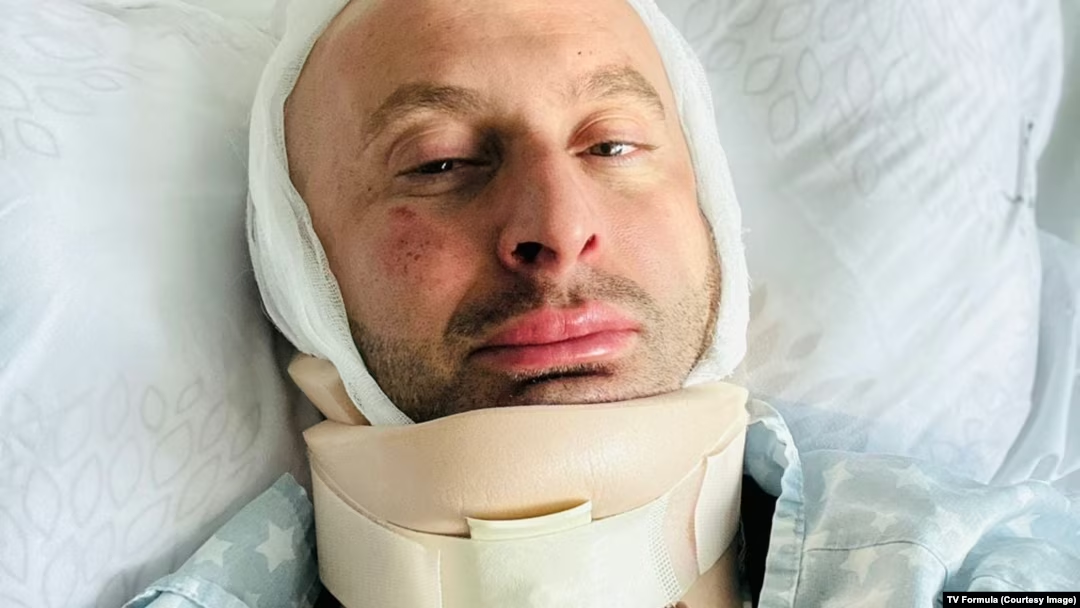
Police used excessive force to detain Lika Basialia-Shavgulidze. Later, her lawyer reported that she sustained injuries to her neck during the arrest.

Lika Basialia-Shavgulidze is the fifth journalist to be detained since the ruling Georgian Dream party passed new restrictive legislative amendments in Parliament.

The Georgian Dream Parliament introduced several changes to laws that further limit the freedoms of assembly and expression. Over 80 people have been detained in the past few days under these changes.

The arrest of journalists by Georgian Dream is a direct attack on media freedom and freedom of expression. Under such conditions, the work of independent media faces serious threats, significantly restricting the public’s right to be informed, according to a statement by the Media Advocacy Coalition.

Another journalist, Afgan Sadigov, was detained for participating in a protest

On Wednesday, October 22, Azerbaijani journalist Afgan Sadigov was detained at a protest for blocking the road.

Judge Zviad Tsekvava sentenced the journalist to 14 days of administrative imprisonment.

In recent days, journalists from the TV company “Formula” — Vakho Sanaia, Keta Tsitskishvili, and Tsira Zhvania — were detained on the grounds of blocking the road.

The Parliament of “Georgian Dream” passed amendments to the law that further restrict freedom of assembly and expression. Based on the amendment, more than 80 people have been detained in the past few days.

Both local and international organizations have reacted to the detention of journalists.

“The detention of journalists by ‘Georgian Dream’ is a direct attack on media and freedom of expression. Under such conditions, the work of independent media is under serious threat, which significantly limits the democratic society’s right to be informed,” states the Media Advocacy Coalition’s statement.