According to Nino Jangirashvili, head of TV company “Caucasus,” the Communications Commission has initiated administrative proceedings against the broadcaster on the basis of an individual donation received from the USA. At the Commission’s request, the broadcaster must provide detailed information about the received funds and the corresponding documentation within 3 working days.
With the amendments made to the “Broadcasting Law” in 2025, foreign funding of broadcasters was completely prohibited, and the regulator’s powers were significantly expanded, including mechanisms for access to financial information. In parallel, the “Law on Transparency of Foreign Influence” has been in effect since 2024. These regulations have had a substantial impact on media funding models, resulting in several broadcasters continuing to operate, including by relying on donations from citizens.
According to Nino Jangirashvili, TV company “Caucasus,” given the legislative environment in the country, uses citizen donations as one of its main sources of funding and ensures broadcasting continuity based precisely on this model. Such income is generally used to cover operational expenses necessary for the daily functioning of the channel, making it practically impossible to specify the exact purpose of any particular donation.
This case clearly reflects the environment in which media operates against the backdrop of legislative changes, while the regulator’s initiation of proceedings based on individual donations raises additional questions regarding the proportionality of regulatory practices.
JamNews Copywriter Irakli Datunashvili Fined Twice for “Artificially Blocking the Road” at February 28 and March 6, 2025 Protests.
JamNews copywriter Irakli Datunashvili was fined twice for “artificially blocking the road” during protests held on February 28 and March 6, 2025. He appealed the fines at the Ministry of Internal Affairs, which together total 10,000 GEL.
In the context of pro-European protests, the Georgian Dream party increased the fines, which have been applied since November 28. Under amendments to Georgia’s Administrative Offenses Code, fines for illegally blocking roads were raised tenfold—from 500 GEL to 5,000 GEL.
On August 30, 2025, Tozu Gulmamedli, a journalist for the independent online media outlet “Mautskebeli,” was fined 5,000 GEL for a second time on the grounds of “blocking the road” near the Parliament building. Although the journalist was performing her professional duties – as evidenced by materials published on “Mautskebeli’s” platforms investigative authorities failed to take this circumstance into account.
According to information released by “Mautskebeli,” the National Bureau of Enforcement has frozen the journalist’s bank accounts and threatened to seize property registered in her name, granting her a seven-day deadline to comply with the aforementioned demand.
Such practices constitute the criminalization of journalistic activity and an interference with professional duties. Furthermore, the use of seizures acts as a mechanism for additional financial pressure and substantially restricts the freedom of a journalist to carry out their professional activities.
On January 16, Tbilisi City Court Judge Nino Enukidze terminated the administrative proceedings initiated against journalist Afgan Sadigov and referred the case to the Tbilisi Police Department, as the court assessed that his actions may contain elements of a criminal offense. This means that the journalist faces the risk of a criminal investigation being launched.
The case concerns an incident that occurred on December 17–18, 2025. The Ministry of Internal Affairs accuses Afgan Sadigov of obstructing traffic and/or pedestrian movement. According to the court’s assessment, since the journalist had already been subjected to an administrative penalty on the same grounds in October 2025, the conduct contains signs of a criminal offense.
This decision was made against the backdrop of legislative amendments under which, in the event of a repeated violation, administrative liability is replaced by criminal liability.
On December 9, 2025, the Tbilisi Court of Appeal upheld the decision of the Tbilisi City Court in the defamation case brought by former Minister of Internal Affairs of “Georgian Dream,” Aleksandre Chikaidze, against the television company TV Pirveli and journalist Sopho Niauri. The dispute concerns a report aired on TV Pirveli in the program “Nodar Meladze’s Saturday,” in which Chikaidze was accused of having links to so-called call centers. The Court of Appeal ordered the television company and the journalist to issue a retraction of the information disseminated about Aleksandre Chikaidze and to pay moral damages in the amount of 10,000 lari.
It is particularly problematic that in such a dispute the journalist was considered a proper defendant, which contradicts the Law “On Freedom of Speech and Expression,” according to which, in defamation cases related to content published by a journalist in the media, the defendant is the media owner. Such an approach is the result of incorrect judicial practice that has taken root in recent years and creates a precedent harmful to media freedom.
This judicial practice is developing against the backdrop of amendments to the Law on Freedom of Speech and Expression, which “Georgian Dream” adopted under an expedited procedure on June 26. The amendments shifted the burden of proof to the defendant, abolished important mechanisms for the protection of journalists, including guarantees for source protection and the so-called qualified privilege, and increased the risks of legal pressure against the media and critical voices.
This is not the first instance of legal proceedings initiated against critical media on the grounds of defamation. According to the Georgian Young Lawyers’ Association, in recent years 28 lawsuits have been filed against three leading critical television channels—Mtavari Arkhi, Formula, and TV Pirveli—most of which were initiated by representatives of the ruling party and individuals close to them. In the organization’s assessment, such cases bear the hallmarks of SLAPP litigation and point to a coordinated trend aimed at intimidating critical media.
On November 24, the Tbilisi City Court dismissed the case of Mzia Amaghlobeli, founder of “Batumelebi” and “Netgazeti,” against the Georgian Dream Prime Minister, Irakli Kobakhidze. In the lawsuit, Mzia Amaghlobeli sought a denial from Irakli Kobakhidze of the false accusations he made about her.
In July 2025, through pro-government television channels “Imedi” and “Adjara TV,” Georgian Dream Prime Minister Irakli Kobakhidze stated about the imprisoned journalist Mzia Amaghlobeli that she had slapped the then Batumi Police Chief, Irakli Dgebuadze, on the orders of “foreign powers.”
The judge ruled that Irakli Kobakhidze’s statement was made within the context of political debate.
After the hearing, Mzia Amaghlobeli’s lawyer, Ana Rekhviashvili, said: “Such a decision in a case like this is a dangerous precedent for Georgian justice, as the court has opened the way for political officeholders and told them that they can make any statement, spread any falsehood, and political officeholders will not be held accountable for spreading such falsehoods.”
“TV Pirveli” journalist Giorgi Mamniashvili, who was accused by the Ministry of Internal Affairs of minor hooliganism and disobeying a lawful police order, was fined 3,000 GEL by Judge Zviad Tsekvava.
Mamniashvili was detained on November 22 while covering a protest. According to a police officer witness, Mamniashvili allegedly insulted and verbally abused them at the time of his arrest. However, in a video released by “TV Pirveli,” which Mamniashvili himself recorded, it is clear that the journalist was explaining to the police that he was performing his professional duties. According to the television company, footage retrieved from Mamniashvili’s phone confirms that he did not use any offensive language.
Mamniashvili’s lawyer stated that after the arrest, the journalist was subjected to degrading and humiliating treatment at the Dighomi pre-trial detention facility. Specifically, for several hours, his hands were cuffed behind his back, he was fully stripped, and forced to perform so-called “squats.”
The international press freedom organization Reporters Without Borders (RSF), together with the Center for Media, Information and Social Research(CMIS), released a review of the media environment in Georgia, noting that “these arrests reflect how Georgia has become a country where nearly 50 incidents against independent media outlets are recorded every month.”
On November 22, during a protest in Tbilisi, near Ingorokva Street, “TV Pirveli” journalist Giorgi Mamniashvili was detained. According to the television company, the journalist was performing his professional duties at the time of his arrest and was covering the protest. For several hours, the “TV Pirveli” newsroom was unable to get in touch with him.
At the moment of his detention, Mamniashvili was filming the police arresting other protesters on his mobile phone and sending the footage to the newsroom, when officers attempted to seize his phone. Shortly after, they ordered his arrest. In the video recorded by Mamniashvili, he can be heard telling the police that he is a journalist and is carrying out his professional duties.
According to the journalist’s lawyer, after the arrest, Mamniashvili was treated in a degrading and humiliating manner at the Dighomi pre-trial detention facility. Specifically, for several hours, his hands were cuffed behind his back, he was fully stripped, and forced to perform so-called “squats.”
Deputy Minister of Internal Affairs Aleksandre Darakhvelidze described the practice of strip-searching detainees upon admission to the detention facility as “a required procedure to document any possible injuries.” Public Defender Levan Ioseliani, however, calls the strip-searching of detainees “degrading and humiliating treatment.”
“The case of Giorgi Mamniashvili is a clear example of the repressive policies of Georgian Dream, aimed at restricting independent media and silencing critical voices,” the Media Advocacy Coalition stated.
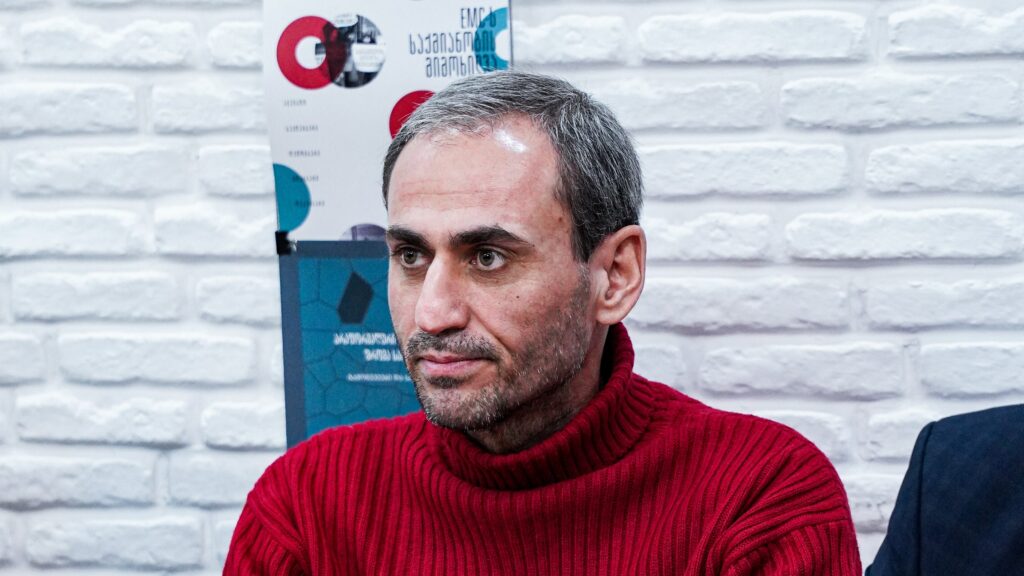
On November 12, 2025, Afghan Sadygov, an Azerbaijani journalist residing in Georgia, was sentenced to administrative imprisonment for the second time under the pretext of blocking a road—he will spend 7 days in prison. He is accused of blocking the road on October 19-21, 2025. Afghan Sadygov had already been imprisoned once on the same charge, having been sentenced to 14 days of administrative imprisonment. At that time, the exiled journalist was accused of blocking the road on October 18.
According to the “Social Justice Center,” the organization defending Sadygov’s interests, at the time of Afghan Sadygov’s first detention, the Ministry of Internal Affairs (MIA) already knew that the journalist would stand on the roadway during the protest on subsequent days, but did not merge the cases: “This circumstance once again indicates that the MIA intentionally did not appeal to the court regarding the remaining days, so that the court would have the opportunity to apply administrative imprisonment against Afghan Sadygov twice. It is obvious that the MIA is trying to make an example of an activist actively involved in the protests by punishing him through the court.”
Since October 19, 2025, after the “Georgian Dream” parliament adopted another set of repressive changes under an accelerated procedure, 13 media representatives have been detained for participating in, and in some cases covering, the ongoing protest on Rustaveli Avenue in Tbilisi. Administrative imprisonment was applied to most of them.
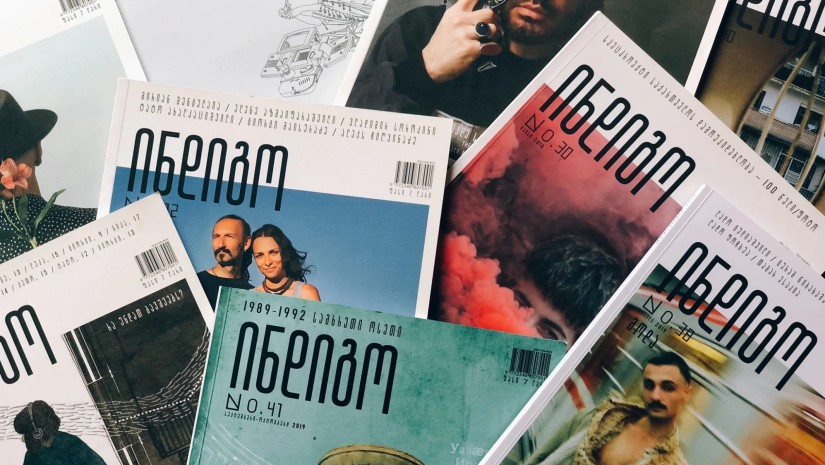
On November 11, 2025, the publication “Indigo” released a statement from which it became clear that the Anti-Corruption Bureau had initiated proceedings against them based on the so-called Law on Grants adopted by “Georgian Dream.” “Since our entire activity is based on open communication and only your trust, we want you to know this news as well. Obviously, we continue and serve the mission that created us—we continue working for free speech and expression, for free thoughts and ideas,” the publication writes.
The amendments to the “Law on Grants” are one of the repressive changes adopted by the “Georgian Dream” parliament in recent months to restrict the media. The law came into force in April. These amendments prohibited the issuance of foreign grants without the permission of the government. A grant received without consent leads to a fine equal to double the amount of the grant received.
The Anti-Corruption Bureau carries out the monitoring of the issuance and receipt of grants. This agency has already initiated proceedings against several media outlets based on this law, including: “Project 64,” the investigative media “iFact,” the publication “Mountain News,” GMC, which manages the publications “Realpolitika” and “Flangvis Detector” (Waste Detector), Georgian Media Group, and also the organization working on media rights, the “Georgian Charter of Journalistic Ethics.”
In addition to media outlets, the Anti-Corruption Bureau is requesting information about grants from civil and non-governmental organizations as well; in total, the agency’s letter has been received by more than 60 organizations, including member organizations of the “Media Advocacy Coalition.”